In Redes de conversión (Webs of Conversion), Peruvian artist Ximena Garrido-Lecca braids together different materials, forms and technologies to bridge her country’s aesthetic, economic, geographical, and social past with its present. As is characteristic of her recent work, Garrido-Lecca uses traditional weaving techniques with industrial materials. In this case, electrical copper wire sheathed in a variety of colors, woven into designs based on the shapes and patterns of pre-Columbian textiles.
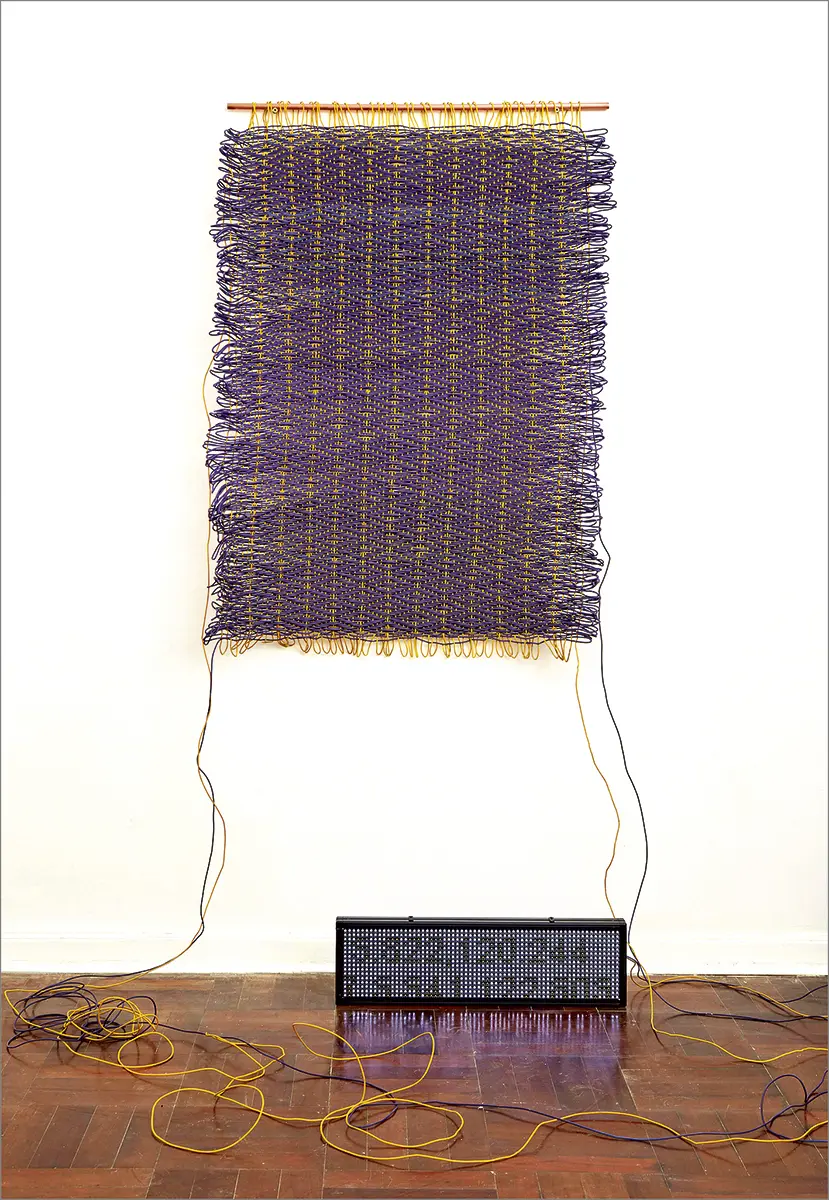
Garrido-Lecca systematized the pre-Columbian designs she uses as aesthetic models for these works by compiling recursive compositional structures and formal elements that constituted a kind of millenary design language, which she represented graphically and numerically. The (visual and textual) information that emerged from the configuration of her works was in turn converted into a text-based programming language (JavaScirpt) by a team of programmers working with the artist.
This translation of design structures into a computer code is one among many lines of conversion that come together in this exhibition, as its title suggests. This code, the product of a conversion from information to informatics, is also present in a conversion process with a technology base. Installed in the gallery front patio were electricity-producing solar panels; the power they generated flowed through the weavings-circuits and fed into a set of LED screens, which came on line to display the code that “translates” the design patterns that shape the artwork. What is in play here is an energy conversion: solar to electric to light. And this passage from solar to light energy takes us to yet another conversion, one between worldviews and understandings of the cosmos: that of pre-Columbian, pre-industrial, and pre-modern Peru, where the Sun was worshipped as a deity; that of Westernized, industrial, modern Peru, anchored since the colonial era to its extractive economy; that of a post-industrial, digital-network country shaped by computer software and code; finally, that of a yet-to-come Peru, which the imagined future horizon of renewable energies and environmental (and social) sustainability.
The woks on exhibit project, then, a temporal sequence that connects the past and the present in particular ways. Ancient aesthetics (from the pre-Columbian design on which they are based) and ancestral textile traditions (in the traditional weaving techniques used) are actualized via an extractive-economy present (copper mining) with industrial elements (as implied by the production of sheathed cables), even pointing towards a digital future (announced by the computer codes on those LED screens that, interestingly, signal in the direction of fiber optics rather than copper wiring as such.) In such a conjectural time to come, ancient beliefs—Inti, the Sun-god—open themselves up to the vision of a sustainable future—represented by solar energy—that counteracts the exploitation of finite resources—mining—and its negative externalities, such as contamination.
An important geographical and historical nexus is also in play here, linking the traditional art forms cited by Garrido-Lecca with the materials she uses in the creation of her contemporary works. The regions of Peru from where many of the textile artifacts she uses as her sources come, as well as the country’s main centers of artisanal textile production, roughly coincide with its mining regions. Similarly, many populations traditionally engaged in textile production are now often employed in mining and industrial manufacturing, which have displaced many other productive activities.
There is an implicit, hidden substrate to the energy shifts that traverse these passage Ximena Garrido-Lecca traces from pre-Columbian textiles, through artisanal manufacture, mineral exploitation, industrial production, renewable energies, all the way to computer programming: the problematic social, urban, economic, and environmental remainders that these conversion operations have persistently left behind as they fueled Peru’s modernity. And while not always seen or made visible (displaced populations, lost traditions, sacrifice zones, contaminated bodies), such remainders, more than an unintended side effect, they seem to be a precondition for their working.