The exhibition Wifredo Lam, the Imagination at Work, at Pace Gallery, New York, organized in collaboration with Gary Nader of Gary Nader Art Center, is a much needed comprehensive look at one of the most important artists and great innovators of Latin America’s art, and which covers the entire career of the artist and includes a selection of rarely seen sculpture. The works shown have never been seen in New York, in this quantity and displayed in such a curatorial manner. This exhibit is the closest this artist has ever gotten to a museum-like retrospective in New York City. The only significant exhibition in a museum in New York, though not a retrospective, took place a full thirty years ago at the Studio Museum in Harlem, Lam and his Contemporaries 1938-1952, from Dec 6, 1992-April 11, 1993. The exhibition was curated by Giulio Blanc and the catalog, which remains a landmark in the studies of Cuban art, contained important essays by scholars Lowery Stokes Sims and Julia P. Hertzberg, who are recognized authorities in the field. It also featured very important works of Cuban painters that were his contemporaries.
The exhibition starts with paintings from the ‘30s when Lam was still in Spain and was starting to develop into a full-fledged modern artist. The figures in these paintings like Le désastre are clearly influenced by African art—in this case Kifwebe masks. Superb examples from the 1940s follow on the wall across when Lam created his signature style incorporating his own version of the African deities, which are always depicted as a mixture of animal and human fusion, charged with energy, sometimes caught in a whirlwind of lightning that can only be suggested by the fierce slash-like paint strokes.
A series of paintings showed great examples of this style in a grouping of three paintings from 1945. In 1941, Lam had left Europe through passage at Marseille, where he had met up with Andre Breton and other artists and intellectuals that escaped the Nazi invasion of France by coming to the Americas. By 1945 Lam had already been in Cuba since his arrival there in 1941 which had put him in contact with his African roots and in 1945, he had gone to Haiti at the invitation of Pierre Mabille who organized a solo exhibition for him in Port-au-Prince. While in Haiti he also attended a number of voodoo ceremonies. It’s between those years of renewed contact with his roots and with the ancestral African religion, Santería, that his definitive style had developed.
The first painting on the wall, Butinantes (Saque Adoras) (Les saccageurs) depicts three flying entities, the three have eleguá heads, which will become a recurring motif in Lam’s work; the ones at the bottom are two intertwined beings, that together create a third head at the center. These manifestations of the double-sided deity, Eleguá/Eshu, one of the most powerful deities in the Santeria/ Candomblé pantheon is a demonstration of Lam’s awarewness of the ancient pagan religion and how like the Hindu or Egyptian deities, the animal, and the human fuse together in a deity. The second painting, Le miel noir has more color, the red and black are colors of eleguá in particular, and the heads vibrate surrounded by angel wings reminiscent of the cherubin as depicted in medieval manuscripts. The last painting of the triad, L’eau solide is a creature similar to the two of the first painting, but more powerful because it looks ferocious, which accomplishes Lam’s intention, to be seen as a Trojan horse that would spew forth hallucinating images with the power to surprise and disturb the dreams of the exploiters. Surrealism’s use of dreams, and particularly erotic and sexual imagery, has made the movement much more difficult to accept in America, where puritanical waves of censorship reoccur regularly in the culture, and ‘the exploiters’ have renewed strength in the present. Bible-obsessed sectors of the society at large maintain thorough repression of the nude/erotic in every form of expression, demonstrating a retrograde mentality at odds with the international art world.
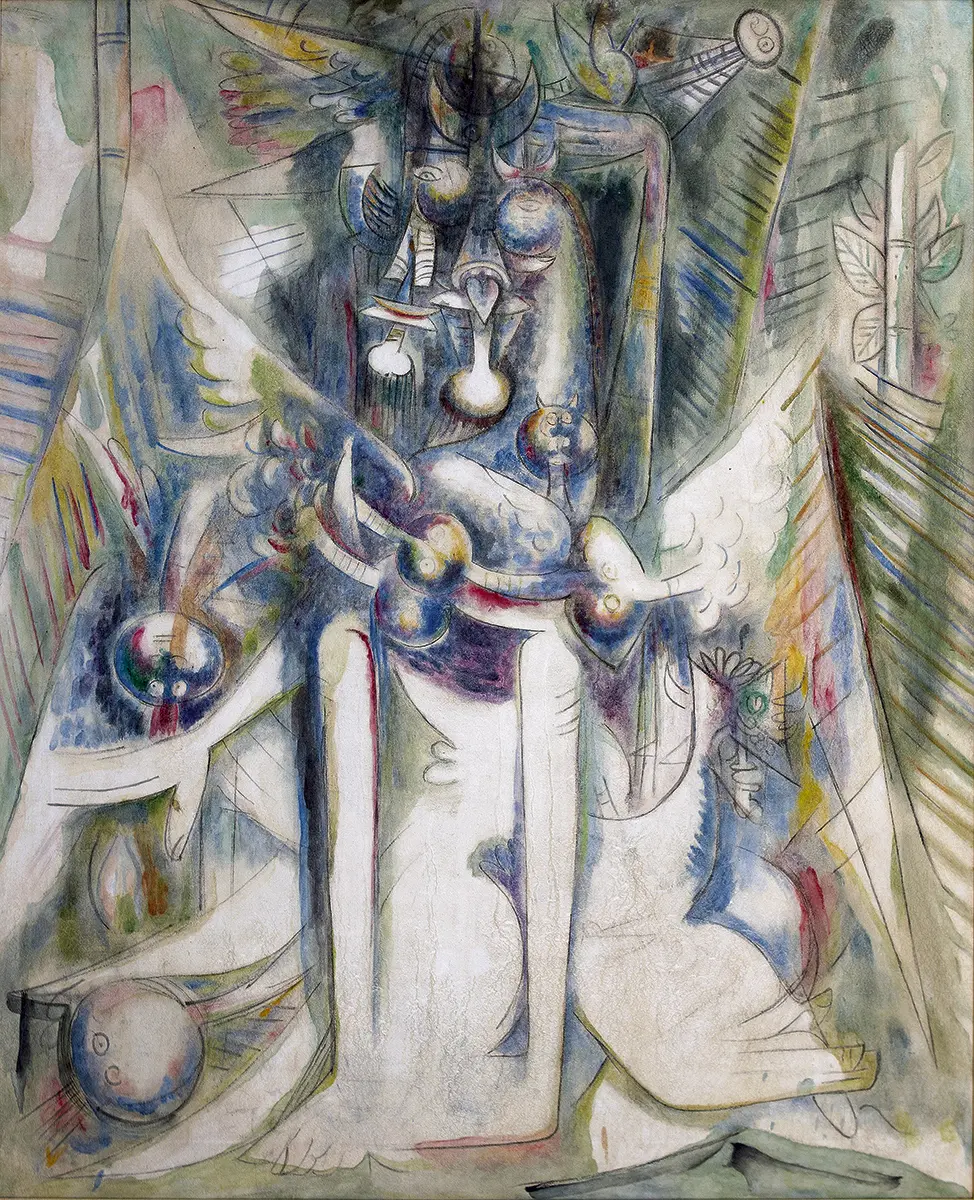
Next to these three paintings is a masterpiece that can stand on its own as one of the greatest Surrealist paintings; it represents a deity coming out of the foliage of a jungle, a supreme example of which Lam had already accomplished two years earlier in the painting named The Jungle, which features the gods in their habitat. The Jungle is prominently displayed now at MoMa, in a gallery dedicated to Surrealism, but it was for many years tucked away next to the coat room, most probably because the nude deities are simultaneously transgressive and subversive. The great painting is Hermes Trismegiste, a god of secret knowledge and alchemy. It must have been natural for Lam to be attracted to this combination of two cultures, Egyptian and Greek, and the secrecy associated with the esoteric writings attributed to Hermes Trigimeste relates as well within the context of secret societies in African religious practice in the Caribbean. This painting was the center of attention of the entire exhibition. It stands perhaps as the ultimate figure of power of the Divine that Lam created. The apparition of Hermes Trismegiste is stunning as he is barely manifested in the physical plane. Lam’s subtle colorations around the triple head and the double set of male genitals pending from two of the heads emphasize its power, fertility and might.
In the following gallery there was a selection of twelve magnificent paintings from 1947 to 1955, all depicting a central figure sporting his special fusion of the animal and the human shapes. The first of these, Le guerrier (the warrior), has two heads looking in opposite directions that look like birds, of the prehistoric era, and like the Sorcier de l’océan (the sorcerer of the ocean) is one that stands out for its powerful presence; it is also a first approach towards one of Lam’s most iconic images: The Femme Cheval. This creature half woman, half horse is a strong fertility/sexual deity. There is one at the exhibit that is particularly compelling, from 1955. This is a motif that Lam started to develop in the late forties and that he continued to develop all the way till the late ‘70s, an empowering Santeria image of the enchantress/love goddess. The Guggenheim has a remarkable one, Zambeia, Zambeia, that unfortunately has not been shown in over 40 years and did not even make it to the Georges Pompidou Museum in Paris for the 2015 retrospective.
The exhibition’s last gallery featured several vibrant works from the ‘70s including a beautiful selection of small bronze works, some of which had never been shown before. The most compelling in the group was Yemaya, a powerful rendition of the goddess of the sea in Santeria. The objects looked great in a display that emphasized their magnetic strangeness of shape and made them look like idols or votary figures at an altar. Looking at the paintings from the ‘60s and ‘70s the figures are much more angular than in the earlier work, but the power and presence of this strange and mestizo world that he was a pioneer in demonstrating, are as strong as his earlier works. Ici sur la terre (here on earth) from 1955 looks like the landing of a spaceship-like creature made up of rhomboid forms and could easily be mistaken by the work of a contemporary of Basquiat. Abalocha which dates from 1964 features a much more stylized and angular presence than the earlier deities and is still armed with a double set of chins carrying male genitalia, different from the more complex and fluid forms of his seminal years but still a strangely powerful presence that we cannot help admiring. This Pace exhibition is an outstanding contribution to the cultural landscape of New York that will always be remembered for its extraordinary quality and for the fact that it far surpasses any other done by a museum here to show the best works by an artist of great significance and relevance for our time. Finally, and this is very important in the North American cultural context, we are starting to integrate, expanding and comprehending the contributions of great artists unfairly overlooked.