
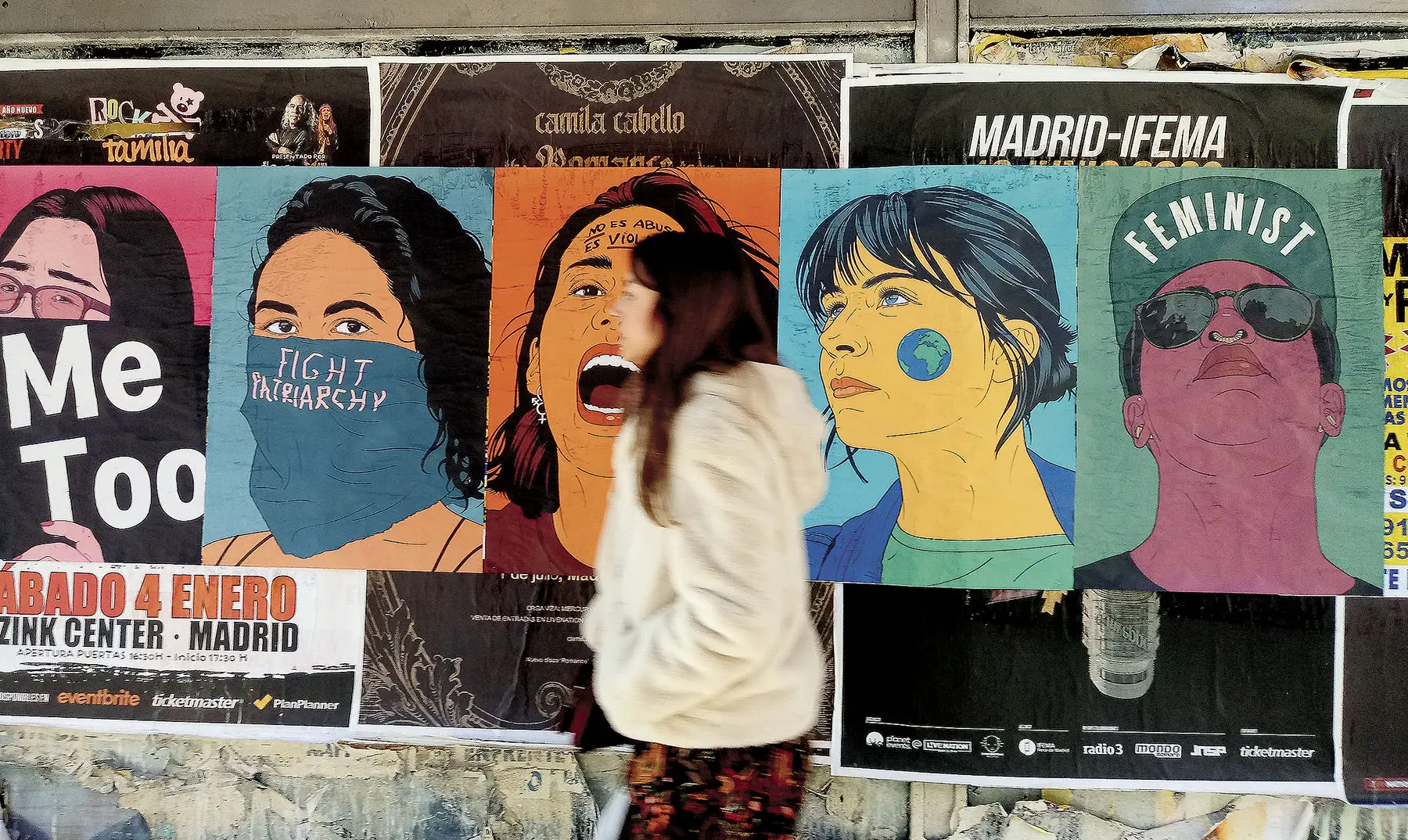
The art of María María Acha-Kutscher is at the tireless service of the feminist cause. However, it’s so imaginative, complex, and polymorphous that it far surpasses the limitations that usually constrain art directly and immediately at the service of political unrest. This is only natural since her understanding of the cause is as much or even more complex and multifaceted than her own protean art. For her, feminism is not limited to campaigns or demonstrations against the daily abuses and humiliations suffered by women worldwide. No. For her, as for feminism’s most lucid theorists, which she often reads, what these campaigns and mobilizations definitely put in question is the patriarchal regime that for centuries has not only subdued women, but has entirely shaped our culture. Extremely oversimplifying, one could say that patriarchy’s most lasting, effective—and also most sibylline—achievement is to have generated an image of woman, which women themselves ended up making their own. The opposing stereotypes of the virgin and the femme fatal were wedded to hide women’s true condition, so diverse and heterogeneous, and so full of strengths and possibilities, that it has played a crucial role in the history of humanity.

We must not continue to see it as “history of humanity” because it is also incontestably a history of the feminine, as Acha-Kutscher thinks of it. With exceptional determination, she has not merely demanded that we pay attention to this other story, but has also gotten down to business by making a series of works named Womankind. Of special interest are the five series of photocollages inspired by—according to her own confession—Une semaine de bonté (A Week of Kindness), Max Ernst’s collage-novel, published for the first time in 1934. His influence is evident both because her images are also collages with a clear narrative force, and because many are set in the nineteenth-century bourgeois interiors that inspired Ernst and where their owners’ desire to imitate palatial interiors led to an oversaturation of furniture, lamps, carpets, curtains, wall clocks, porcelain, and paintings.
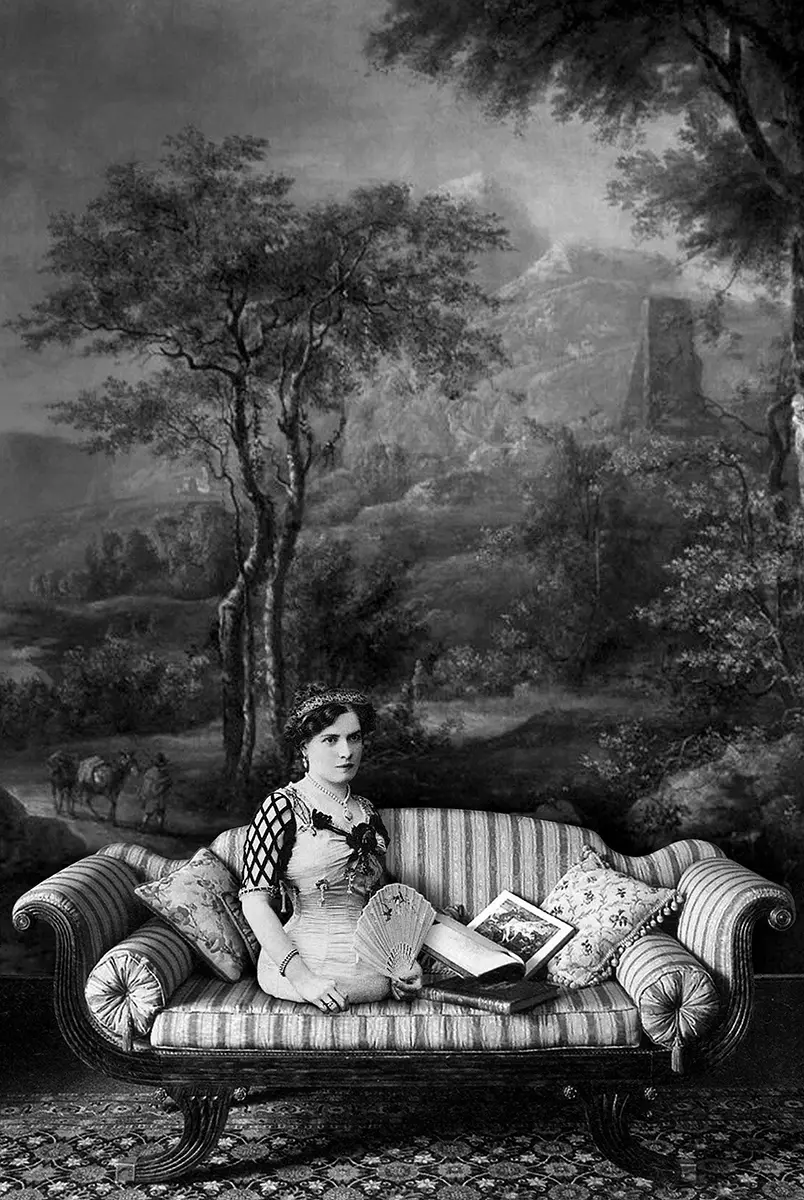
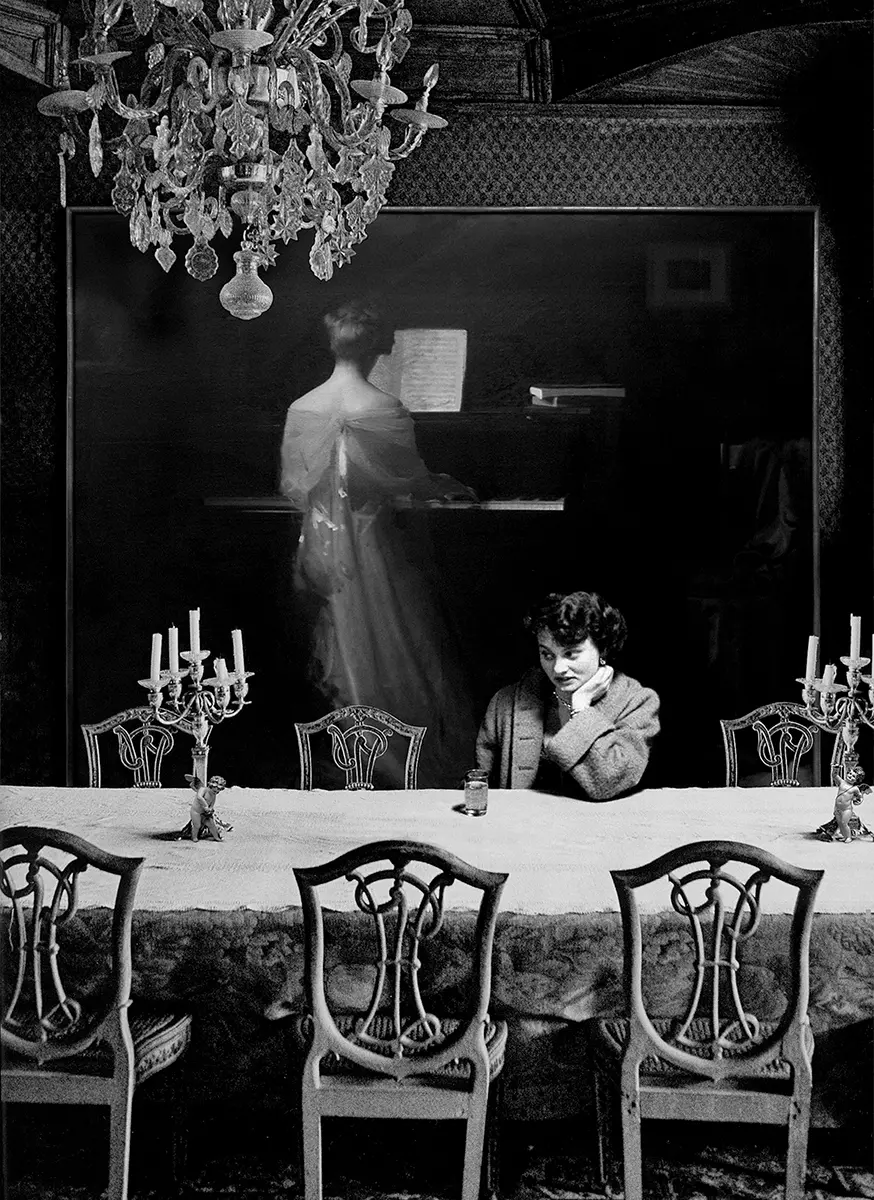
There are, however, two crucial differences that account for the unique production of this Peruvian-Mexican artist who currently resides in Spain. The first is the complete exclusion of the monsters that populate Ernst’s images: the result of the “Egyptian” copulations of animal and human, embodying a vision in conflict with Acha-Kutscher’s intended verisimilitude. The other difference is even more important since it concerns the status of women. In many of the 182 collages in Ernst’s graphic novel, women are objectified by often portraying them naked, tied-up, whipped, or prostrate. They are illustrations of a painful feminine status, given Ernst’s affinity with Surrealism and its exalted vindication of Sade and, therefore, of a sexuality only satisfied by inflicting humiliation and torment. In Acha-Kutscher’s collages, pain never reaches such stridency. If there is something painful about them, it is the cloistering evoked in subtle ways that address domestic confinement, which women have been subjected to by a patriarchy that claimed for men the monopoly of the public sphere. This is also offset by the fact that in the Womankind series, the interiors, rather than places of impotence, constitute scenarios for stories in a state of suspense and whose protagonists are invariably women. Be it the couple of Japanese women kneeling on the bed in a room where the neoclassical sculpture of a winged angel and a traditional Japanese painting are hanging on its walls; or the Western woman clad in a coat and seated between chandeliers at a long empty dining table, behind whose back hangs an equally huge painting depicting a woman in evening dress playing the piano; in each and every one of these fascinating collages, women are the protagonists. With these kind of images, Acha-Kutscher shows, contrary to the culture of the cancel-culture, that even in the harshest situations of confinement and subordination, women have managed to construct their lives, achieve prominence and, ultimately, impose their stamp on the dense historical fabric that we usually term ‘culture’ or ‘civilization.’
This awareness of the complexity of the feminine condition, resolved in ethical and aesthetic terms, also operates in Les spectaculaires, a series of ten images in black and white, and many others in color, focused on the class of women who were circus attractions for some time: bearded women, dwarfs, giants, Siamese, or with missing arms or legs. Our artist casts a loving and conspiratorial gaze on all of them—a gaze not unlike the one filmmaker Federico Fellini exemplarily cast on his characters—which she invites us to share.
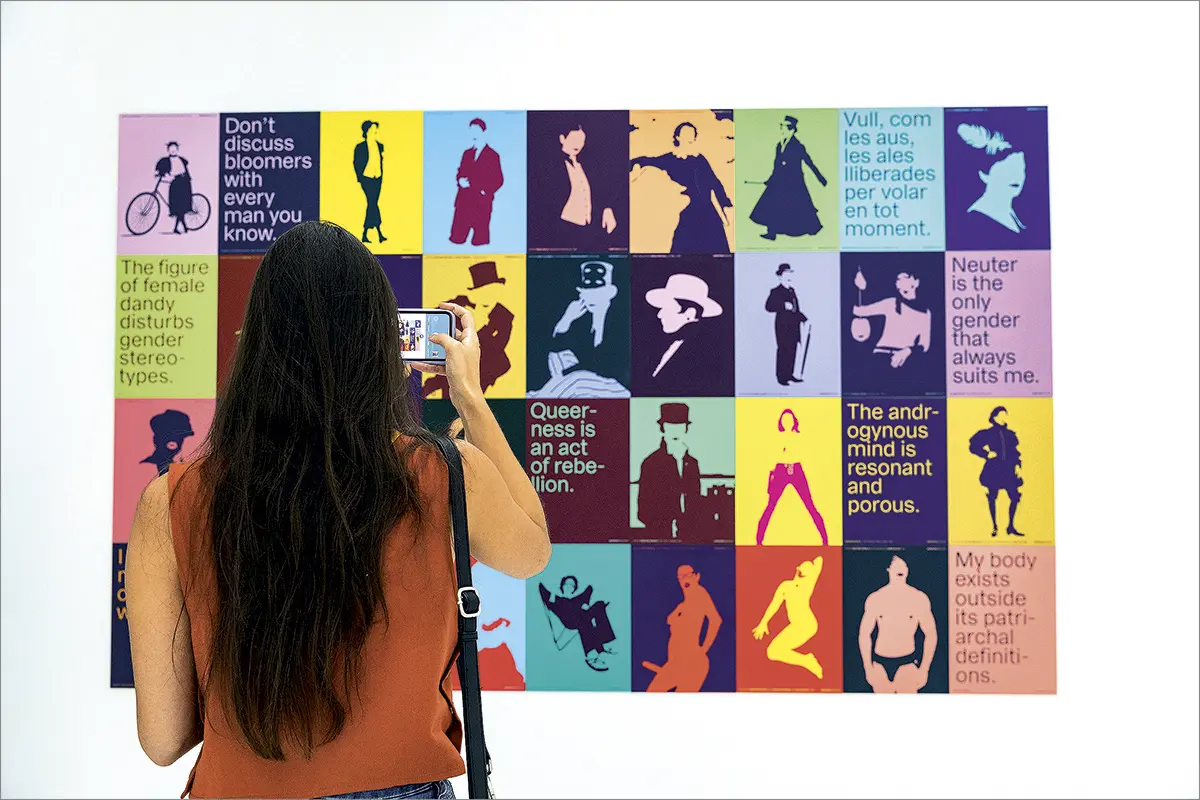
The wide range of Acha-Kutscher’s art also includes projects such as Herstorymuseum and Indignadas (Outraged Women). In the former, she abandons the field of photocollage and decisively enters into the pictogram by successfully reducing very complex themes to contrasting color stains, without losing an iota of communicative efficacy. This project also aims to vindicate women; not the anonymous characters of Womankind, Derruidas (Demolished) or 365 Days, but women who, thanks to their talent or activism, have achieved social recognition and therefore deserve to be consecrated by a museum. A sui generis museum; an open, ongoing, protean museum that just as well displays its images on public posters as in art centers or galleries that meticulously keep them in boxes, which are artist’s books themselves. The artist has explained that the starting point of these works is always a term, like ‘Salomania’, for example, which unleashes a chain of associations that ends up condensed in a pictogram, often accompanied by a pertinent, sharp, piercing text.
The importance of the grouped images in Indignadas is hard to overstate. As important as her objectives in other projects may be, perhaps none is as vital as making feminism the key to contemporary outrage, successfully invoked by resistance veteran Stéphane Hessel in an essay published in 2010, after young people in so many countries took to the streets to demonstrate their radical dissatisfaction with a world that did not seem to offer them a future other than that of precariousness and hopelessness. However, her appeal could still be understood in patriarchal terms, so it was necessary for our artist to interpret this ubiquitous and protean mass outrage from a feminist perspective. Or, what amounts to the same thing, to offer women, the female gender, if you will, as a model for interpretation and action in the heterogeneous insurgencies that are now guiding the hopes of millions of people throughout the planet. To offer it as a specific mode of sensitivity, imagination, intelligence and, of course, courage. And finally, to give a promising content to the fact that ‘protest,’ ‘hope,’ ‘revolution,’ and ‘freedom’ are feminine nouns [in Spanish]. Indignadas is, therefore, a visual catalogue of the protests that, for all kinds of reasons, are currently depriving the owners of the world of their sleep. Although they are often motivated by reasons that do not fit the agenda of, let’s say, orthodox feminism, women are always their most lucid and consistent protagonists. This catalogue therefore includes female images associated with the slogan “I Can’t Breathe,” specifically linked to the sufferings of Afro-American minorities, along with those chanted in marches and mobilizations by Femen, Pussy Riot, SlutWalk, or Red Carpet: We Want Us Alive, I Shout for Those Who Can’t, The Rapist is You, or Rich Women Have Abortions and Poor Women Die.
Indignadas undoubtedly evokes the graphic activism of the Guerrilla Girls, and its author recognizes the influence of the graphic lessons given by Emory Douglas, the artist who created the Black Panthers’ iconography, and by Jesús Ruiz Duránd, the extraordinary poster artist of the Peruvian agrarian reform in the 1960s and 1970s. But I think she has gone further than any of them due to her soaring ambition: to make women the symbol of resistance and hope in the world.
CARLOS JIMÉNEZ