Foreword
Margolles’ transference of this subject matter to high-culture spaces and her mechanisms for sensorial stimulation are in themselves political acts, in that they are energetic attempts to influence what is meaningful for others: situated social agents with whom the artist, the audiences, the experts, and the teams working in the locations where the social circulation of her projects takes place all interact.
With a forcefulness that never ceases to jolt her interlocutors, Margolles signals the gravity of the social rot activated by the irradiations of the material and cultural remains she manipulates, connected to acts of violence around drug trafficking, crimes of State, femicides, and migration. The latency of these remains promotes the construction of meanings for the horror that was exerted upon bodies that are no longer present.
SEMEFO
The analysis of Teresa Margolles’ participation in SEMEFO, between 1990 and 1999, is traversed by the paradoxes of her interactions with formal institutions or alternative spaces, as Jorge Reynoso Pohlenz has reflected.
The diversified reference to corpses in expressive solutions was a constant condition fueling SEMEFO’s passage —noted by Pilar Villela Mascaró— from performance to installation, from installation to objects, and from objects to interventions with expressive media and fictional or illusory gestures, but also the emphasis on the group’s authenticity based on a marginal or extreme stance.
Mariana David has noted the group’s dismantling of “the adoration of death in Mexican culture”, in order to denounce the folklorization of state violence.
The political processes that triggered the crumbling of PRI as the party of government in the 1990s in Mexico, and in the cultural field, the coexistence of a kind of art officially supported by the State and another kind that, like SEMEFO, circulated in independent alternative spaces or initiatives (La Quiñonera, La Panadería, Temístocles 44, Revista Generación), or even in some public-sector spaces that received an incipient support for the diffusion of those practices: X-Teresa, the Museo de Arte Moderno, or the Museo Tamayo, shaped two of Margolles’ earliest actions, Eclipse (Eclypse,1991) and Necrozoofilia (Necrozoophilia,1992).
The founders of SEMEFO, Teresa Margolles, and Carlos López, sold books in the Philosophy department at UNAM; López also played in a band, and they often met with Arturo Angulo at the Academia de San Carlos’s printmaking studio where he studied. They began to visit the medical school amphitheater and to document the abandoned La Floresta hospital, with practices of destruction, torture, witchcraft, yellow journalism, criminalistics, and forensic medicine.
Luis Javier García Roiz has observed that the actions of their performances were regulated by underground music pieces, in genres like Death or hardcore, featuring guttural, monotonous, distorted sounds or the sounds of necropsies. They often performed at the Tianguis Cultural in El Chopo, playing in genres such as Death and hardcore, with guttural, monotonous, distorted sounds, or with necropsy practices.
El canto del chivo (The Song of the Goat, 1993), their performance with Greek theater elements at the Architecture School of Universidad Nacional in Mexico City (UNAM), dates from that period. It features characters emerging from containers filled with pulque, while another character is kept inside a cage but frees himself and joins his companions to capture an audience member and mock-stab them.
Later, they produced Lavatio Corporis (1994) for the Museo de Arte Carrillo Gil, in Mexico City, using remains collected in a clandestine horse slaughterhouse and in dialog with José Clemente Orozco Los teules (1947).
The horse fetuses were carefully studied by restorers from the INAH’s Nation Art Conservation School in Mexico City to determine the technique to be used in their manufacture of this installation. According to Javier López Guzmán, the fetuses were intervened in 2010, which indicates the provocative degree to which SEMEFO involved itself with the technical processes of traditional forensic embalming, in pursuit of solid anchors for the artistic practices the group promoted.
SEMEFO intently sought and probed the socially determined revulsion provoked by any work that involves the manipulation of animal or human remains.
Dermis, a 1996 project produced with a grant from Mexico’s National Creators Fund (FONCA, in its Spanish acronym), signaled SEMEFO’s move towards conceptualism with installation. From the corpses of prisoners, they salvaged fragments of human skin displaying tattoos, scars, or other markings, and the work included sheets imprinted with blood and other fluids after being used to shroud the bodies and having deliberate pressure applied on them. They posited the traces of animal or human remains as readymade, what SEMEFO dubbed “the life of the corpse."
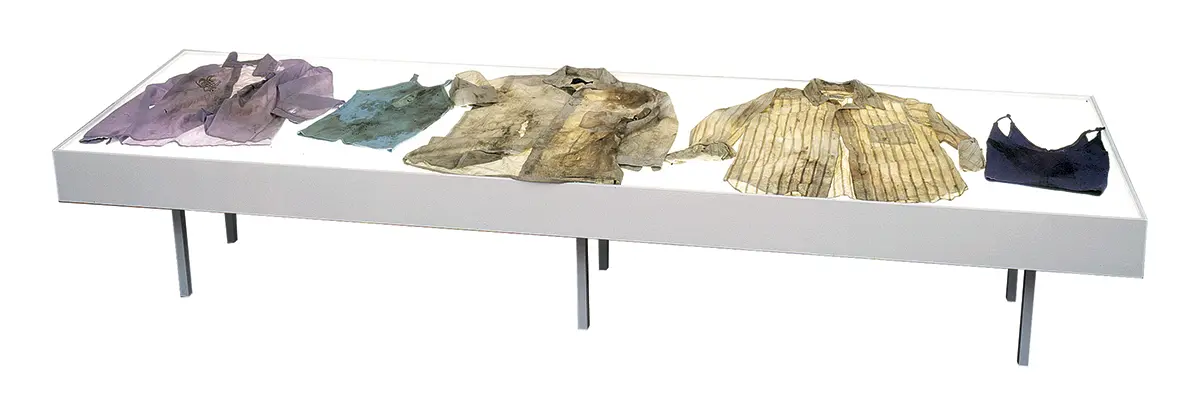
Among other projects in a similar vein, in 1997 they developed 8 contenedores (8 containers), filled with grease accumulated from the boiling of bones, and Estudio de la ropa del cadáver (Study of the Corpse’s Clothes); in 1998 came Cabello humano recuperado de la morgue (Human Hair Recovered from the Morgue), an installation with hair spread on the floor so that visitors would carry it around, stuck to their shoes, and Sillón tapizado (Upholstered Chair), lined with strips of horse intestine.
The growing complaints as the materials used in the projects decomposed prompted a search for different expressive approaches based on the concealment of the corpses and associated elements, but not their elimination from the creative process. One example is 157 kilómetros México-Tecali (157 Kilometers Mexico-Tecali,1998), where roadkill remains were collected along that route and buried in a concrete block, with some parts jutting out.
This was the start of a new period for the group: to talk about corpses through the objects that are in contact with them, an intention later transferred to the burial in concrete blocks of personal objects belonging to murder victims, for example in Memoria fosilizada (Fossilized Memory, 1999), which won the sculpture prize at the Monterey Biennial, and Andén (Platform), presented that same year at Parque de las Banderas in Cali (Colombia). The latter was SEMEFO’s last action as a group.
Margolles on herself and death
Commenting on an exhibition that reviewed some of these projects and was first held at Centro de Arte 2 de Mayo, in Madrid, Ferran Barenblit, María Inés Rodríguez, Juan A. Gaitán, and Óscar Gardea prompt us to revisit processes of conflict on the basis of artistic considerations, and, in social-collective terms, of the testimony of bodies that have suffered the violence of drug trafficking, corruption, precarity. Ciudad Juárez emerged as a motif to actuate various individual processes for Teresa Margolles, as a metonymy for the contemporary global reverberations of cruelties and coercions, and as the unmasking of official, government-provided explanations of problems. This exerts pressure on the linkages between reality and representation, fiction and documentary, and the appropriation and socialization of forensic techniques in order to bring events closer to the viewer and confront the latter with the insecurity of their personal conditions and their own attachments, as an ethics of enunciation. Other projects with a similar approach are:
• 21 (2007), featuring a number of gold jewelry items designed by a jeweler who worked for drug traffickers, with applications of glass produced from the remains of murder victims connected to the drug trade.
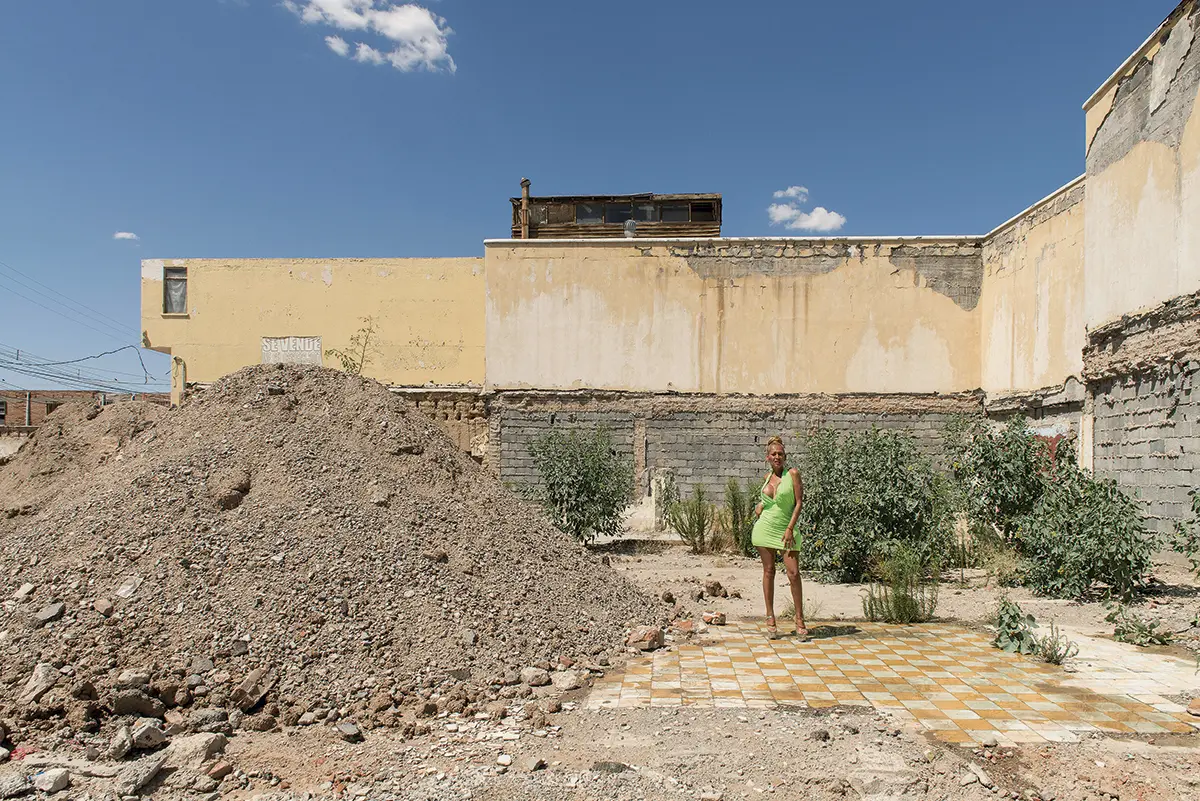
• ¿De qué otra cosa podemos hablar? (What Else Can We Talk About?, 2009), one of Teresa Margolles’ actions for the Mexican Pavilion at the 2009 Venice Biennale, where she placed sheets stained with blood she collected after violent incidents in Culiacán, Sinaloa, and Ciudad Juárez, Chihuahua in interior spaces and the building’s façade.
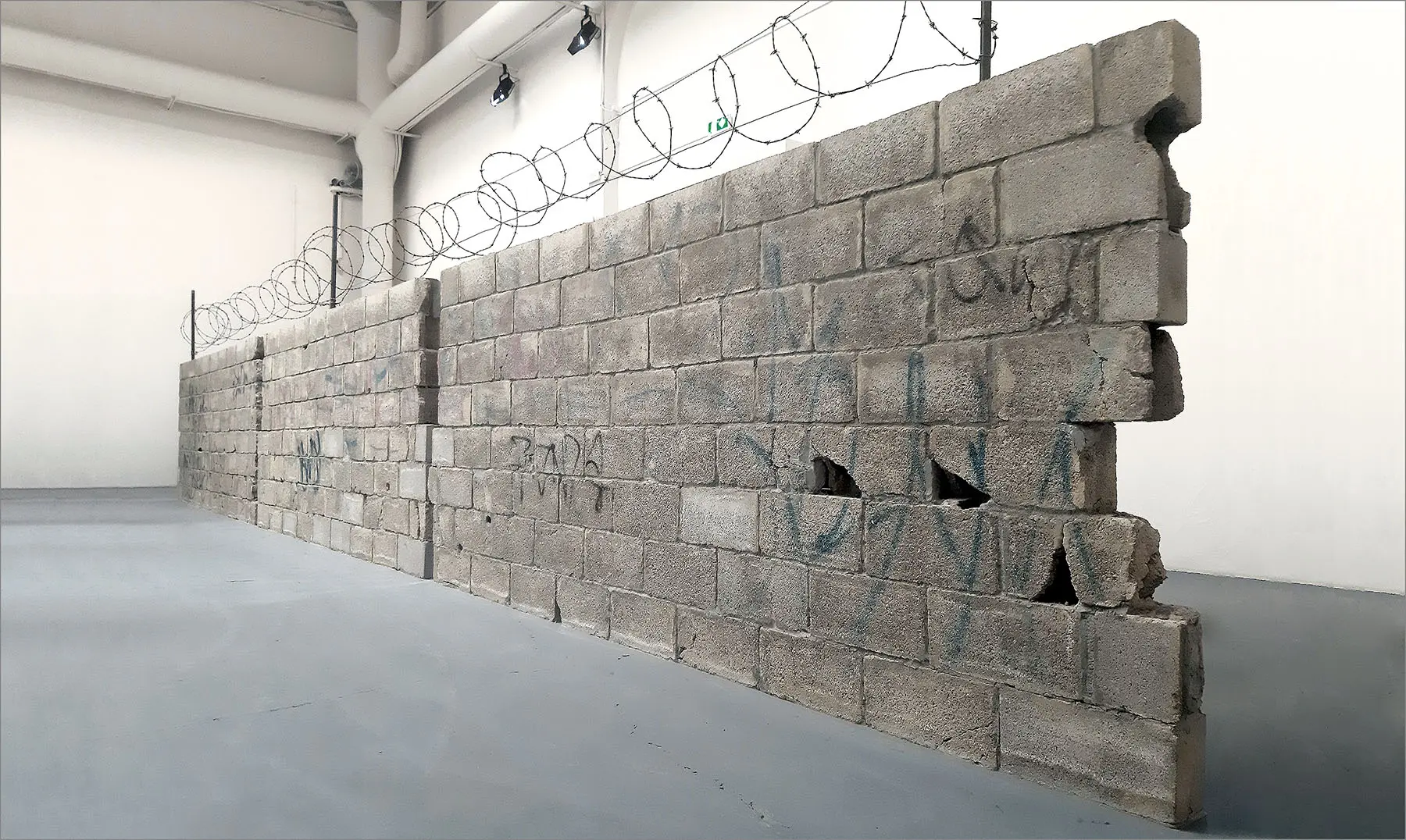
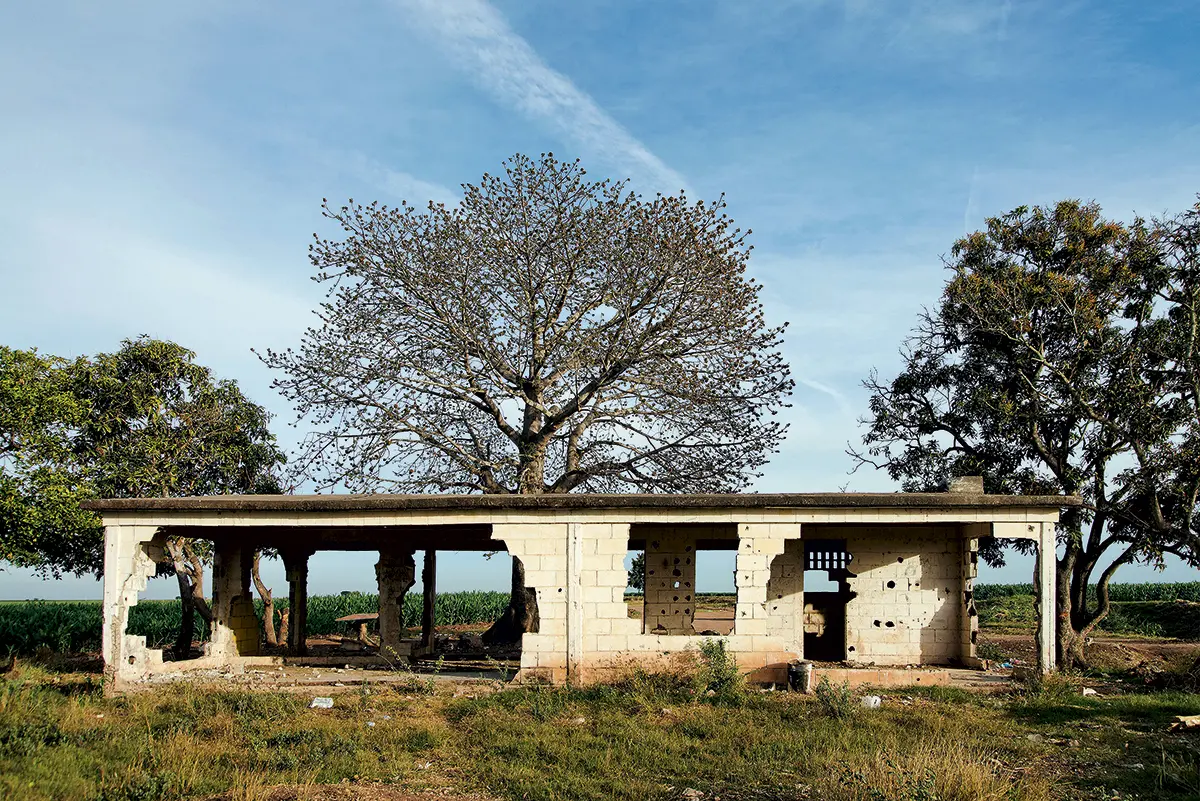
At the 58th Venice Biennale, in 2019, Margolles received an honorary mention for Muro Ciudad Juárez (Ciudad Juárez Wall, 2010), a cinder-block wall with bullet holes, taken from a school in the titular city across from which a score-settling gunfight took place, intended to activate a protest for the devastation in different realms (youth and educational spaces).
In A través (Through, 2011), 150 youths from Culiacán, Navolato, Altata, Ciudad Juárez, Querétaro, and Mexico City impregnated the t-shirts the artist gave them with their bodily fluids. The material deposited on the shirts was painstakingly applied —like an autopsy, noted Josefa Ortega, the project’s curator— to the large windows of its first site, the Museo de Arte Moderno-INBAL’s Gamboa Hall, in Mexico City, as a way of bringing the energy of those youths into that location. Margolles deliberately avoided introducing anything else into the space, as a metaphor for the absence of the young dead in contemporary Mexico’s landscape of violence.
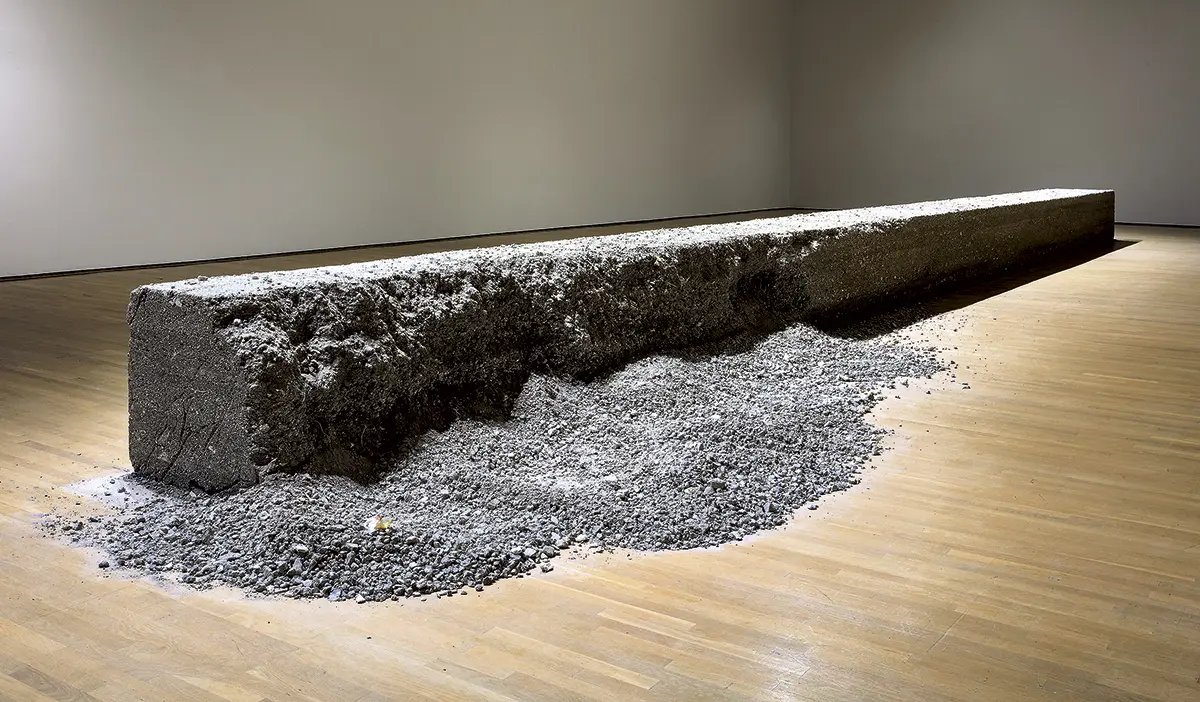
La promesa (The Promise, 2012) is a project that began with the purchase of an empty social-interest house in Ciudad Juárez’s southeast sector, in one of the urbanizations surrounded by maquiladoras that have sprouted in the area’s desert. The house was deconstructed piece by piece, and the disabled pieces were registered photographically and painstakingly cataloged. An account of the stages of this process was provided with phrases such as accumulation of material from dismantling and salvage or Taking down moorings to classify steel. Margolles’ also recorded the crushing of those remainders into a rocky material, which was then transported to one of the project’s early sites, UNAM’s Museo Universitario Arte Contemporáneo, in Mexico City. There, a rectangular block traversing the exhibition gallery was set up, and a number of volunteers gradually dislodged material from that structure and spread it throughout the surface of the space. Rossana Reguillo emphasized that at the time of that project, Ciudad Juárez’s had many maquiladoras located near each other, scarce public transport, a large number of clunker vehicles circulating around, the ruckus of a young population in a city overrun by “bad times," and homes emptied of people and filled with fear, flight, deprivation, and tragedy. The authorities have spoken of a repopulation, but no clear plans have been drawn.
Annexed to the exhibition is a newspaper and video archive with notes and articles about migration, and En torno a la pérdida (Around Loss, 2010-2013), a video featuring testimonies of individuals about their homes, with expressions such as I don’t feel this to be a happy home… My door was kept unlocked, that’s how they got in… I want to go to my daughter’s house to see…
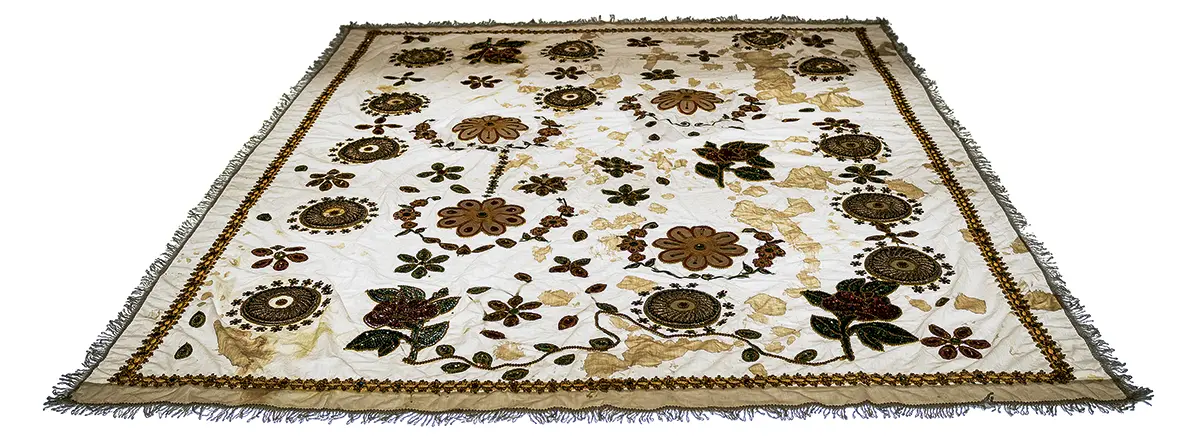
A new synthesis of an object from a different country —one that safeguards traces of the absent victim of violence and dialogs with new expressive elements— is exemplified by Tela bordada: Bolivia (Embroidered Fabric: Bolivia, 2019), a metonymy of the high incidence of domestic violence in the country. Embroidery, an activity currently undergoing an economic boom and with a significant ritual presence there, materializes on fabric salvaged from a morgue, where blood shares space with the ornamental motifs created by a local craftswoman.
In recent years: Expanded indictments in global circuits
Margolles’ projects in recent years place her in the communicational center of exhibition spaces processes of collecting and transforming the bodily remains or belongings of murder victims, in reflective and sensorial devices that function as metaphorical hammer blows attesting to instances of violence and death. In what follows, we will spotlight projects grouped according to their shared thematic lines.
Migration and Marginality
Los otros (The Others, 2018), was first presented in Berlin through the Mexican gallery Labor, as part of the event titled Langen Nacht der Ideen (Long Night of Ideas). The processes involved in this project were rendered concrete by the cloth used to clean the blood of a murdered individual, on which a line was embroidered by Latin American immigrants in Berlin.
Margolles exhibited her work in Belgium for the first time with O te alineas o te alineamos (Get in Line or We’ll Get You in Line, 2019), also through Labor Gallery. The title cites her 2007 project Decálogo (Decalogue), which does not allude to the Ten Commandments of Catholic religion, but to messages left behind by drug traffickers before their executions. Among those messages was the phrase that provided the title for the new project, which was made in collaboration with people from the Charleroi neighborhood, an urban area with an elevated incidence of drug-related activities and prostitution.
Based on her 2017 investigation of the border between San Antonio de Táchira, Venezuela, and San José de Cúcuta (Colombia), invited by Bienal Sur, Teresa Margolles hired Venezuelans to transport rocks in the river that separates the countries and to weave their stories into pieces of fabric stained with the local soil and documented their conversations during these actions.
Trayecto. Fases 1. La entrega. 2. A través. 3. Inclusión (Pathway. Phases 1. Delivery. 2 Through. 3 Inclusion) was installed in 2018 at what is today the Kunstinstitut Melly, in Rotterdam, spreading the bodily matter left by the workers on the shirts the artist provided unto the locale’s windows, and later encasing them on cinder blocks marked with each worker’s initials and arranging these as an installation, accompanied by their portraits.
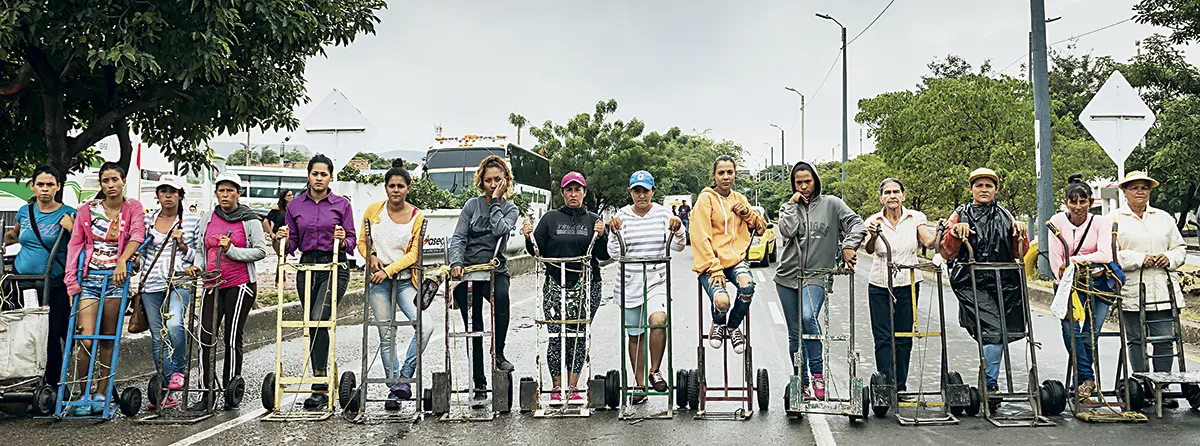
Another axis in this exploration was the 2020 installation of La piedra (The Rock), documented on the web page of the Es Baluard Museu d’ Art Modern i Contemporani in Palma, Spain, focused on the dynamics of the Simon Bolivar International Bridge, with a photo-mural depicting women who in 2017 worked as cart vendors and, with the closing of borders due to Venezuela’s recent history, began to work carrying merchandise across clandestine border paths. The counterpoint was Trocheras cargando piedras de 50 kg (Porters Carrying 50kg Rocks, 2019). The performance Sobre sangre was also presented. Its material traces are the final portion of a trajectory: a wall onto which, in this action, migrant Venezuelan women in Palma affixed 100 Bolivares banknotes using water and blood from a soaked fabric previously used to shroud a victim murdered in one of those border paths, while recorded testimonies of the women’s difficult migrant lives are heard in the background, both in the gallery and in another area.
Space and dignity for gender diversity
The video Poker de damas (Four Queens, 2016) documents the memorial gatherings of the friends/elective family of Karla, a transgender sex worker who was brutally murdered in Ciudad Juárez in 2015. Also present was Sonia, an Ecuadorian transgender sex worker living in Munich, the city Margolles had initially intended to invite Karla to visit. The location, a mirror-filled room in the Bombín Hotel, a safe space in the midst of their unsafe dynamics, allowed them to reflect, as noted by curator Alejandra Labastida, about their ability to see what lies behind, read situations, and alter behaviors in predatory and addiction-ridden environments.
Priscilla Presente Trans.Bordando (Priscilla Present Trans. Embroidering, 2019), also a video, pays homage to a transgender girl murdered in São Paulo. Her friends dragged fabric along the street where she died, then embroidered it while talking about their experiences of violence, materializing on the canvas bodies and free, brilliant colors representing their decisions as to how to live their female lives.
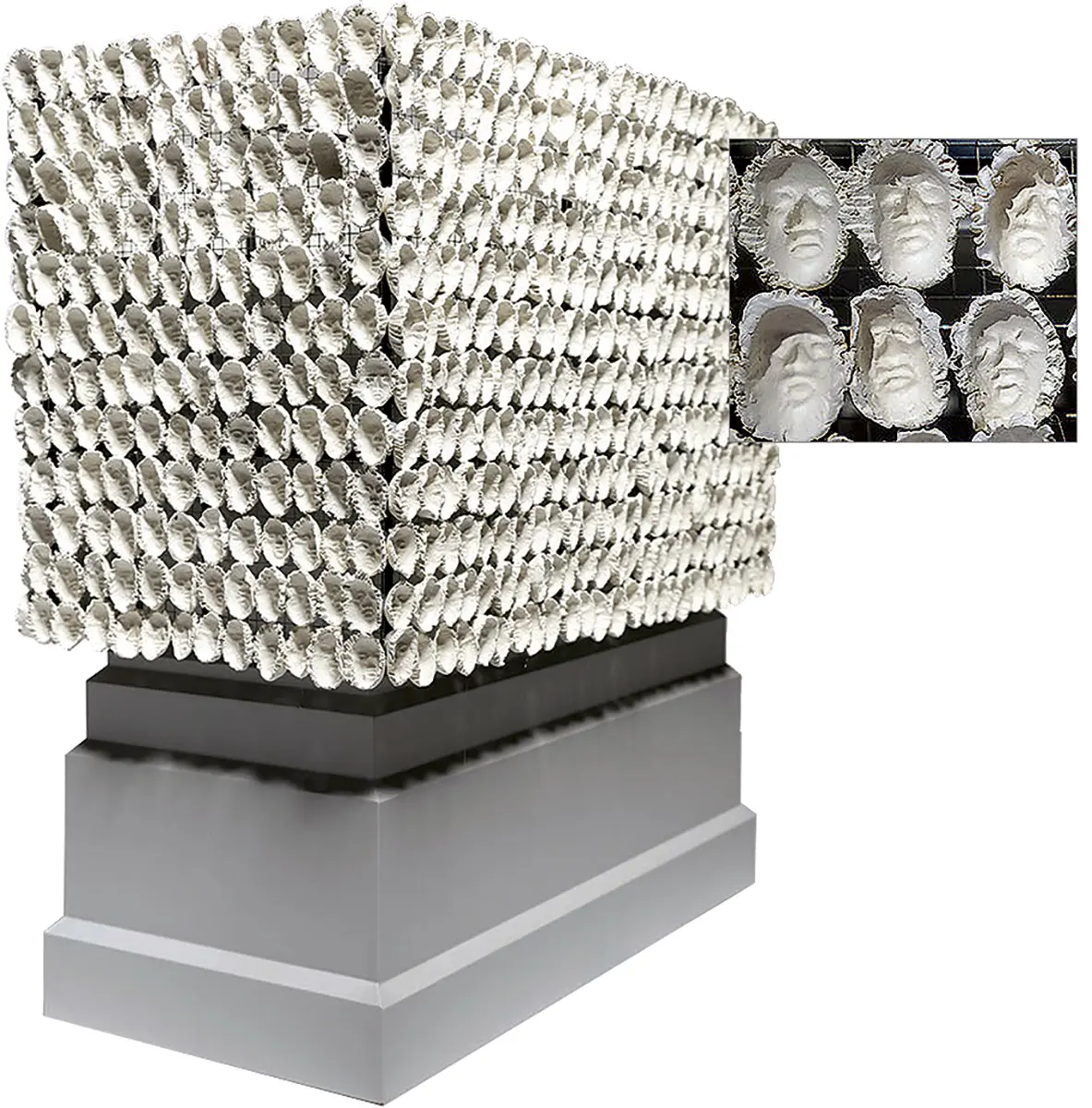
The project 850 improntas (850 Imprints) is slated for installation in 2024 in Trafalgar Square, London’s emblematic location for contemporary public art. It will surround the central pedestal with the molds of faces of transgender sex workers from different countries. Margolles will include as a motif the decay of the work by the action of the elements, which will distort the facial features; this will play with the notion of the anti-monument, so powerfully current in today’s urban protest interventions by social movements around the globe.
SOURCES
1. ArtNexus/Transgresiones. Mujeres que cuestionan. Teresa Margolles. Priscilla Presente Trans.bordando (2019). https://www.artnexus.com/en/fundacion-artnexus-exhibition-women/obras-artista/5f4d2fc300f7b8db1f34806e/5f5006fe65b7044aff7ed1f1/Transgresiones.%20Mujeres%20que%20cuestionan. Teresa Margolles. Tierra bordada: Bolivia (2019). https://www.artnexus.com/en/fundacion-artnexus-exhibition-women/obras-artista/5f4d2fc300f7b8db1f34806e/5f5006fe65b7044aff7ed1f1/Transgresiones.%20Mujeres%20que%20cuestionan
2. Ferran Barenblit, María Inés Rodríguez, Juan A. Gaitán, Óscar Gardea Duarte, El Testigo, Centro de Arte 2 de Mayo, Madrid, 2014, pp. 9-56.
3. Venice Bennale, Teresa Margolles. Muro Ciudad Juárez, 2010. Retrieved from: https://universes.art/es/bienal-venecia/2019/fast-tour-2/teresa-margolles
4. Mariana David, Bárbara Perea, “Prefacio/Necropsia: Historiar el colectivo”; Luis Javier García Roiz, “Las sinfonías de la putrefacción”; Jorge Reynoso Pohlenz, “La recreación de lo verídico”, Pilar Villela Mascaró, “El recuerdo de un cadáver que nunca estuvo ahí”. In Mariana David (coord.), SEMEFO 1990-1999: De la morgue al museo, Mexico, UAM/Palacio de Hierro/La Colección JUMEX/FONCA/CONACULTA, Mexico, 2013, pp. 9-31, 36-48, 52-73.
5. Es Baluard Museu (2020), Teresa Margolles. La piedra, Palma, España. Retrieved from: https://www.esbaluard.org/exposicion/teresa-margolles-la-pedra/
6. Labor Gallery website: https://www.labor.org.mx/artistas/teresa-margolles/
7. Kunstinstitut Melly (2018), Trayecto, Róterdam, Países Bajos. Retrieved from: https://artmap.com/melly/exhibition/teresa-margolles-2018
8. Labastida, Alejandra (2020), Poker de damas, México: MUAC-UNAM. Retrieved from: https://muac.unam.mx/exposicion/sala10-teresa-margolles
9. López Guzmán, Javier, Informe de los trabajos de conservación sobre la obra: Lavatio Corporis / Grupo SEMEFO, Mexico, Modern and Contemporary Artwork Restoration Seminary-Worshop, ENCRyM-INAH, 2010, pp. 21-36.
10. Rossana Reguillo, “Escombros: la promesa fallida”. In Teresa Margolles, María Inés Rodríguez, La promesa, Museo Universitario Arte Contemporáneo/UNAM, Mexico, 2012, pp. 103-109.
EUGENIA MACÍAS