Transparencies, overlays, dialogs between motifs with formal referents and abstract gestures. With such features, Taka Fernández sounds an alarm for the damage humans cause to ecosystems in a selection of pictorial works currently on display at Arróniz Gallery in Mexico City, part of his recent series La estación flotante y los satélites suspendidos (The Floating Station and the Suspended Satellites, 2020).
Fernández trained at the UNAM’s Escuela Nacional de Artes Plásticas (later renamed Facultad de Artes Plásticas), in Mexico City, and in workshops abroad. His work is found in Mexican and foreign collections, and has been exhibited internationally. Fernández often combines landscapes, their contemporary problems, and their evocation by means of memory.
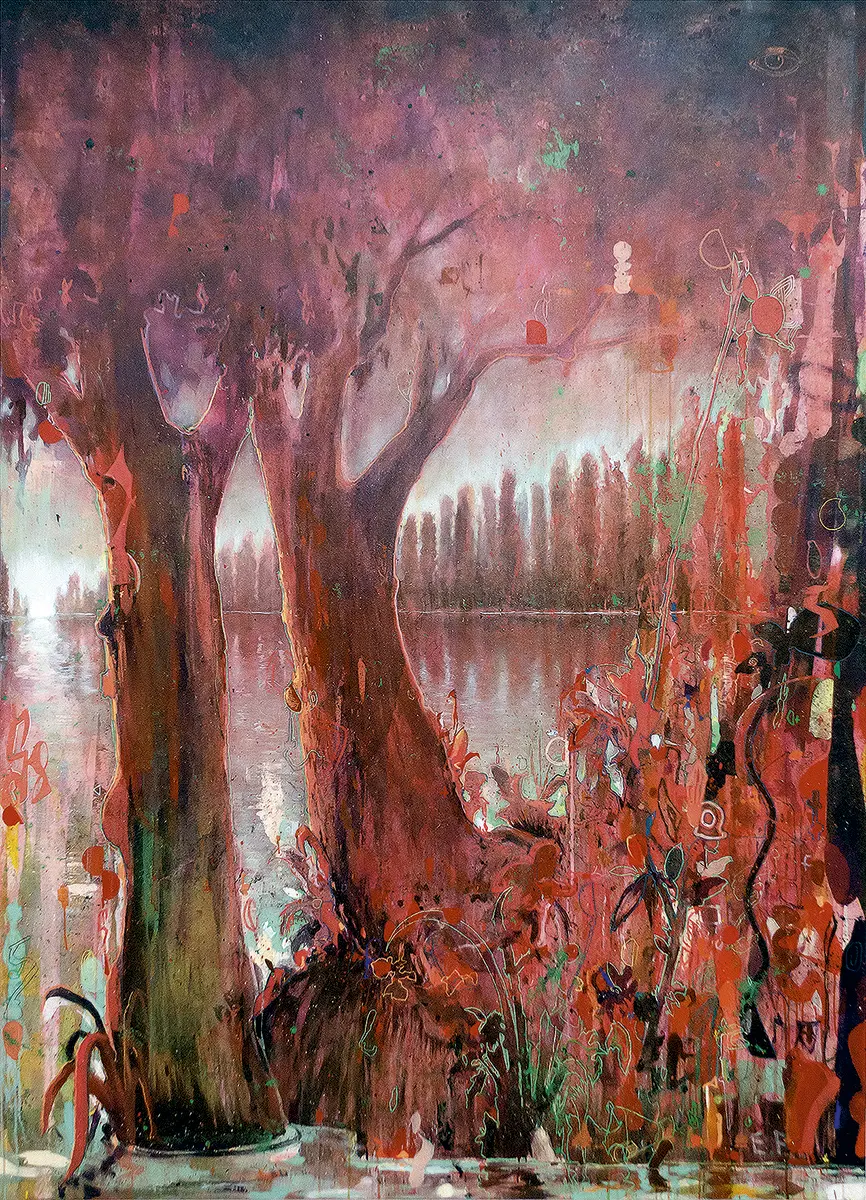
La estación flotante y los satélites suspendidos is a painting series that unfolds through monochrome shifts, with red hues always as the starting point towards rose-colored or purple, dense or translucent domains. We see as well borders of canvases touched by lines that are pictorial in intent; delineations underlying applications of free and loose colors, splattered at times; precise markings between ambiguous profiles; a passage between high lights and shadows, sometimes subtly, sometimes in counterpoint; signs of other ranges: grays, greens, ochres.
There are also references to various expressions of visual culture: graffiti; the comics’ caricature-like schematization; collage-like or bricolage-like additions of other materials; typographies; denotative figures; leveling lines of the kind used in topography; constellations of light points between color textures.
An investigation central to all these practices rests on the fact that, while some of the works in the series lean on immediate painterly gestures on a canvas with its grid on view, others are a patient, limpid reworking of tonalities to suggest a background of watery environments, with mists, fog, and vegetation.
Are those reds and their shifts or unfoldings a warning about the damage to the environment, the ecological precariousness of the resources and life in general in such places?
Is the radiant presence of a school desk lid, leaning against a tub of red paint on the floor of the gallery, a wink in the direction of conceptual artistic strategies that invite us to see beyond the apparent? Or is it an invitation to preserve our sense of humor? This series makes entry difficult, but on second view it invites one to travel more and more into existential conditions of empty spaces and saturations in the natural and the human.
Another dialog takes place in this exhibition between the paintings and two artifacts or devices for the navigation and experimentation of climate conditions. These devices feature propellers, berths, rods, as if ready to sail into the waters and take their special measurements. In the gallery text, Taka Fernández called them “Floating Stations for Active Contemplation” (EFCA, in their Spanish acronym), and explained that the devices were designed to perceive nature in bodies of water, but also to see and be seen through the dialog between people and contexts that is generated in the process. The text indicates that the two prototypes on exhibit were produced between 2013 and 2015 as convertible spaces between home, studio, sculptures, nomadic workshops, and observation towers in the Manialtepec Lagoon, in Oaxaca.
Taka Fernández wanted to transfer the exercise to Mexico City’s Xochimilco canals, but the COVID-19 lockdown began and she shifted to creating her series based on her memories of the space and its landscape, and how it bears the impact of social and historical processes. Many paradoxes course between the brilliance of the range of monochromes explored, the darkness of nature’s vulnerability, and the call to respect it again.