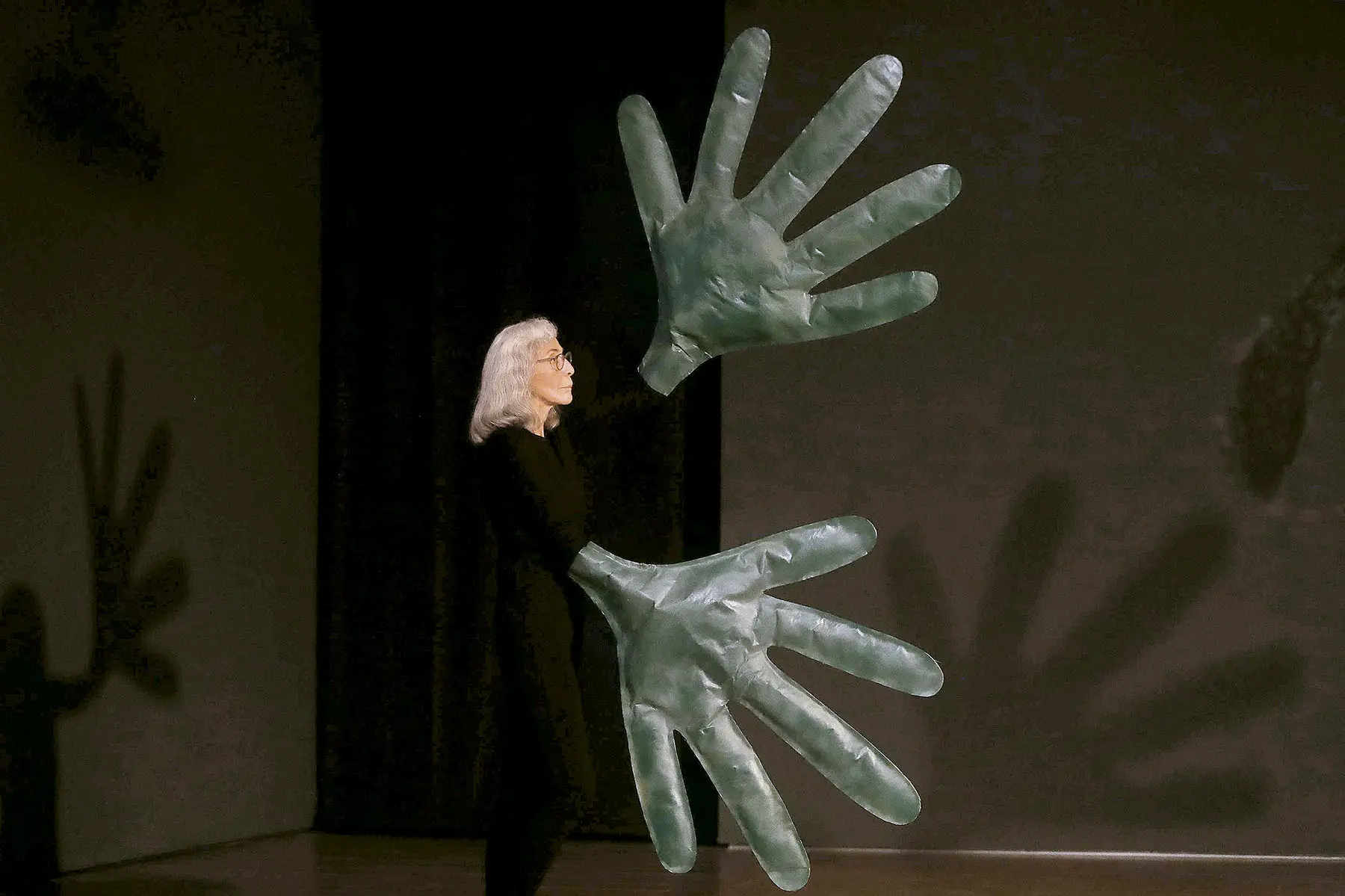
Down South, we tend to forget about those who leave, especially those who don’t return for a long stretch. Therefore, Sylvia Palacios Whitman’s first solo show in Chile came as a pleasant surprise. Borrowing the title of “Alrededor del borde/Around the Edge,” the concert that had taken place in 1978, the Centro Nacional de Arte Contemporáneo (CNAC) hosted her exhibition with iconic works made during the 1970s in New York, the city where the artist (born in Osorno, in 1941) has lived since the late 1960s. Commissioned by the CNAC, the selection was in charge of Jennifer McColl Crozier, who has been researching Palacios Whitman’s work for several years. The result was this landmark exhibition along with the publication of Pequeñas máquinas de consciencia (Small Machines of Consciousness).
According to the curator, the works were organized around two main axes: “a set of twelve performances accompanied by graphic works and, on the other hand, archival elements that shed light on the processes leading to the construction of her imaginary. The montage harmoniously combined both conceptual arenas by distributing the works according to their relation to materiality, dimensions, and the spatial scenography required for their display.”
The first difficulty was precisely the works’ performative character and the relevance of time and action in space. The second was the absence of a subject to activate the objects in the gallery and produce the works in real time. Finally, there was the gap between the experience of a context such as New York during the 1970s, where Palacios Whitman carried out her actions, and present-day Santiago. Notwithstanding these relevant details, I dare say that the works managed to connect with today’s viewers. In that sense, to witness the performances at the opening was key to understanding the “exercise” on bodily perception, the behavior between the subject-performer and the spectators. The physical presence of objects, drawings, and videos pierced a timeline that carried us to past actions. Placing monitors with recordings of the original actions at the end of the show was an effective curatorial decision.
In the room on the first floor of the old airport, there were various remnants of past performances, such as the paper spiral cut to wrap a body for Human Paper Coil (1975), displayed on a 700 x 30 x 40 centimeter-wooden plank supported at the ends by logs to allow a 50-centimeter separation from the floor.
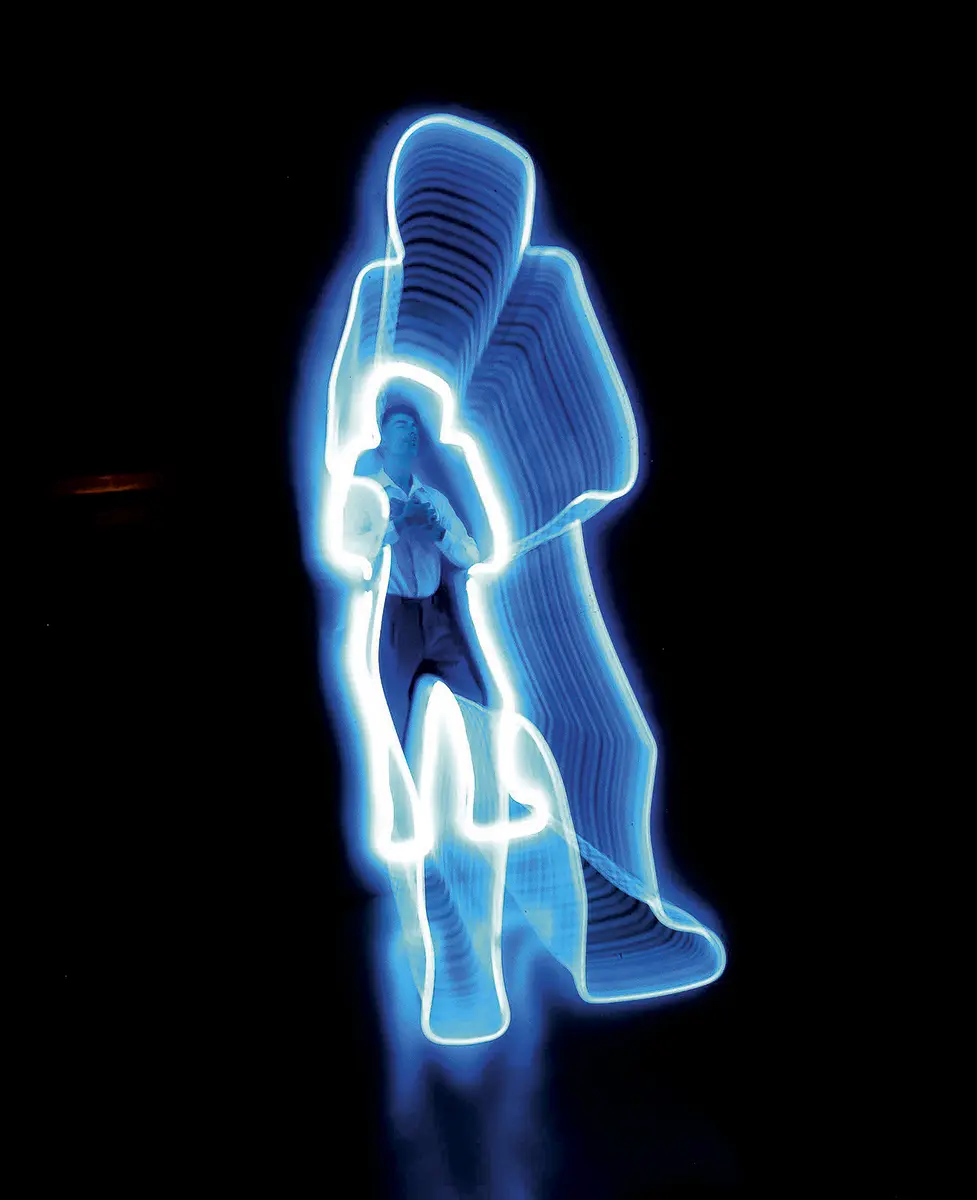
In Palacios Whitman’s performances, bodies are placed in tension with specific objects. She creates relationships through minimal, slow actions involving leaps, or balance and resistance tests, stressing the limits of both the performer’s body and the possibilities and material nature of the objects. Spectators become involved in the actions through their emotional reactions to the dynamics of action-repercussion. The influence of theater and dance is tangible, as in Bed (1978), where the artist made use of technology in dramatic ways.
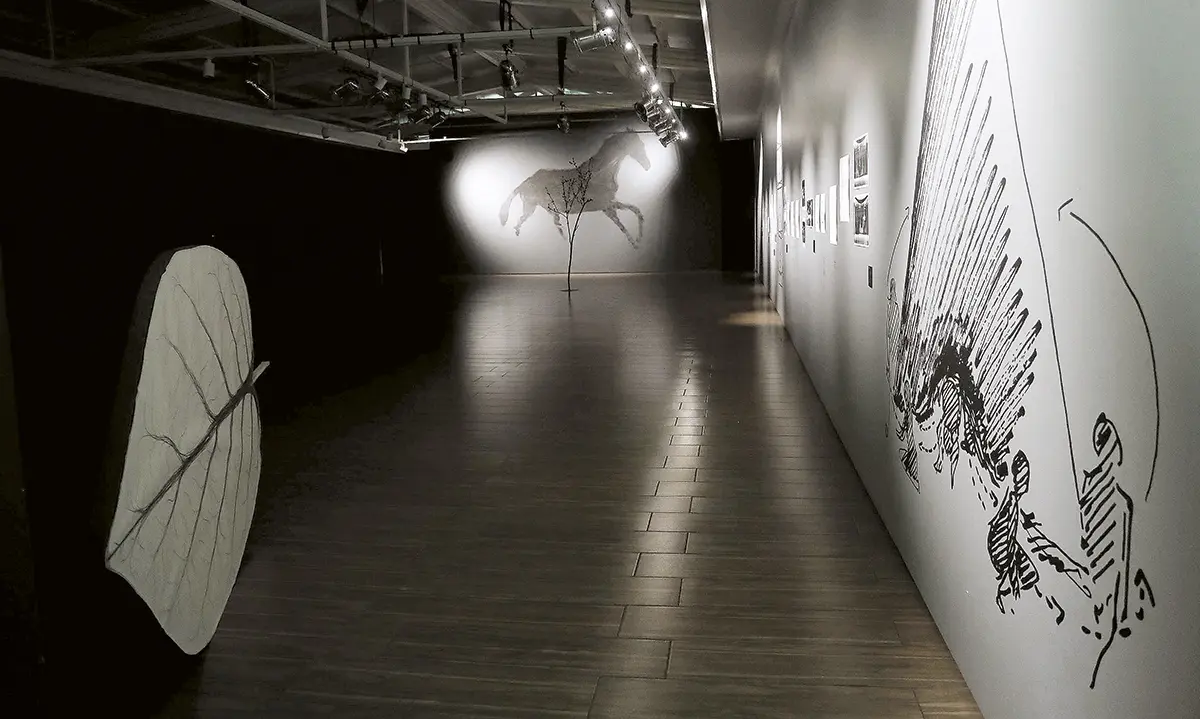
On a gray wall of the second floor, under a dim and theatrical light, were notebook sketches for actions and performances, posters, and photographs. A mix of documentation and works were displayed to help the visitors better understand the artist’s methods and mindsets, as well as her participation in the most relevant and active spaces of the New York scene of the 1970s. The large charcoal rendering of a horse provided the backdrop for performances linking nature and humans, such as Love of Tree (1980), Leaf (1978), With a Tree (1976), and Green Hands (1977).
One could say that “Around the Edge” was a “conceptual” show for the ways in which many artists of the 1970s delegated the staging of their works through instructions and lists so that they would be carried out by others without the direct intervention of the artist. The intention was to complicate the idea of authorship. The show was furthermore enriched by other types of non-objectual visuality, such as photographs and process-based sketches.
Sylvia Palacios Whitman developed her practice in an artistic environment where many of her peers were breaking with the concept of artwork and the status of elitist art, in a state of radical effervescence that would take the precepts of the avant-garde to their ultimate consequences. We should consider that during the late 1960s and early 1970s, New York was immersed in the countercultural movement of post-May 1968 and the Vietnam War. Photographed for Harper’s Bazaar by Richard Avedon, Sylvia Palacios Whitman also worked with The House, the dance company founded by Meredith Monk, a multidisciplinary artist whose influence and contributions to the performance arts were well recognized at the time. Tribeca, Soho, and East Village were places of encounters and collaborations between artists that completely renewed and revolutionized the local and global art scenes. Since the rise of the protoconceptualists and conceptualists, artists began to place increasing emphasis on their creative processes, rather than on the final product, leading to the dematerialization of the art object (see Lucy Lippard’s essays on the subject).
What relevance could this show by Sylvia Palacios Whitman have beyond the historical revision and repositioning of an artist of Chilean origin in the local context? In our present revitalization of performance art in Chile and beyond, it is necessary to reflect on the historical and contextual processes that gave rise to contemporary practices. The peculiar radicalism of Palacios Whitman in the 1970s New York scene was due to the formal aspects of her work and her intersection of genres; a radicalism that is particularly relevant to current performances of a rebellious, confrontational, and political nature. Therefore, this singular exhibition by the Chilean-American artist constitutes an unavoidable contribution to the research and retrieval of Chilean art’s historical memory.
DERMIS LEÓN