Raquel Rabinovich’s exhibition at Hutchinson Modern & Contemporary is a revelation, as to how much her monochromatic works, some of which are also inscripted, can reveal of the meditative process in art making. Raquel has travelled extensively in the Himalayan countries, and the serenity of her work permeates a strong connection with Eastern philosophy and meditation practice, which has influenced her aesthetics and her particular approach to the process of making art. The title of the exhibition, “Portals”, aptly underlines that her works are much like windows into unknown territory, a series of openings from which to perceive the visible and the hidden. What lies beneath the surface in these works has an integral repercussion into what that final layer conveys.
The artist has been living in the Hudson River Valley for a very long time, and that may have been one reason as to why she has been under the radar in the art world; a lot of her works are stone installations by the river that are meant to interplay with the tides of the river itself. She started making these pieces at a time when climate change was not yet a concern, but they acquire new meaning now, when it’s evident that water levels are on their way to definite new levels. It may also explain why we have for so long not been aware of this talented artist’s work. This type of work practice strongly relates to Earth Art, a movement that was an offshoot from Minimalism, and what can now in retrospect be seen as the beginnings of the environmental movement, which came forth in opposition to the rampant commoditization of American art in the late 1960s. These ideas and works were, to varying degrees, divorced from the art market and similar to the Italian movement Arte Povera, which also was a reaction against the commercialization of art, placing a strong emphasis on simple, non-elaborated materials.
Her work is mysterious, it requires observation, rather than ‘looking’ which is about the opposite of how we look at the commercial product that is far too often mass produced, to meet the demands of the ever growing art fairs and auctions. It is truly refreshing to see work that is demonstratively profound, that exposes a technique developed from thinking rather than objectifying the work that is generally now made up of appropriated material. This work comes from a place of meditation, of reducing to reach an essence, and then revealing it by suggesting, approximating, making us aware that there is a completely different way of seeing what seemed unreachable.
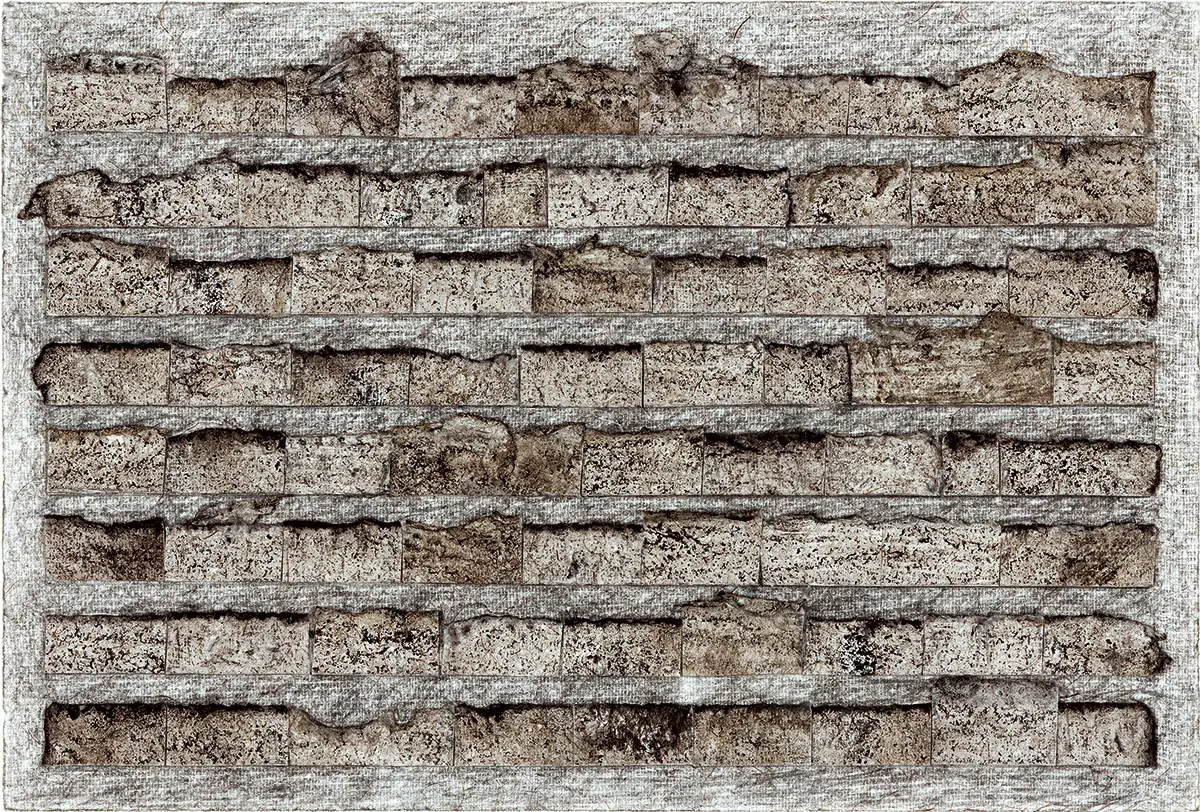
Raquel settled in New York in 1967 but she is originally from Argentina, and more importantly she has been influenced by readings of Jorge Luis Borges, the brilliant writer who never received the Nobel prize because his literature could not be manipulated into politically committed posturings, and also because he came into conflict with Peron’s dictatorship soon after the general and the legendary Evita took over Argentina. Rabinovich was imprisoned for her political views. Upon Raquel arrival to America, this terrible experience helped her on her path to see, or better yet understand, the light of darkness, or as one of her works titles eloquently expresses it: La Oscuridad tiene su Luz (Darkness Has its Own Light). Borges’ narrative comes up in her work: One of the most compelling works in the exhibition, When Silence Becomes Poetry 2: for Jorge Luis Borges is composed with mud from the river Danube on Essindia paper; there are visible rows of rectangles, which may suggest a wall suspended, or one of the labyrinths in Borges’ short stories. This piece is not large in size but the way the mud integrates with the paper produces a very interesting surface and the process of observing it produces the sensation of trying to figure out the remains of an archeological inscription, undecipherable yet somehow still powerfully present.
Raquel’s idea of mixing mud from different rivers to construct books is best explored in this exhibition by River Library 300, 2007-08 which is composed with sediment from the Paraná River attached with glue to Essindia paper. It gives the impression of a manuscript, but it’s just about of the materiality of the river, without any writing, which shows a specific color of the sediment giving the impression of an ancient book that has been discovered. It also unfolds in the same way as the ancient Maya and Aztec codices, which is radically different from the European book format, ancient or modern. Her books are writings that seem to spring forth from nature, with as little intervention as possible from the artist author that strongly yet gently emphasizes the much needed appreciation and preservation of the waterways that have been taken for granted for far too long.