The businessman and art collector Eduardo F. Costantini chose to commemorate the twentieth anniversary of the Museo de Arte Latinoamericano de Buenos Aire (MALBA) with an anthological exhibition of the great Uruguayan avant-garde artist Rafael Barradas (Montevideo, 1890-1929). The museum’s founder presided over the inauguration, visibly overcome with emotion, because, as he has said many times, the MALBA is a part of him and of his being in the world. Furthermore, in a country like Argentina, with so many discontinuities (the MALBA was inaugurated three months before the 2001 crisis, which drained the incumbent president of power and imposed four other presidents in eleven days), it is no small thing to create and sustain a first-rate private institution over time. Today, the MALBA is one of the most visited museums in the city; a friendly place that houses some of the region’s artistic treasures and an essential landmark in the urban landscape of Buenos Aires.
The anthological show “Hombre flecha” (Arrow Man) was curated by Enrique Aguerre, director of Uruguay’s Museo Nacional de Artes Visuales (MNAV), and organized together with the Uruguayan Ministry of Education and Culture. Aguerre, artist and forerunner of video art from Uruguay, chose to bring to the fore one of the most fruitful stages in Barradas’ trajectory, which took place between 1913 and 1923, during his stay in Barcelona and Madrid. When he was 22-years old, the artist traveled to Europe at the beginning of the 20th century “to incorporate avant-garde resources into his poetry, which allowed him to develop his own pictorial language, called Vibrationism… Although Barradas experimented with formal solutions at different moments in his career, this is the period when his production reaches a central relevance,” Aguerre explains.
The show brought together more than 130 works from the MNAV and MALBA collections, as well as other private and public collections from Montevideo and Buenos Aires. His paintings not only project the dynamism, speed, and modernity of the new city, but also recreate some aspects of his relationship with his sister Carmen Barradas (Montevideo, 1888-1963), an outstanding composer and pianist with whom he had a profound artistic exchange. Likewise, he establishes a dialogue with a selection of paintings by Joaquín Torres García (Montevideo, 1874-1949), friend and accomplice in the modernist adventure. The mixed technique Still Life with a Letter by Torres García (1919) synthesizes the great bond with his acclaimed colleague. The title of the exhibition is taken from their correspondence, where they discuss their creative processes. In a letter from 1926, Barradas alludes to Pedro Figari (Montevideo, 1861-1938): “What happens with Figari is what happens to us. The only thing that should happen, happens. He is a man on the road, like us. An arrow-man; an arrow going towards a target. Even if you don’t hit the target, what is important—perhaps the only really important thing–is to have a target. An arrow without a target is not an arrow, as is the case with many men.”
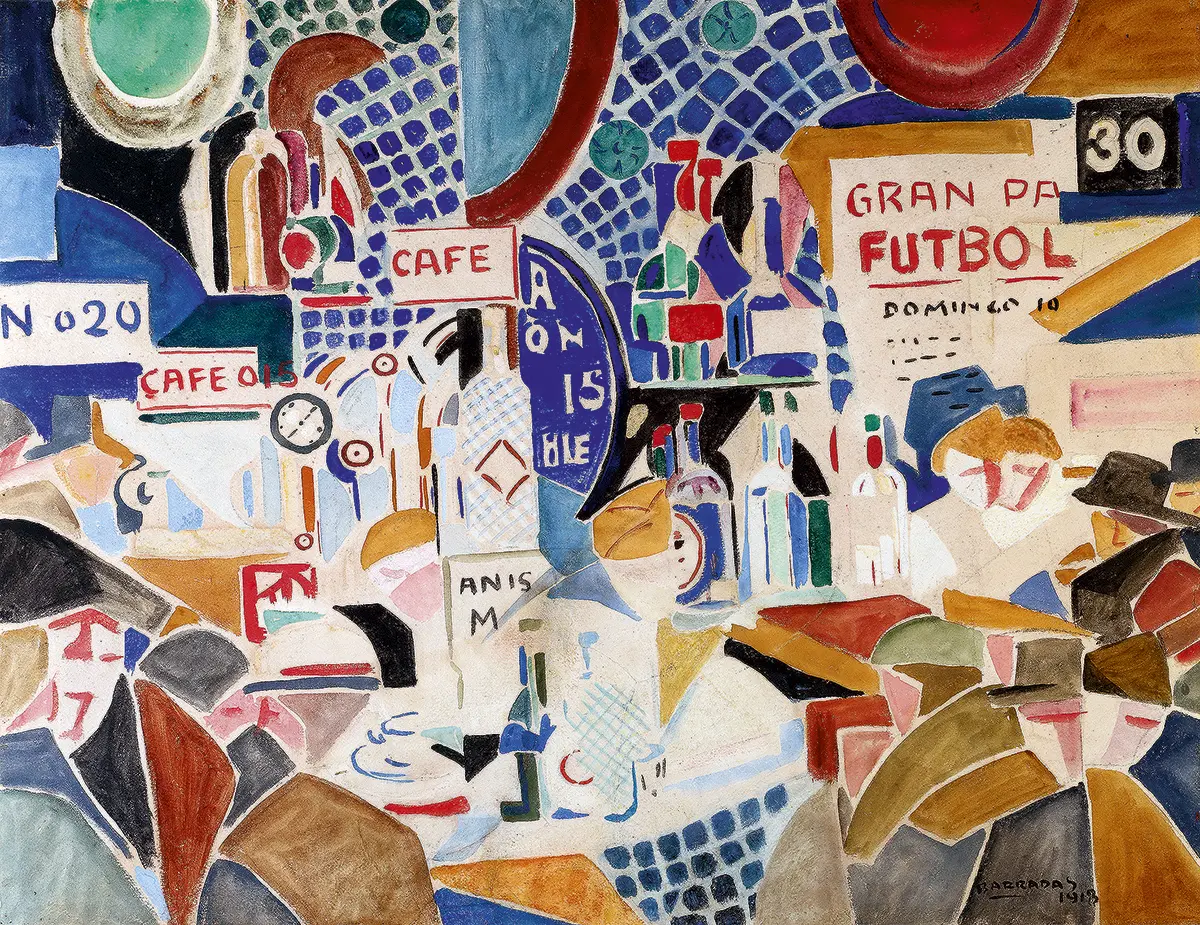
The exhibited oil paintings, temperas, watercolors, and drawings on paper were made during his stay in Barcelona and Madrid, after passing through Milan and Paris, where he learned about Futurism and Cubism. It was in Barcelona where he broke into his enduring idea; where he conceived that new pictorial language, his own “ism”, which had an impact on Spanish painting. This aesthetic conception, Vibrationism, can be seen in works where both geometric and fragmentary features are accentuated in various settings, such as The World’s Cutest Circus (1918) and in individual or group portraits such as Zíngaras (Gypsies, 1919).
The rhythm of these works reflects his view of the commotion and cadences of the modern city agitated by new technological developments, with daily life and its protagonists in constant change. He emphasized street colors in La catalana (tren de caballos)—The Catalonian (Horse-Drawn Train), 1918—and also in Quiosco de canaletas (Waterway Kiosk, 1918), where the painter and draftsman highlighted his love of life at the cafés, which he depicted over and over again.
In various gatherings he met poets, artists, and critics of the avant-garde such as Salvador Dalí, Luis Buñuel, and Federico García Lorca (whom he painted and for whom he imagined theatrical sets). Barradas also collaborated in magazines of the Ultraist movement (free verse and complicated metrical innovations of advanced symbology), disseminating the progressive visual identity of this literary movement with his drawings. He also frequented Ramón Gómez de la Serna, Guillermo de Torre, and the Borges siblings, Jorge Luis and Norah (an artist in her own right, and along with other moderns she helped to build a connection between the European avant-garde and local imagery), who later spread Ultraism in Argentina.
The great connoisseur, eminent speaker, and former president of Uruguay Julio María Sanguinetti, during the inaugural conference on Rafael Barradas recalled what André Malraux said: “Each work is born from a time and in a time, but it only becomes art when it escapes it.” Such is the case of this artist, who, although admired by his colleagues during his lifetime but not by the general public, today is enjoying an ever-increasing posterity that places him among the giants of that era of giants.”