“I will tell God everything,” the new solo show by the prominent Chilean-Uruguayan artist Pedro Tyler, was presented at the Montecarmelo Cultural Center’s chapel and was part of the selection made by the Bienal Sur 2020, an extensive art platform hosted by various countries, which brings together great Latin American artists.
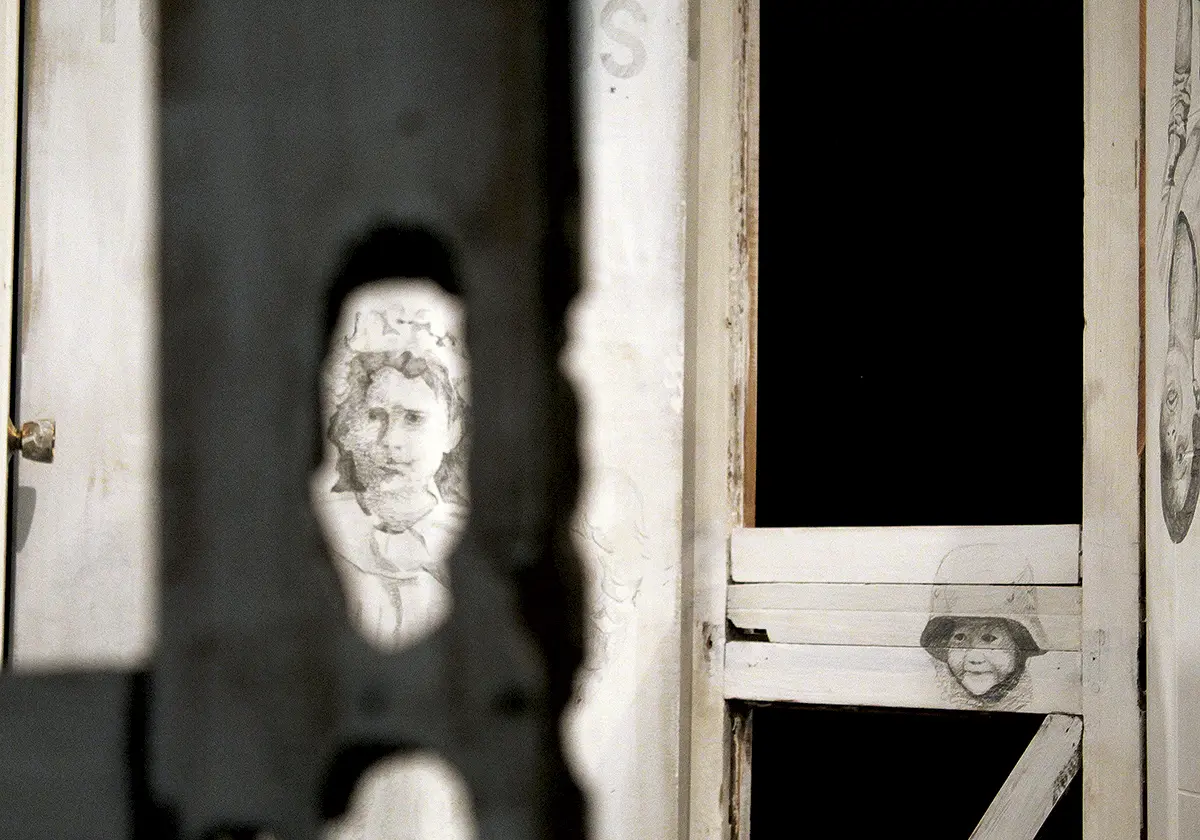
In May 2014, the media published a photograph of a three-year-old Syrian boy who, moments before he died, uttered a moving phrase: “I will tell God everything.” Pedro Tyler quoted this phrase in his book Memorial sin fin (Endless Memorial) along with drawings of children playing or posing with firearms. These drawings were made with bullet points as pencils. A single text is divided between two doors: “When I get to heaven, I will tell God everything.” What would we answer him? The drawings are inspired by real photographs from the artist’s varied archive. His daughters, nephews, child-soldiers, children before World War I and from the present day were the artist’s inspiration. “Drawings have a fresher quality and since they’re made with lead, this material aspect makes you see the work in a different way. That’s why I’m more interested in drawing from photographs than reproducing them perfectly,” explained Tyler.
Art must communicate. Yes, communicate concerns that the artist visualizes and captures from his own environment because he deems it crucial to convey them to his community and surroundings in order to create awareness and incite people to act when necessary. Such is the case of weapons and children’s games that blur the transition from a mere game to a cruel reality.
We are born unaware of violence, sheltered by our mothers who protect us from everything that can happen around us. They, of course, do not teach us to be violent, but games inherited from our parents teach us to play at war, with toy rifles and bullets that will become real when we grow up. The diabolical game will become real. Pedro Tyler recognizes this and says: “My mother was against firearms, even if they were toys.” He then adds: “Breaking into my father’s workshop to make swords and guns was vital to me. I think that’s why I’ve always been captivated by tools, weapons, and their history. The idea that people can use a tool as a weapon, or vice versa, transforming objects and their uses, has influenced my art.”
Bullets are the raw material for this exhibition; the artist uses the tips of ammunition to draw children playing in times of war and peace around the world. He hammered different bullets into lead pellets, carved a sculpture on the tip of one, and used an empty-shell casing to make a whistle. Pedro Tyler achieves his goal of signifying the bullet game with apparent ingenuity, but we are filled with horror when the game turns out to be real. His statement is addressed to common viewers so they reflect upon the meaning of violence in wars, revolutions, social unrest, anarchist actions, or acts of terrorism. We see how these naive toys used in children’s games are turned into weapons that kill people, regardless of whether they are enemies or friends, elders, women or children, respecting nothing; just seeking to satisfy dark passions.
Tyler agrees with Johan Huizinga, who in his 1938 book Homo Ludens wrote that when “every trace of the concept of play is extinguished, the whole culture will wither,” but who also believed that regardless of the circumstances, children will always play.
In short, the artist manages to surprise us in his attempt to warn us of the use of weapons as vehicles of violence. His installations face us with a looming reality. We are living in a powder keg that can explode at any moment. Tyler’s work is mature, consistent, and demonstrates extensive mastery of technique and materials to produce harmonic installations. Pedro Tyler’s exhibition portrays children’s talent for play, as well as their innocence, imagination, and ability to disengage from any place, in war and peace.