In collaboration with Pedro Friedeberg, curator David Miranda designed a special room for the Museo Experimental El Eco, which opened like a conclave, as some mediums have done to invoke and bring to a specific space the appearance or apparition of a simultaneous multiplicity of probable worlds. Based on conversations between Friedeberg and Mathias Goeritz, as evidenced in their epistolary correspondence seasoned with drawings and photographs, which was exposed on glass panels that acted as windows to the process or matrix of synergies invoking or bringing to the present moment an installation consisting of Friedeberg’s objects arranged in a space created by Goeritz.
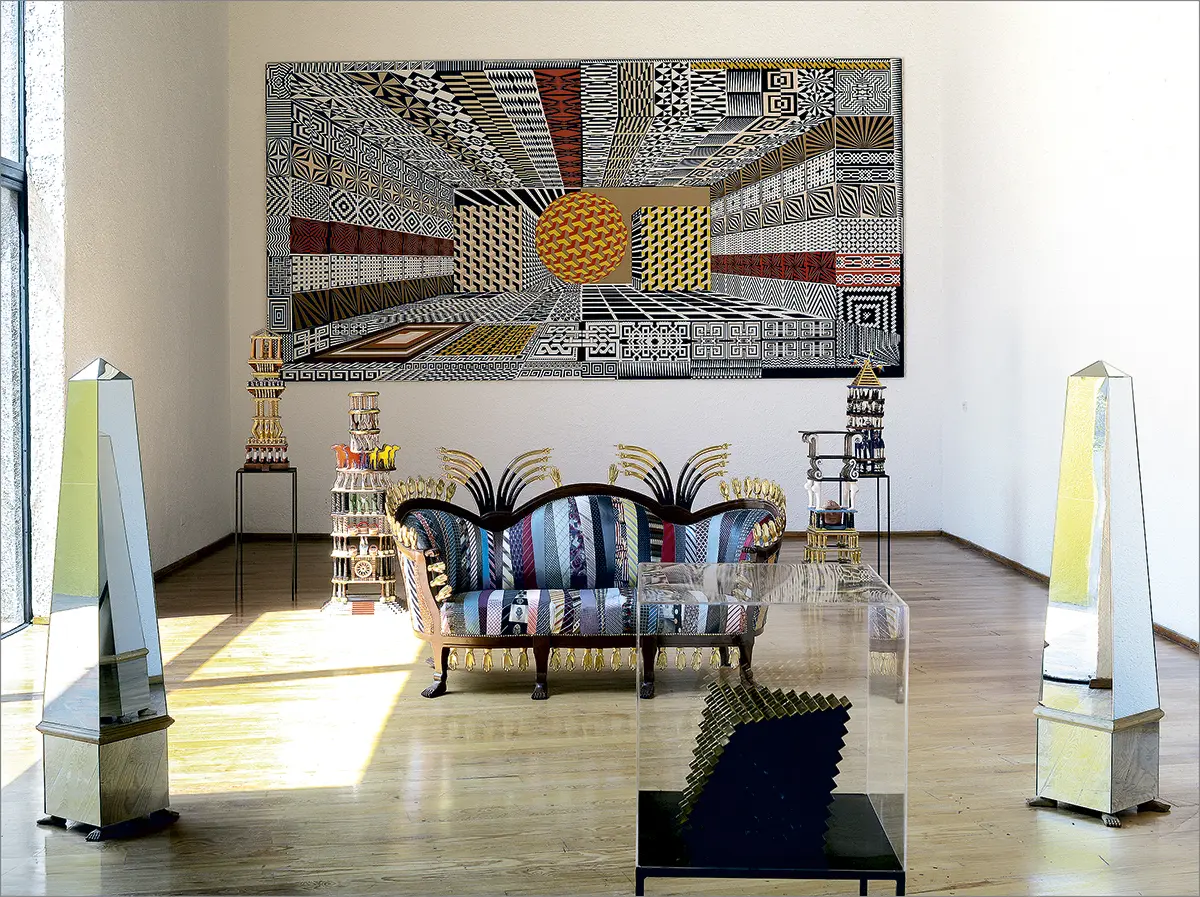
The room complied with the deceptive limits of a credenza, although there was no separating glass. It was not about seeing through, but rather about seeing during; like walking between the objects that projected a tension not only among themselves but also in their function and nature. The place was dominated by a sofa that testified to this, and which was superimposed on the museum space. Framed by the illusion or the simulacrum of being a living room, the conclave opened as a place to engage in conversations (or performances in this case) of one kind or another, more or less banal, and within a more or less mechanical exercise of representation. The place invoked the marks of the modern age in order to disobey them. This was an exhibition space for artifacts imposed as elements of a social status (that transcended or transgressed conventions) to sublimate them from their traditional or utilitarian matrix towards a fantastic logic.
The sofa somewhat mimicked the taxonomic features of the Louis XV style to highlight other peculiarities. The tapestry is made from neckties, the legs emulate feet, little hands crown the edges like golden steles, and the extensions embellish the backrest like bouquets whose flowers are, again, hands. The potential sitters were drawn into the illusion of being surrounded by ceremonial headdresses, halfway between those described in Arabic tales and the filigree adorning the ancestral stones of Mesoamerica.
Of course, there was the temptation to sit down and document the act, despite the conventional drawbacks of such a stance. A forbidden field where temptation persisted as a means of transcending or transgressing an environment imposed or manifested by different and confusing layers of convention. It was less about actually sitting down than about the temptation to do so; something waiting to happen and, yet, as in a display window, an intangible distance or separation only allowed us to resort, in alchemical terms, to a sublimation.
Traces of the claws of domestic animals could be seen on the sofa, brought from Pedro Friedeberg’s home. This peculiarity served as a bridge between public and private spaces in order to detect the exceptional from the everyday. Between restriction and impossibility, a magical quality (if it can be described that way) was discovered, which merged, distorted, and transformed these spaces. The temptation to speak from that place persisted as a call to the exceptional.
And in terms of space, confronting it with the notions of a specific place, imposed and confused in the dialogue established in this room, the exceptional was perceived as an appearance. A ghost, if one could call it that way, drawn-out in a supernatural way over the conversation held by the objects and their delimitations, as a cosmological extension. The public served as witness to the dynamics created between the monoliths and the towers of a Babel built as a field. Delimitations superimposed from various rescued imaginaries, dragging the elusive noise of dead languages, lost voices, and totems viscerally recognized within an abstract dimension; uttered from places where the superposition of objects belonging to their specific times and references, appear as embodiments of a hallucination.
Space as architecture contravened the notions dictated by the modern regime (the great normalizing spirit of function’s greatness), conjuring up time as a bastion of the organic for a catalogue of the world. It was an attempt to translate or reduce something as open and evanescent as the term “emotional” was for Goeritz, and even doing it as a provocation, as if to find the words that can conjure an “emotional” space set in a time out of time. An emotional place that evoked, in its materiality and as a mise-en-scène, the fields of exception that have survived through the conventions of the modern. Astrology as a means of registering and narrating. It speaks of placing in the world, of topologies, of probable futures based on registered notions and givens–in extenso–in a traditional way. Homeopathy as divergent or alternative medicine, which postulates that what is similar cures that which is similar. This is how they heal, from their similarities, breaking with the traditional, surviving as an alternative to the modernist norm.
“The Hall of Homeopathic Astrologers” takes its name from a small work by Friedeberg, which was expanded in more ways than one to adorn the wall and lend it, with patterns and geometric games, an abysmal depth.