On May 1, 2019, the four nominees for that year’s Turner Prize were announced: Lawrence Abu Hamdan (Jordan, 1985), Helen Cammock (United Kingdom, 1970), Óscar Murillo (Colombia, 1986), and Tai Shani (United Kingdom-India, 1976). Great Britain’s foremost arts award is given every year to a “British” artist. This, according to Tate Britain’s website, “can mean an artist working primarily in Britain or an artist born in Britain working globally.”
Even though the four nominees differ in their choice of mediums and formal solutions, they share a common thread: political concerns. Borders, feminism, trade-union struggles, systematic violations of human rights, and migrations permeated the content of their exhibitions held between September 2019 and January 2020. It was a crucial moment since Brexit—England’s departure from the European Union—was about to take place on February 1, 2020, though the event was overshadowed by COVID-19 and the confinement it entailed.
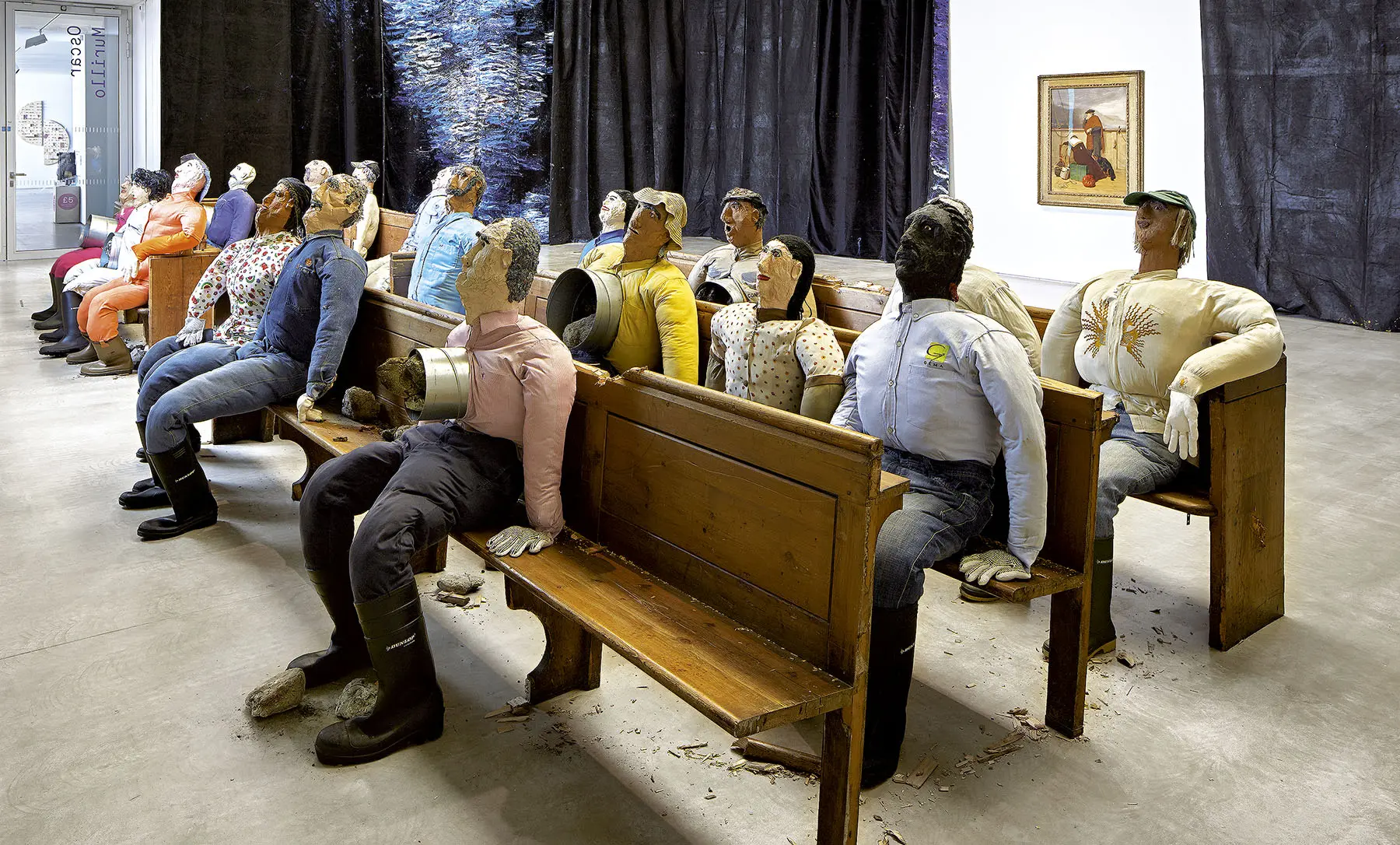
The exhibition that year was hosted by Turner Contemporary in Margate, right off the North Sea. Murillo’s installation occupied a room with large windows covered by huge canvases hung like curtains and painted with textured layers of black oil with some traces of blue, resembling the ocean waters that were hidden behind those very same canvases. Sitting on church pews, papier-mâché effigies with aluminum-cylinder bellies filled with mud and corn had been brought from London to Margate on a train, like passengers, each with a paid ticket, and then transported by volunteers to Turner Contemporary on wheelchairs through the streets of the city, as in a procession. The curtains left room only for a small 1883 painting, which Murillo borrowed from a private collection. Lochaber No More, by John Watson Nicol, depicts a Scottish couple after being expelled from their land during the infamous Highland Clearances: the forced displacements in Upper Scotland by English landowners during which no less than 200,000 inhabitants were dispossessed between the 1770s and the 1850s.
John Watson Nicol’s painting detonated the show. One migration juxtaposed with another. The dolls seemed to be waiting in some political-refugee office or federal police station in hope of obtaining a permit, a visa, a passport... Murillo’s curtains cancelled the view of the romantic painter J.M.W. Turner’s beloved sea, which is now seen as the only possibility of escape by displaced people from so many parts of the world: be they Colombians, Venezuelans, Nigerians, or Scots. Every century, every epoch, carries its own dispossessed.
The decade-long production of this 36-year-old artist is structured around three fundamental axes: work, migration, and identity. The identity of migrant workers who, according to the artist, have become a new global class lost in an illegal/legal status and found in the preservation of their customs, i.e., language and food. Murillo’s work therefore advances from a global dilemma to his specific autobiographical condition.
The artist’s father, Belisario Caicedo, made two attempts to leave Colombia. In 1987, two board members of the union that Caicedo led in La Paila (Valle del Cauca) were murdered. He decided to cross the Darién Gap and reach the Panama Canal toboard a ship as a stowaway, but he was captured in the jungle and forced to spend three months in a foreign prison. Ten years later, after losing his job, Caicedo arrived to London without a visa, but with a letter stamped by his old union, sixty sterling pounds, and the goal of obtaining political asylum. This time he succeeded, and four months later, with a loan from María Virgelina Murillo, he bought the plane tickets for the entire family. That is why at the age of ten, the life of Óscar Murillo—who decided to adopt his maternal surname to follow the female lineage—drastically changed. He went from playing in the streets under the powerful sun of Valle del Cauca to forced isolation due to London’s endless winter, finding solace in art, drawing, and painting. And this is just what his artworks deal with: family and group exile, and the perpetual waves of displaced people traveling our planet under the cyclical scheme of capitalist accumulation.
Murillo’s first solo show lasted only a few hours. Entitled “Arepas and Tamales,” and hosted by Cole Contemporary in London (2011), he cooked at the gallery and offered the food to the public as a way of introducing himself and his people. During one of our conversations, I naively asked him how he got the ingredients:
–It’s easier to make a sancocho valluno in London than in Bogotá. Everyone comes here.
–And the tamales?
–The leaves are brought by Filipinos and Nigerians. We have everything here.
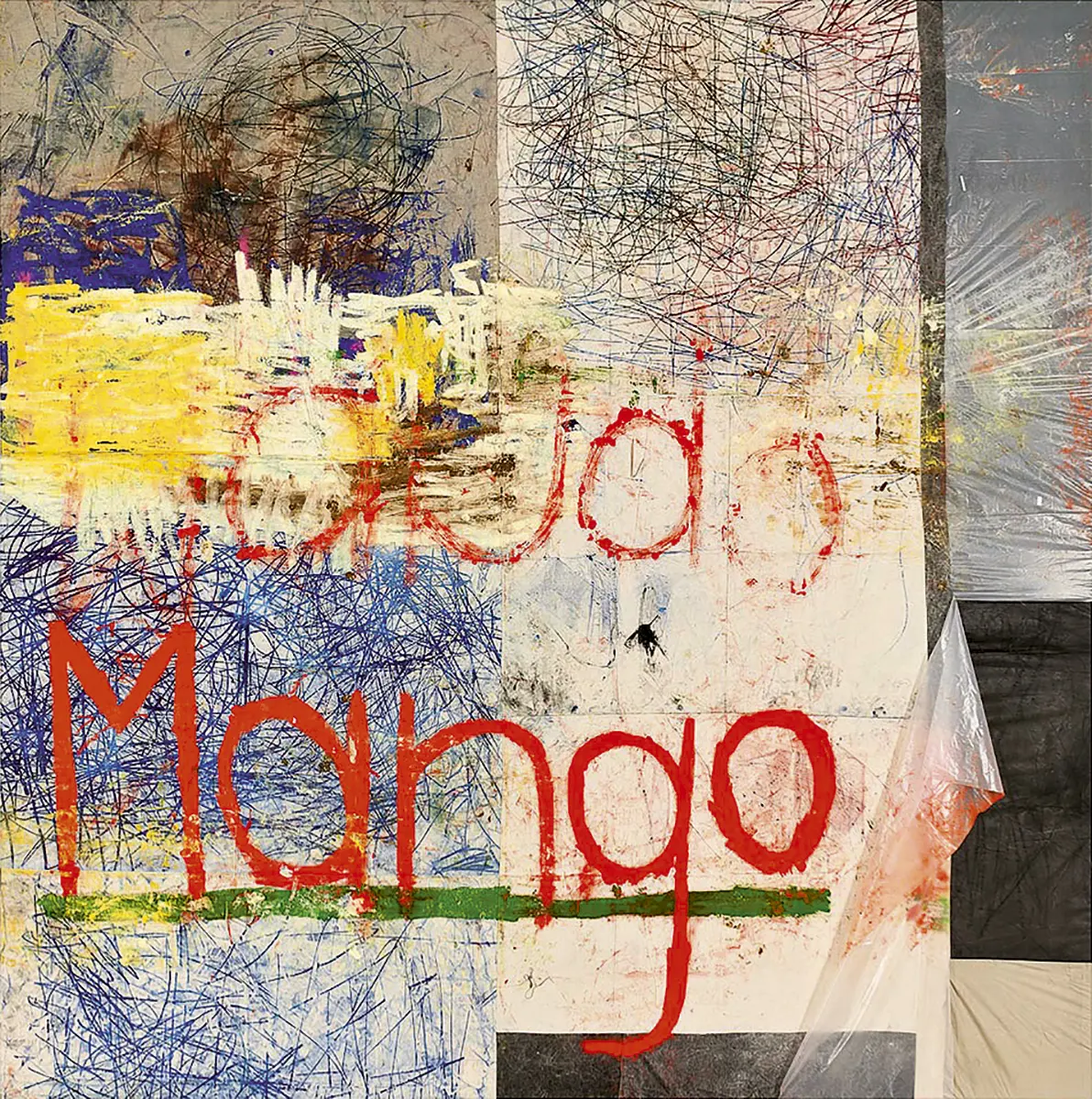
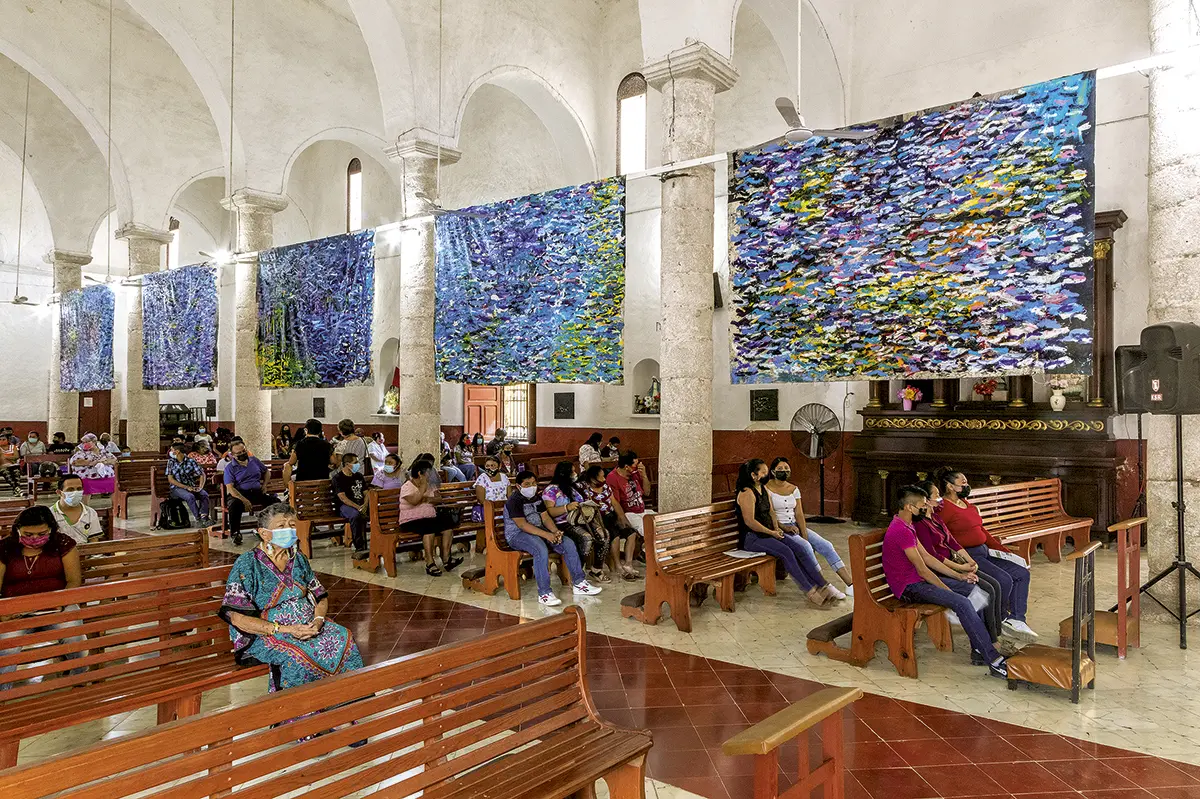
In that period, Murillo began to write words and numbers on his canvases: Colombian lottery numbers or names of foods: chicken, yucca, arepas and, naturally, tamales. They were drawn with large oil crayons on canvasses lying on the ground. It is important to insist that Murillo paints in large formats on the floor, not on the wall or easel, leaving traces that involve his bodily weight and especially the strength of his arm. These traces are dense and violent; a noticeable effort is imprinted in each of the words he draws. Words that form a kind of public manifesto about his own self and his intimate world; that which sustains his individual and collective identity. Indeed, during my research for this article, the artist told me: “The first time I wrote them I felt ashamed, as if I were naked and people were watching me.” He later added: “Food and language have been our protective shield against getting lost in globalization.”
The artist’s palette is limited, precise, even when it generates a luminosity that reminds me of some of Rothko’s canvases. Several series, however, only show the black, red, and blue colors of the cheap pens bought at the stationery store next door, and which Murillo employs in frenetic drawings made during his many hours on planes and waiting in theaters. Let’s not forget that today’s artist is a legalized nomad who travels the world hopping from biennials to museums. His chromatic reductions also produce huge entirely white canvases; although “entirely white” is not accurate because in a Murillo painting, traces of brush strokes and stains of time are always present.
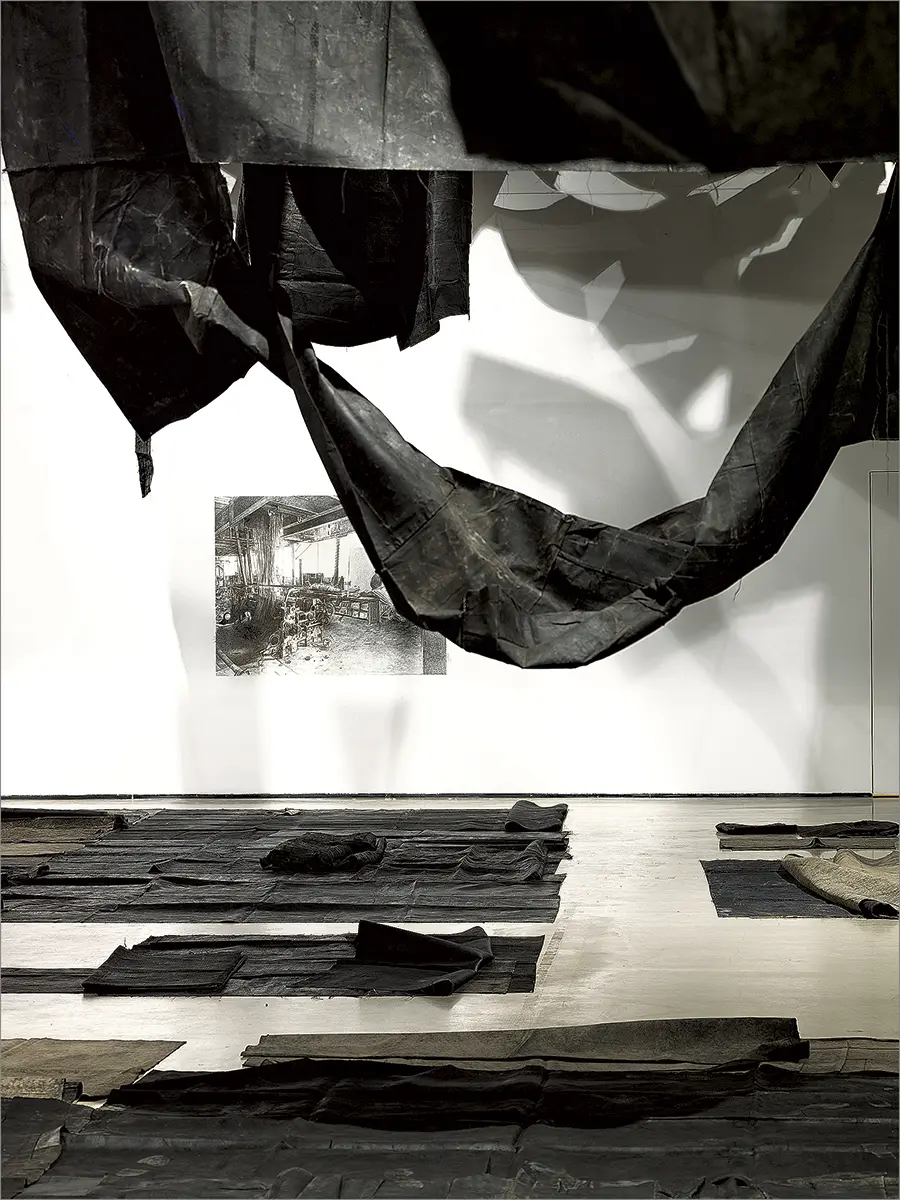
The black canvases occupying much of his latest production, dense and heavy like extended bodies, are full of seams agilely made with his sewing machine. Many of these fabrics have left the frame and are shown as three-dimensional masses. In fact, Murillo usually hangs them—like the “curtains” in the Turner exhibition—on hooks that drop with all their corporality and weight, or simply places them on the floor, where they may appear rumpled like volumes confronting both architecture and the viewer’s body, and inviting us to pose a recurring question in the history of modern art: Can painting even be called a two-dimensional art?
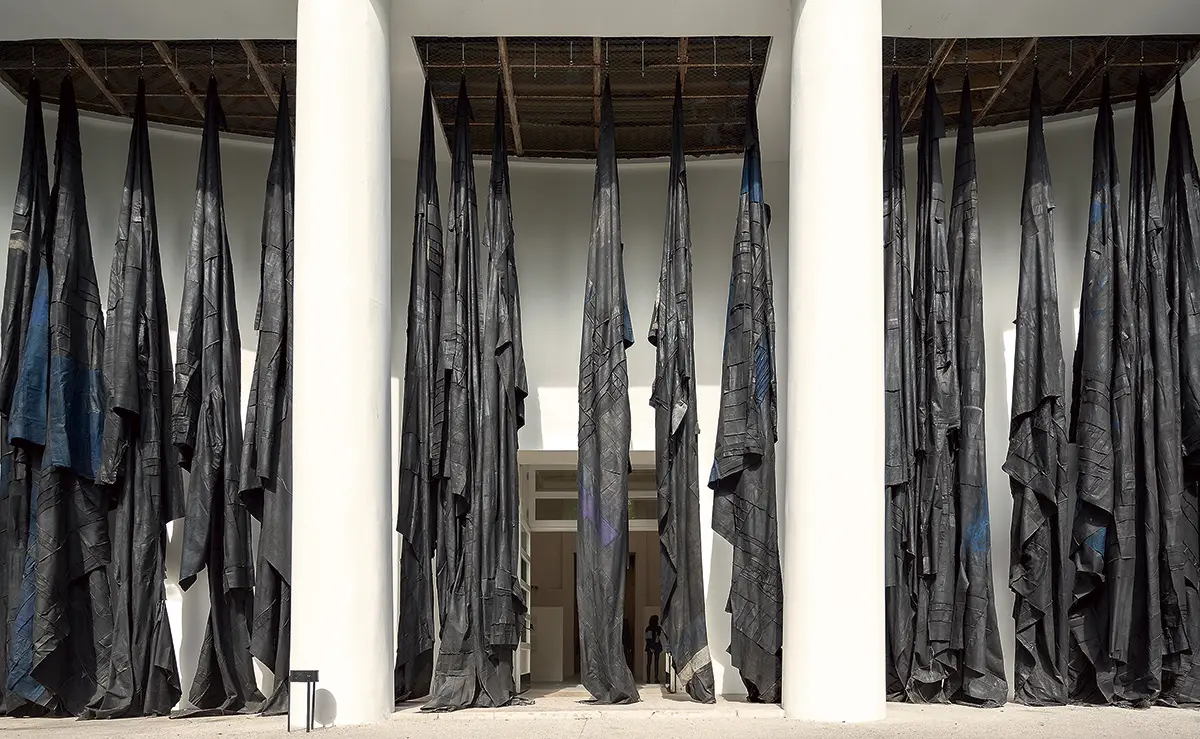
Black fabrics were also hung like unfurled flags on the wide façade of “All the World’s Future,” the central exhibition at the 56th Venice Biennale; spread among the trees at the Moroccan Biennale; and exhibited in the large hall of the Yarat Contemporary Art Space in Azerbaijan, where Murillo held a show focused on the country’s northern town of Sheki, whose silk factory was dismantled after the fall of the Soviet Union, leaving thousands unemployed and destitute. A drawing of the factory in ruins was the detonator for that 2017 exhibition, as was the painting by John Watson Nicol for the 2019 Turner Prize show.
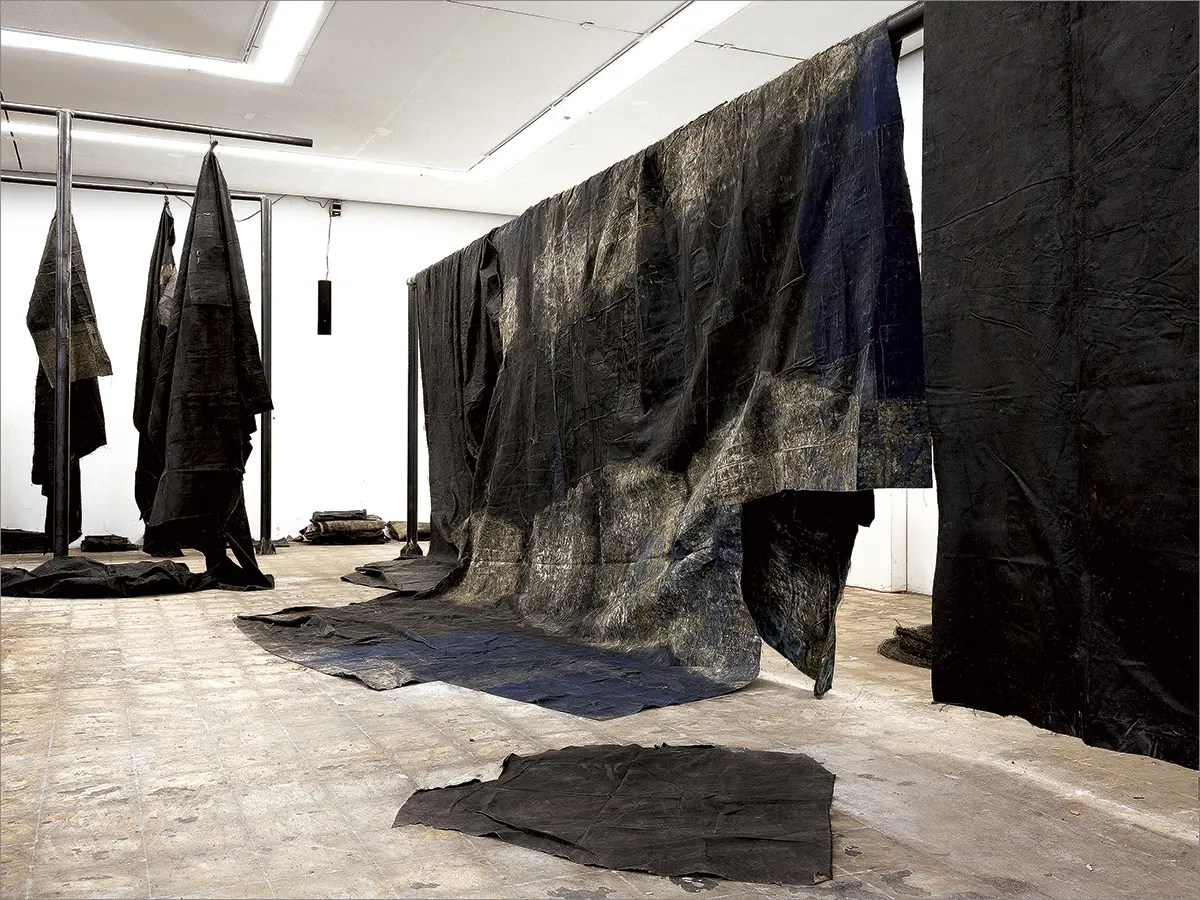
In “Condiciones aún por titular” (Conditions yet untitled), the show curated by María Belén Sáenz de Ibarra at the National University of Colombia in 2021-2022, these large black fabrics reappeared, similarly to like the Sheki drawing and the Turner dolls, which in turn came from the Kettle’s Yard show in Cambridge. Murillo usually frames his exhibitions to turn them into windows that open onto a single process.
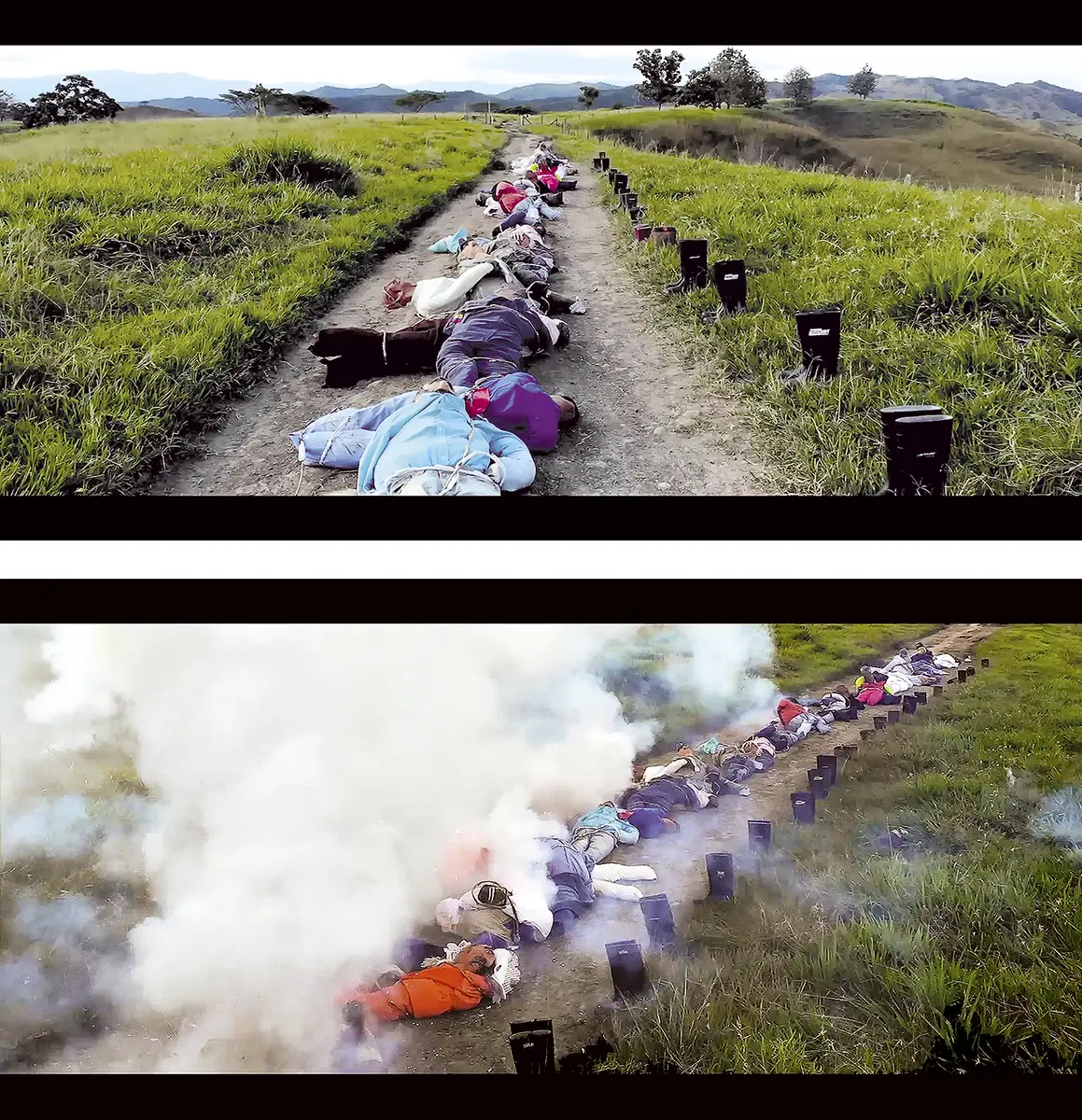
The Colombian exhibition also featured a video where effigies, stuffed with gunpowder and stretched out along a trail, explode, burn, and turn into a pile of crumpled bodies. Rather than migrants, these dolls look like bodies about to fill mass graves, and the pitch-black canvases seem to refer to the ashes left by the constant burning of sugarcane fields in Valle del Cauca, which cause rains that harm and kill the elderly, children, animals... I asked Murillo about this possible parallel and he told me that “black snow” indeed falls on the canvases he is currently working on at his studio in La Paila, but that he hadn’t established an initial relationship with this phenomenon. However, he said, each work is updated by its context. He told me about the sea of workers, unable to join a union or hope for a better future, every day at 5:30 am head like zombies for those sugarcane fields whose ashes are destroying their lungs.
In a letter to the 2019 Turner Prize jury, the nominated artists requested that the award be shared among the four of them. The letter specifically mentioned the words community, multiplicity, and solidarity in an open political position against the world’s divisions, such as Brexit and its new boundaries. This was a letter aimed at finding a different path than competition between peers; against competition for this prize, yes, but above all, against competition within a voracious capitalist system whose free market sophistry mainly leaves a trail of unemployment, exploitation, and displacement.
JULIA BUENAVENTURA