“Desire must have a great deal of imagination to be able to support itself.” These words by Brazilian artist Maria Martins, cited in the catalogue of an exhibition in Paris in 1948, opened the solo show “Maria Martins: Tropical Fictions.” Hosted by the MASP and curated by Isabella Rjeille, the exhibition assembled 45 sculptures, prints, drawings, and paintings produced in the 1940s and 1950s, as well as documents, publications, and photographs. In addition, the show falls under one of the thematic axes initiated by the museum in 2019: “Women’s stories, feminist stories.”
Today the importance of Maria Martins’ work for the local and international art history is indisputable, but this was not always so. The artist gained a significant recognition in the cultural centers of her time, especially New York and Paris, and was renowned for her surrealist visual language, despite disliking isms to label her work. At the end of 1940, when she returned to Brazil and held exhibitions in the country, local critics were hostile to her, especially because of the sexual content attributed to her works. This hostility must not have surprised the artist; from the first lines of her poem Explanation (1946), she reflects on the potential impact of her works: “I know that my Goddesses and I know that my Monsters will always seem sensual and barbarians to you.”
The show begins with the nucleus “Amazon Imaginaries.” Here the visitor encountered her production from the 1940s, the period when she was living in New York. Under the strong thematic influence of myths of indigenous origin, ritual scenes and figures inspired by African religions, works such as Amazonia (1942) and Large Serpent (1943) caught the attention of the French writer André Breton and the surrealists who lived in New York at the time. The tropical forest is also an inspiration in the segment called “Como una liana” (Like a vine), a title that refers to the sculpture of the same name: a human figure contorted like a vine (1946). This is a common designation for the sarmentose or climbing plant that hangs from the trees and intertwines with them. However, plants such as the vine, the cipos, and the climbers are transformed by the artist into hybrid bodies, vulvas, breasts, nipples in the form of claws: recurrent erotic elements in Maria Martins’ production.
In the nucleus “For a long time I thought I had dreamed that I was free,” through religious and mythological iconography such as Eve and Medusa, the artist thematizes the relationships of domination to which the feminine is subjected, as well as the search for inner and outer freedom. This idea of liberation is also present in the drawing Untitled (Satori), but this time she was inspired by Zen Buddhism, encountered on her journey through Asia, particularly China and Japan. This work also served as a study for Rite of Rhythms (1959), commissioned by Oscar Niemeyer and installed in the gardens of the Alvorada Palace in Brasilia, the Brazilian capital.
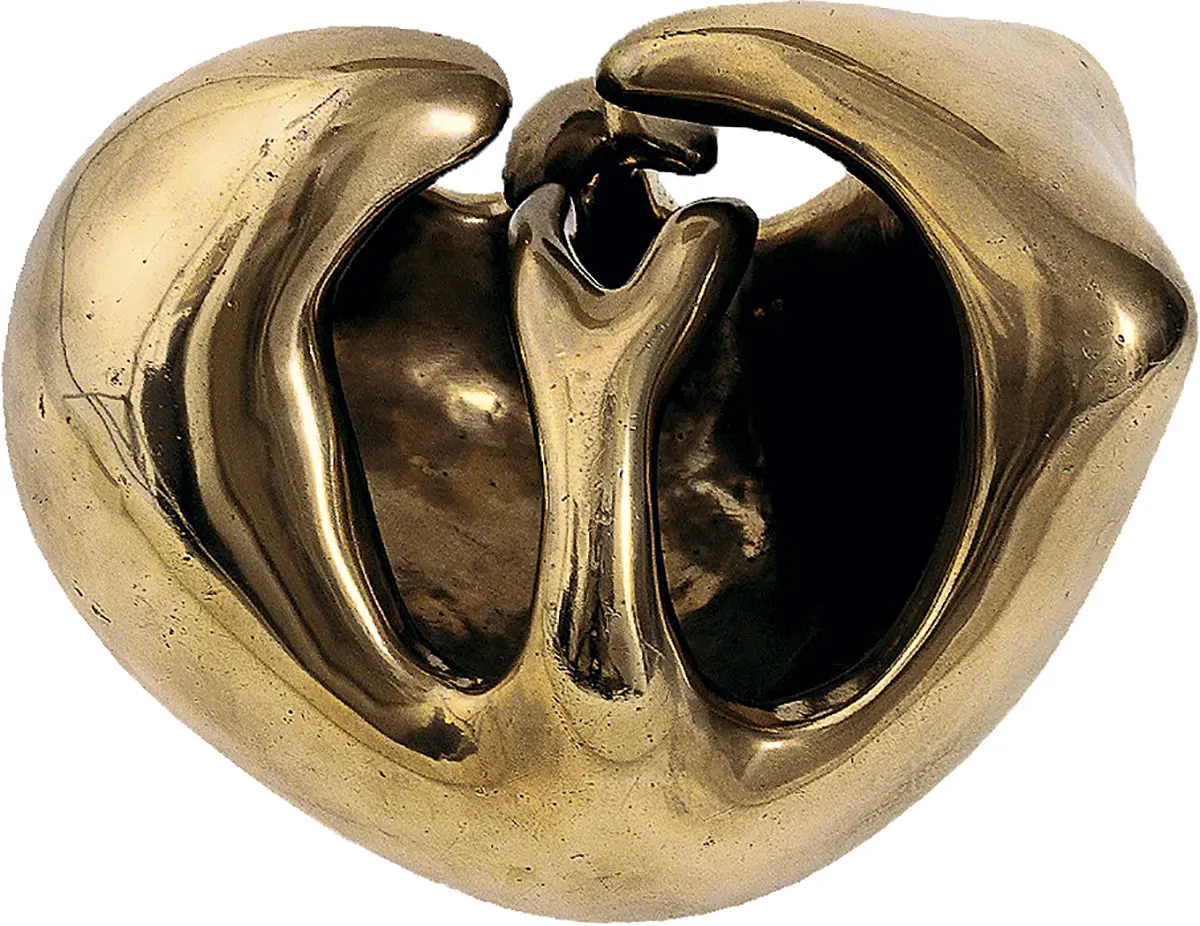
Some of the artist’s most iconic works were assembled in the segment “Double Impossible.” The possibilities and impossibilities in relations between the masculine and the feminine are manifest in figures that mix the human, the animal and the mystical, as in The Impossible, from 1944-1946, and Hasard Hagard (Perhaps Disoriented), from 1947, or even in the more abstract sculpture from 1949, with a title that points to the act of desiring: Très avide (Very Avid).
The final nucleus, “Personal Mythologies,” encompasses works with more “literary” titles that criticize the projections of tropical imaginaries and also synthesize the artist’s own thematic essence: desire, love, death, and transformation. Such is the case of the sculpture N’oublie pas que je viens des tropiques (Don’t forget that I come from the tropics), from 1945; or of the poem Explanation, handwritten by the artist in French and engraved on metal as part of a set of engravings gathered in the album Maria and presented at the opening of the artist’s solo show at the Valentine Gallery in New York in 1946.
It’s also worth mentioning that the artist was a key figure for the successful promotion of the São Paulo Biennial’s first editions and for the acquisition of important works for the collection of Rio de Janeiro’s Museum of Modern Art (MAM Rio), where she acted as advisor. Therefore, Maria Martins must be valued both for her contribution to the history of local and international art, and for her role in the projection of Brazilian art abroad and the modernization of the country’s art institutions.