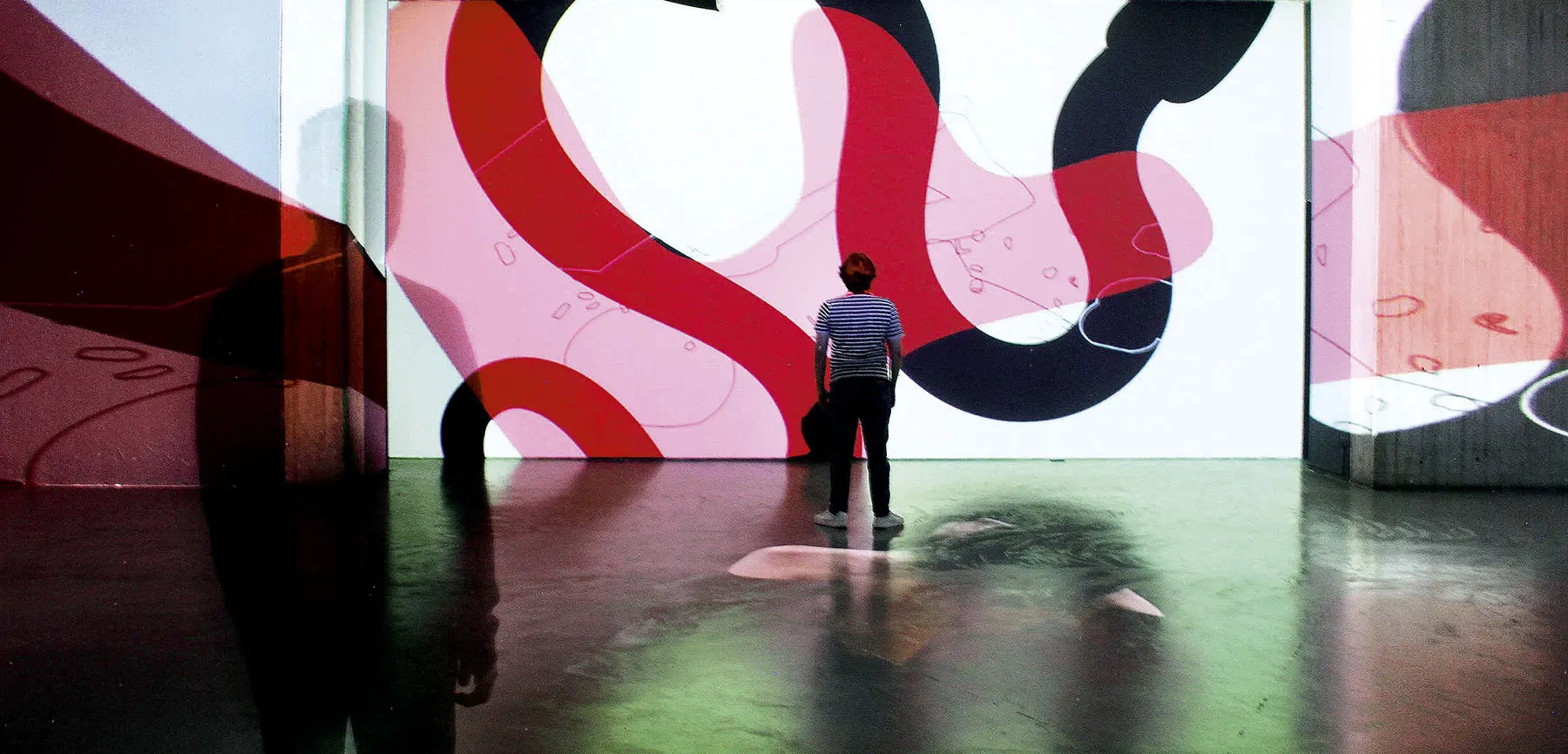
In our current scenario, what is there left for us to do? For art, for institutions, for young people, for anyone who observes the world and asks about the future; who looks around and wonders what may happen. Why are ideas of freedom, fantasy, and the future received with suspicion? Some projects occupy the world with objects and others release questions, like spores into the air, infecting us and making us a little freer, a little more rebellious. These thoughts surfaced after visiting and experiencing the project by María José Arjona (Bogotá, 1973) titled “Como es adentro es afuera” (As within, so without) hosted by NC-arte from September 30, 2021, until March 5, 2022, and curated by André Lepecki, a specialist in performance, choreography, and dramaturgy studies. The project took place between the exhibition space, in La Macarena, and the 38th floor of the Atrio Tower, at the intersection of Caracas and El Dorado avenues, and from where one can contemplate the iconic Central Cemetery, the Eastern Hills, the mountains leading to the Magdalena valley, and the rest of the city, as if it were a scale model.
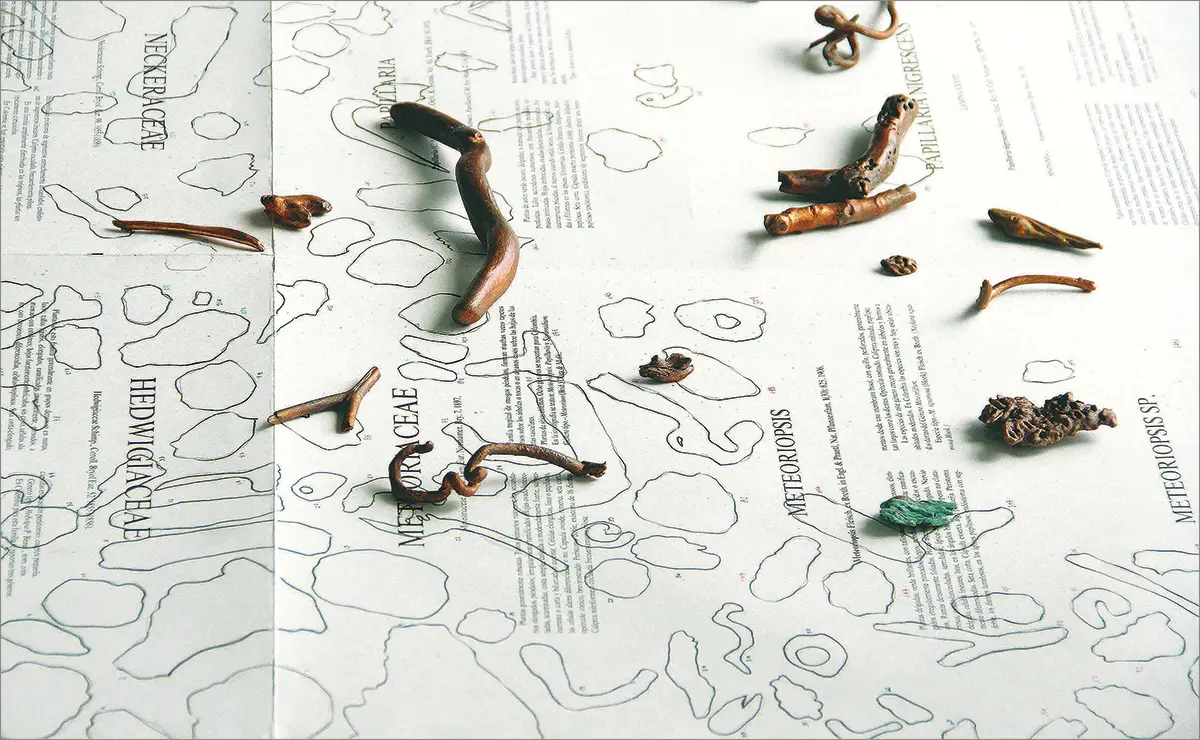
In early 2019, María José Arjona was in Guachaca, on the Caribbean coast of Colombia, at the foot of Santa Marta’s Nevada Mountain Range, the ancestral and sacred territory of the Arhuaco, Kogui, Wiwa, and Kankwamo peoples. At the mouth of the river, where the snow-capped mountain peaks can be seen on clear days, the artist encountered 307 things that seemed to come from another world. By mutual choice, these things and the artist began a journey that raised questions along the way, until a project inevitably arose, based on these questions, throughout the months of confinement in the new world that has been taking shape ever since. In a text written during the curatorial process, Lepecki states that “a thing is not the same as an object (even if it may have an objective reality). Rather, it is a way of assembling issues (virtual and real) that precipitate the unforeseen... Each thing is a gateway to other forms of life.” In this sense, “ As within, so without” was born from an encounter that opened an endless number of doors and was conceived along the voyage of things—thresholds of the oracular— present in the Nevada landscapes all the way to Bogotá. At the journey’s end, in terms of the exhibition time, the paths were as multiple as the number of people who were able to experience the project.
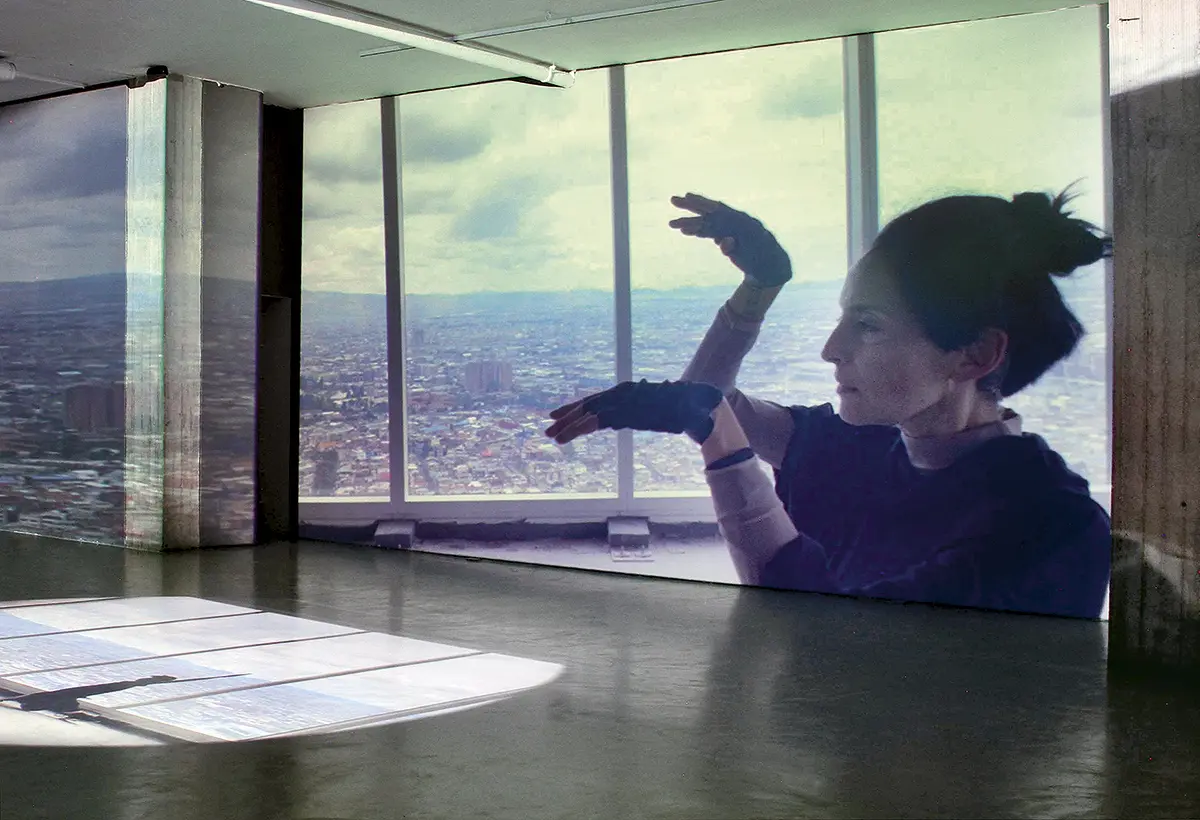
The idea that things invite us to cross thresholds if we are willing to take a leap into the void permeated every step taken here, even before arriving at the final design for every moment that made up this experience. Before leaving their place of origin, things coming from the ocean and beyond acquired an oracular character. In all this unfolding of journeys, landscapes, and elements of ancestral and urban origins, of the voices of guest translators who unfolded the potential of things and their cosmogonic planes, we ask ourselves what role do bodies have in all this? From their gestation as vehicles for the transmission of knowledge, things unfold through the artist’s body, who inevitably brought them closer to herself and translated them into motion scores under the guidance of dancer and choreographer Meg Stuart.
When entering the exhibition space there was no live performer. Instead, what we encountered was an experience that pierced our bodies; we spectators were the collective body of the project. Part of this sensorial and premonitory moment synthesized all the preparatory work that had translated the things into languages such as graphic images, sound, texts, or movement. The spectators’ bodies came to NC-arte consciously making a pact, accepting the invitation to live the pendular experience whereby the oracle manifested itself. We entered one of the four planes of the cosmogony proposed by the artist, which represents the knowledge of the world through the encounter with things: World, Underworld, Fog, and Cosmos. Each of these planes had nine entries, adding up to thirty-six possible navigation charts that wandered around the answer to the opening question. We arrived here thanks to a pendular movement, as well as to the numerology of our names. Following the thread of this journey, the sense of smell was activated through an invitation to choose from a palette of essential oils such as cypress, lemongrass, vetiver, rosemary, mandarin, and lavender, among others. The smells transported us and allowed us to build an inner landscape that activated our senses, memories, and imagination, adding a fundamental complement to our sense of sight, which usually determines our visit to an exhibition. And so, with the staggering emptiness of uncertainty and intoxicated by the landscape’s olfactory tones, we became immersed in an audiovisual experience through the portal leading to a navigation chart. Does art have a more important role than to raise questions and doubts?
The role of art institutions and exhibition formats was at the center of this project’s inquiries. What responsibilities do institutional structures have in the face of the changes and protests that have recently taken place in our latitudes? What future do our bodies have in Colombia? Arjona addresses the importance of encounters with others, of different forms of existence, of dialogue, and of the multiplicity of voices that arise around a project such as this one; of inviting other bodies in an act of generosity and collective proliferation; one that constitutes a forceful response to the initial question. Indeed, what is left for us to do when what we see makes us wonder about the future?
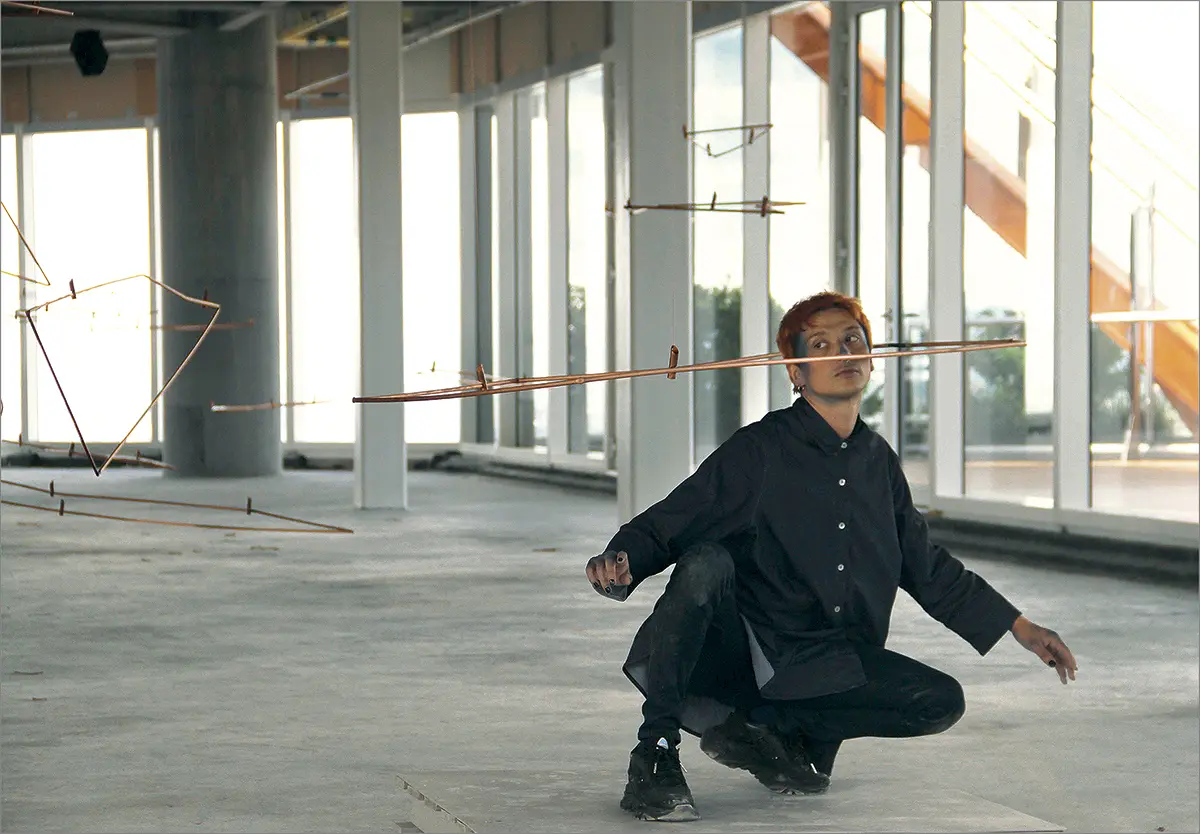
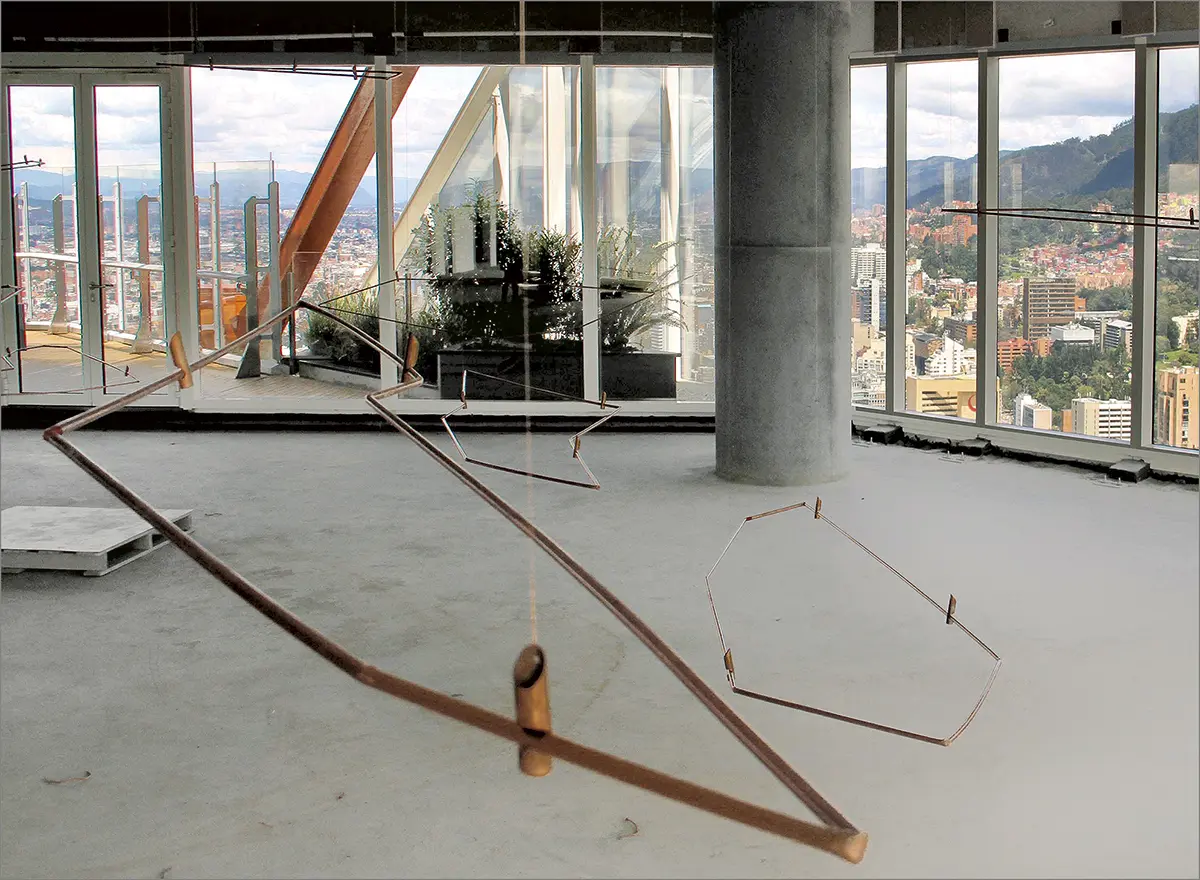
The Atrio Tower was the central stage for this proliferation, with a program of performances by guests with diverse profiles: Alejandro Penagos, Jessica Mitrani, Juan Betancurth, Danza Común (Bellaluz Gutiérrez, Jenny Angulo, Juliana Rodríguez, and Andrés Lagos), Juanita Delgado, Lina Botero, Impromptus Collective (Ana Contreras, Daniel Corredor, David Arenales, and Joan Arenales), Villamil & Villamil Collective (Felipe and Sebastián Villamil), Elisa Triana and Vanessa Gómez, la Demonia Yeguaza, Lady Hunter Texas, Cristina Consuegra, and Nueve Voltios Collective (Leo González and María José Marulanda). They proposed long-term actions in dialogue with the project, and in particular with each of the thirty-six geometric pieces made with copper tubes for each navigation chart. After freely invoking images, objects, moods, words, whistling…, both personal and referring to the work and its four planes, the Ocean was established as a metaphor for the entire process and the Fog came to reveal all that was hidden in plain sight. The Fog allowed us to move freely and to experience outward and inward feelings. Interestingly, each time the view was obstructed, our stellar origin, our animal roots emerged with more clarity. Things will return to the Ocean and the Fog, leaving us with a cosmos of answers, a world of questions.
CARIDAD BOTELLA