The Brazilian artist Lygia Clark would have turned 100 on October 23, 2020. Celebrating her centennial and her contributions to the history of local, regional, and global art provided the occasion for Lygia Clark (1920-1988) 100 years, a landmark exhibition organized by the Pinakotheke Cultural in collaboration with the Lygia Clark Cultural Association. The exhibition started in Rio, from August 21 through October 9, 2021, and moved to São Paulo between December 15, 2021 through January 15, 2022.
Lygia Clark (Belo Horizonte, Minas Gerais, 1920-Río de Janeiro, 1988) was part of the constructive movement with the Frente group led by Ivan Serpa (1923-1973); she was among the founding members of the Neo-Concrete group, and her works broke the patterns of aesthetic representation and reception. Transcending the support, working in the relational dimension, integrating the body into the artwork, using sensorial works therapeutically, Clark was even able to expand the boundaries of her own art, changing the canon of the Brazilian and international art field.
Curated by Max Perlingeiro, the exhibition was organized chronologically and divided into “17 conceptual orders.” The wall texts, authored by the critic and curator Paulo Herkenhoff, guide visitors through the evolution of the artist’s thinking and her creations across different nodes, such as Escadas (Stairs, 1947), Kleemania (1952), Quebra da Moldura (Breaking the Frame, 1954), Unidade (Unit, 1958), Casulo (Crysallis, 1959), Bicho (Critter, 1960-1964), Trepante (Climber, 1965), and Objetos relacionais (Relational Objects, 1968-1973). The exhibition included films and video installations like Memória do corpo (Bodily Memory, 1984), by Mário Carneiro, a record of the artist’s final proposal, Estruturação do Self (Structuring of the Self).
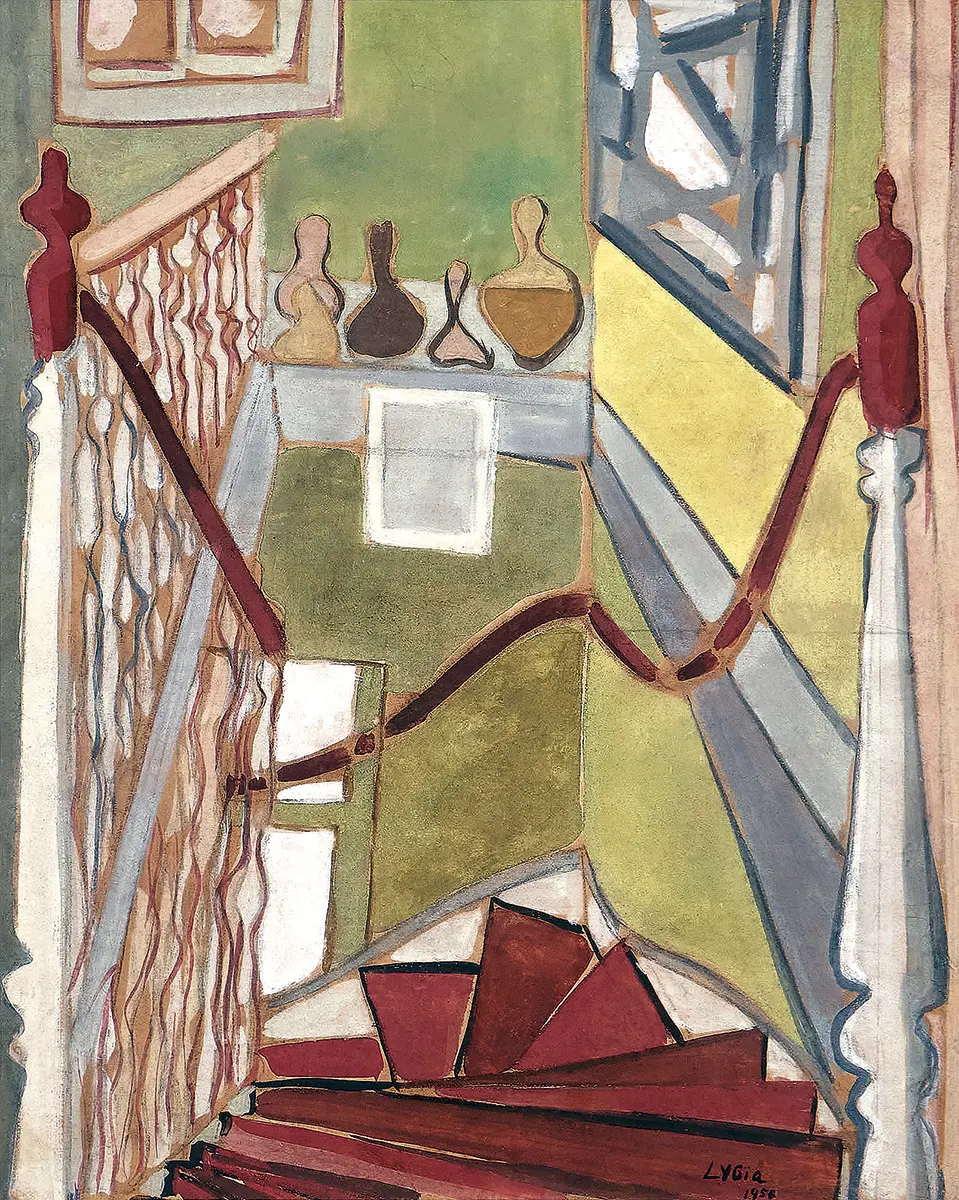
The early sections, between 1940 and 1950, feature formal works largely unknown to the general audience. Among the standouts are Retrato de Bertha Clark (Portrait of Bertha Clark,1943), a portrait of the artist’s sister in law in pastel on cardboard, recently discovered and certified by the Cultural Association that for the past 20 years has worked to preserve and revalue the collection. Dating from the same period is the series Escadas (Stairs, 1947-1051), where, as Lygia Clark declared, it was already possible to see the “unfolding of a bicho”, a “critter on the staircase”. In those early decades, it is interesting to see the web of relationships that Clark begins to establish between her studies, for example, with the Brazilian artist Burle Marx and the Frech painter Fernand Léger.
In the inquiry that followed, Clark investigated artistic problems, issues connected to the relationship between space and time, games of perception and reordering of planes. In a first moment of “parallel geometries”, those planes were overlaid, using transparency, as in Composição (Composition, 1952); she also produced Descoberta da linha orgânica (Discovery of the Organic Line, 1954), where she installed a question about “the meaning of the narrow crack between the canvas and that which was a frame”, and outlined her territory in the Concrete art space with Quebra da moldura (Breaking the Frame, 1954). the emergence of a new notion of the line, “constituted by space and by what constitutes space”, can also be seen here in works like Superficies moduladas (Modulated Surfaces, 1955-1957), Espaços modulados (Modulated Spaces, 1958-1959) and Contra-relevo (Counter-relief, 1958).
Worth highlighting in this chronology are two sets of works where the dialog with the exhibition design greatly enriched both the show and our understanding of Lygia Clark’s oeuvre. The first is the recreation of the iconic scene of the artist with her series Unidades (Units, 1 to 7), sitting on a chair designed by Abraham Palatnik, an image from the Neo-Concrete show at the Museu de Arte Moderna in Rio de Janeiro in 1959. The second is Guy Brett’s (1941-2021) collection of Bichos (1960-1964), never before seen in Brazil. Lygia Clark and the British critic became close friends during Clark’s solo show at Signals Gallery, in London, in 1965. The exhibition features one of the earliest “specimens”, still with a rigid structure, of a series that was essentially organic in character, as their name indicates, and which became mobile in its “spatial eclosion” to turn the viewer into the agent of the bicho.
The exhibition continues towards other domains in the career of Lygia Clark, who saw her production not as an oeuvre but as a proposal, and art itself as a way of life and a hybrid terrain for a poetic/clinical encounter. In the module devoted to the Objetos Relacionais (Relational Objects), visitors are brought into a universe where objects have no specificity in themselves, because their definitions come from their relationship to the subject and the emotional charge therein. Visitors see themselves then among the Rede de Elástico (Elastic Web, 1974), Diálogo de Mãos (Dialog of Hands, 1966), and O Eu e o Tu (Me or You, 1967). The latter consists of two monkeys intended to be dressed by a man and a woman, and for maning to emerge in that interaction, as well as the intention of an artist for whom “what is important is the act of doing in the present” and “the artist dissolves into the world”.