With ambitious commitment, the Museo de Arte Moderno de Bogotá presented the first museum solo show of artist Luz Lizarazo (Bogotá, 1966). Objects, drawings, paintings, installations, and an intervention on one of the museum’s external walls comprise the anthological project curated by Eugenio Viola. Its title, “Scars”, announces the presence of wounded bodies, exposed skin, vulnerable organs, powerful amulets, mythical forms and sewn surfaces. The entire show highlights the universe created by Lizarazo in the last twenty years. Enunciations about the feminine run through the works, which are as beautiful as they are terrifying. The ways in which the artist consolidates a mythology with hybrid forms that reveal the exuberance of nature and the vital force of wild females are impressive. In turn, this mythology constructs a framework between the past and the present.
The curatorial narrative was structured in five thematic instances: “Girls,” “Skin,” “Feminizing the Myth,” “Universe,” and “Cabinet of Curiosities.” In each section one could appreciate the artist’s use of diverse materials and techniques, her talent, and most importantly her consolidation of a poetics that unsettles normalized ideas about what it means to be a woman in our times. In the central text, Eugenio Viola explained that “Lizarazo has developed her own visual language to confront the systemic subjugation of the female voice and body, creating a space that recognizes and celebrates autonomy, sexuality, and female liberation”. This recognition was present in every room and visitors were faced with their own interpretations of the feminine, since Luz Lizarazo disrupts all representations and meanings. Her proposal goes beyond the purely physical to create an imaginary world that paradoxically points to reality precisely because fiction, even the most precious one, seems to immediately reveal the most disturbing truths.
Lizarazo generates fictions with symbols and figures that are, and are not, recognizable. We may see them in everyday life, but mostly in our dreams or in the magical and blood-curdling stories we listened to at home or read as children. That perverse game, which cannot be fully grasped, is what gives “Scars” its significance. Suddenly, a woman’s body with six tits appears; totems of female bodies; a ceramic head with what our grandmothers would call a “forked tongue;” a giant vulva where we could crawl into; crystal organs that exacerbate the fragility of our biology; bodies both monstrous and beautiful, part human and part animal; objects in cabinets, which seem to have been used in ancient times for erotic or witchcraft rites; the intimidating spring of a mattress hanging from the ceiling and interwoven with veiled stockings, evoking a body that has been tortured or loved. All of them, absolutely all of them, are powerful images charged with a critique of the containment of bodies, an apology to feminine bravery, a tribute to the bodies that rise up with all their wounds, to those women that resist even in the midst of the most unbearable darkness.
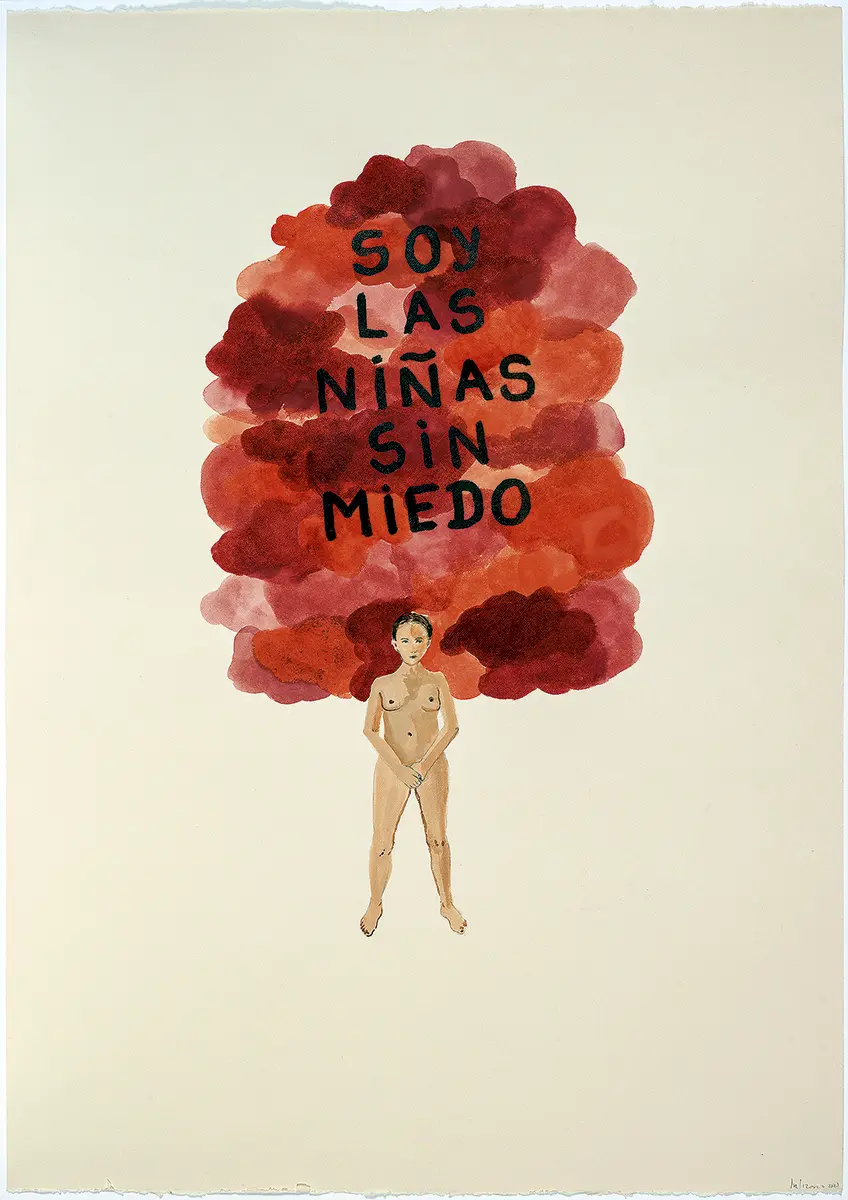
One of the most powerful works in “Scars” and which marked a turning point in Luz Lizarazo’s recent career, is Las niñas sin ejército (Girls without an Army, 2020), a drawing that openly denounces the sexual abuse of a girl by members of the Colombian army in June 2020. The image went viral as an icon of abuse against women and was one of the triggers for the creation of similar drawings in which she further sharpened her language against the vulnerability of certain lives. These works turned into a series where the phrase Girls without... are completed with words that account for other ways in which abuse is exerted on the female population. As a result, the artist and the curator decided to intervene an external wall of the museum with images of Girls without… The wall was papered in its entirety and on its surface the public expressed their ideas, disagreements, and even the most intimate grievances of abuse, mostly of a sexual nature. This intervention strengthened the contents of the exhibition and showed the need to create spaces for art to give a voice to those who are subjected to forms of power that violate their lives.