Like few artists in Colombia, Luis Ospina was interested in the creation of his own myth, in having part of his work be a tribute to himself and a few of his good friends. Ospina is renowned mainly for a handful of films, some of which have acquired cult status. Among them, Agarrando pueblo (Grabbing the People, 1977), which coined the term misery porn, so widespread today, and his film-testament Todo comenzó por el fin (It All began at the End, 2015), a long recap of his creative life and that of his dear friends, the filmmaker Carlos Mayolo and the writer Andrés Caicedo, with testimony of a prolonged hospitalization that almost did away with the artist. Less well known is the fact that, in order to survive in a country lacking a film industry, Ospina held throughout his life a variety of jobs, including working as an editor and a TV director. In Cali, towards the end of the last century, Ospina directed a series of documentaries that were broadcast on regional stations; these are a significant yet hard-to-find part of his oeuvre, to which we will return.
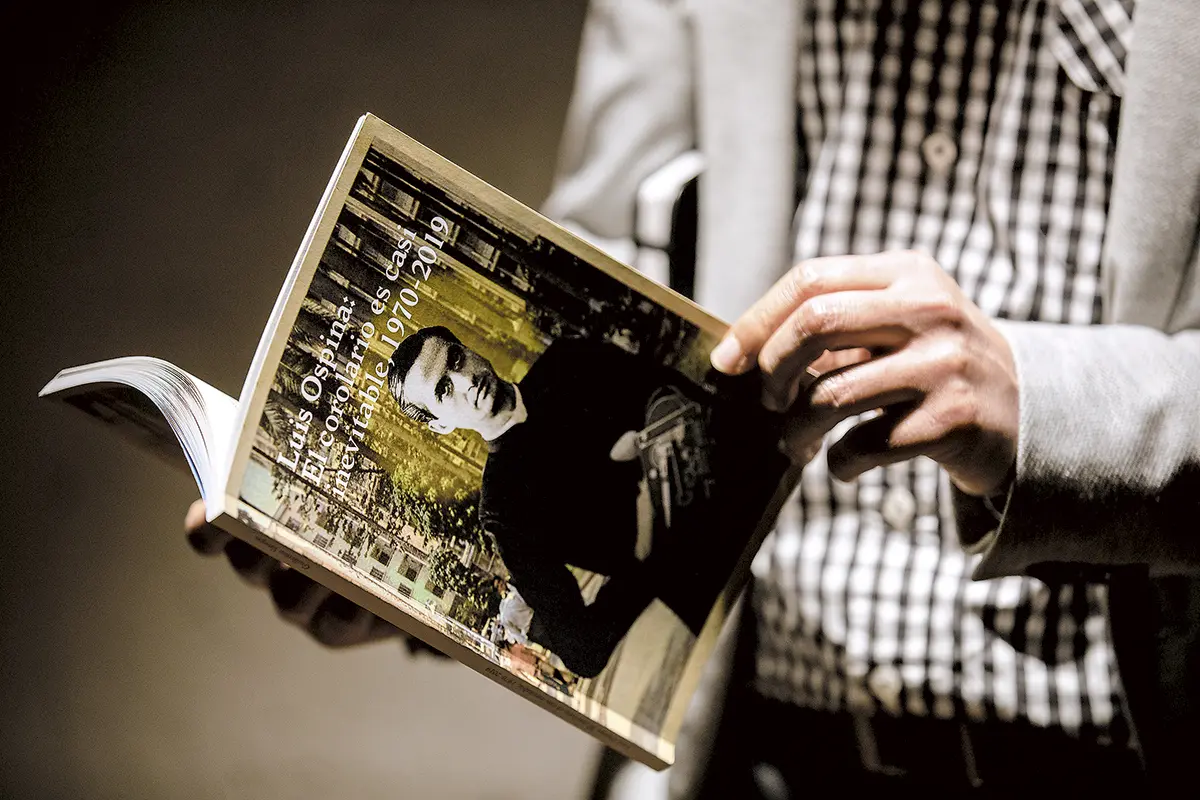
Before his death in 2019, Ospina gave curator and essayist Guillermo Vanegas access to his archive, allowing him to use a grant he had received on a historical curatorship of his entire oeuvre. As a result, in 2020 Vanegas published El corolario es casi inevitable (The Corollary is Almost Unavoidable), a methodological dissection of Ospina’s 50-year career. Adding to this book was a virtual curatorship, also the beneficiary of a grant, that presented part of Ospina’s body of work—in particular, the cultural TV documentaries mentioned above—but could only be seen for a limited period due, unfortunately, to copyright restrictions on the artist’s work.
The physical exhibition, initially programmed for 2020 and postponed due to the pandemic, reemerged a year later at the Jorge Tadeo Lozano University’s Visual Arts Museum, with the title of Luis Ospina: Collage postmoderno permanente, 1970-2019 (Luis Ospina: Permanent Postmodern Collage, 1970-2019). Organized in polyptychs, the exhibition attempted to categorize Ospina’s thinking as an author, and to that end Vanegas deployed segments of his works from the early 1970 to his final days, putting together student works, sections of his films—from a B-Series horror movie titled Pura sangre (Pure Blood) to his celebrated pseudo-documentary Un tigre de papel (A Paper Tiger)—and the already mentioned video explorations of Cali, among others. Structured as a systematic methodological investigation, presenting selected sequences in different monitors, the exhibition examined a personal style, pointing out main themes and also reiterations, tics, knowing winks, and above all—this seems to be what interested Vanegas the most—the way in which the filmmaker constructed his own personality as an artist from a young age. Notably, this is perhaps the first time in Colombia that a curator focuses his analytical, curatorial aesthetic investigation on a TV creator. Vanegas concentrated on those audiovisual productions that had been kept hidden in drawers, Ospina’s work in Cali in the 1990s, and was able to reveal the filmmaker to us as chronicler, ethnographer, and historian of his city.
There may or may not be much to say about Ospina—the corollary is almost inevitable—but this practical guide to his oeuvre, implicitly based on a recognition of TV as an artistic medium and on the salvage of the supposedly outmoded notion of style for the examination of an artist’s work, is as a whole a notable curatorial and research achievement, clearly prepared for the uninitiated, the youth who today have scant access to Ospina’s work and remain unaware of the myth of Ciudad solar and the Cali group (in essence, a generational myth.) In consequence, the exhibition, especially in its digital version, updated Ospina’s legacy to the heights—or the lows—of our immediacy-driven social media times.
On a personal note, I recommend listening to Ospina in Mi banda sonora (https://caracol.com.co/programa/2016/03/26/a_vivir_que_son_dos_dias/1459009639_643639.html) to enjoy his emotional and well-informed musical selection, and to read him in his compilation of good-humored, honest short texts and articles Palabras al viento: Mis sobras completas (Words to the Wind: My Complete Leftovers, 2011).