Lucía Pizzani, from Venezuela, moves with ease between artistic media, exploring diverse materials and processes that, in their various layers and meanings, account for situations and conditions shared between people, territories, and landscapes; those marked by a connected world, where visible routes operate as awnings for the invisible ones, which determine and infiltrate our daily lives. In her latest solo show at Cecilia Brunson Projects in London, she presented a selection of recent works that trace journeys between cultures and peoples through explorations with diverse materials, time, and collective and individual histories.
The starting point of the exhibition is London’s Tate Modern acquisition of two sets of works by Lucía Pizzani: Textiles (2013) and the “Impronta” series (2013), which entered the museum’s collection thanks to funds from the Latin American Acquisitions Committee by way of the Tate Americas Foundation. Textiles are meant to be female cocoons: chrysalis dresses that, when worn, are transformed into “textile sculptures,” according to the artist. From the “Impronta” (Imprint) series, five wet collodion plates were acquired: Black, Julia 1, Annie, Duo, and Reverse, which show women wearing these cocoons. The works were made for the twelfth edition of Sala Mendoza Foundation’s Eugenio Mendoza Award, which the artist received in 2013 in recognition for her piece De la desconocida del Sena y otras Ofelias (Of the Seine’s Unknown Woman and other Ophelias). Lucía Pizzani has created fictional scenarios where temporality becomes elusive and volatile, and where multiple entry points open up and appeal to personal stories that are also collective.
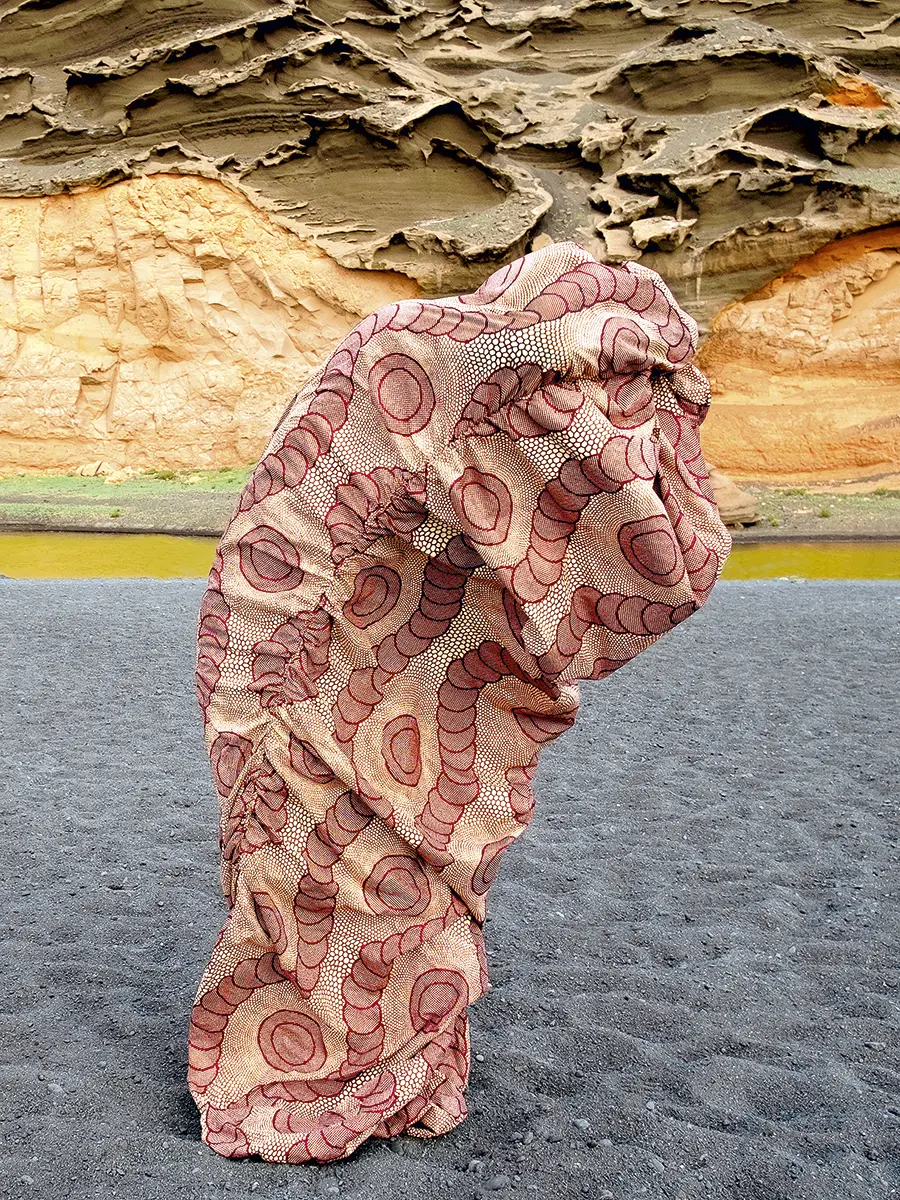
In the exhibition at Cecilia Brunson Projects, the artist showed some of the works she has been developing in recent years, which weave together and build stories around the world we inhabit. For the series of photographs titled Cáscaras Lava (Lava shells, 2015), she worked with the same fabrics as her Textiles (2013), made with materials taken from the volcanic landscape of Timanfaya National Park in Lanzarote. Some of her most recent pieces are the result of her 2021 artistic residence at Casa Wabi, in Oaxaca, Mexico. There she worked with the local flora and its environment; she researched, observed, and explored medicinal and nutritional plants, as well as seeds, branches, leaves, and fragments of plants used to create a series of ceramic pieces, which are now permanently installed in the Botanical Garden of Puerto Escondido. In this exploration, gourds became a significant element, as can be seen in the “Presencia” (Presence) and “Solares” (Sites) series made for the 2021 summer solstice and where she explores the effects of the sun on cotton paper. Through the use of photochromic ink applied to the paper, along with carefully arranged gourds, she created Guaja Mask (2021), where sun and time have delivered delicate and suggestive images. Areas exposed to the sun show the darkest tones and those that blocked it show the lightest tones, evidencing the presence and absence of the gourds on the paper.
The diversity of materials is a constant in the pieces of this show and in all of Pizzani’s work, as evidenced both by her processes and their final results. Among these, ceramics occupy a leading role, especially manifest in some of the pieces exhibited in a vitrine at the end of the show, and in Escritura (Writing, 2020), made up of twenty-four pieces of black stoneware. With the use of this material, routes and transformations are brought again to the fore. Each piece was made with an English clay containing iron and its patterns imprinted with Mexican dried corn.
Lastly, in this vitrine there were also several objects of research, enabling the spectator to better understand this artist’s meticulous working processes. Among them: ceramic pieces with tabachin and parota gourds on amate paper, terracotta masks, and a fragment of a snakeskin membrane. Thus, through transferences, conveyances, fluid movements, traces, and signs, this selection of artworks traced itineraries between cities, landscapes, territories, and cultures to evoke our present condition.