Evolving in a universe of itineraries already baptized by conceptual art and of motives raised by other conquerors,1 since the mid-2000s Lourival Cuquinha has geared his art towards an intimate relationship with money. The recurring use of this material gives us certain warnings. He proposes, on the one hand, that we are subject to a global world with its irrational logic of late capitalism, and on the other hand he seeks to unravel it by opting for a controversial field.2 In “Crapulocracia” (Debaucherocracy), his first solo at the Central Gallery, accompanied by a text by Pollyana Quintela, the artist delights in stressing and expanding the revolutionary albeit retrograde field of capital.
At the very entrance one catches a glimpse of the work that gives the exhibition its title:3 a sonorous word made up of debauchery and democracy. This wordplay has a chromatic parallel: green neon (symbolizing the dollar) for the upper part and black oil extract for the lower part. Aside from his political ideas, he’s also declaring his natural vocation for the poem-object.4
This is how we begin to discover a vast production process with subversive tendencies, where the social dimension is tangential and juxtaposed. He also replaces the usual materials—cloth, inks, or clay—for money in its most literal and common sense: coins, banknotes, textured paper for checks, cartographies made up of receipts... And he presents them in a gradient of uses: the actions of a stock market, the video of an ATM robbery (composed of a recording found on the internet, in the objet trouvé style), and even the recreation of counterfeiting methods as themes for his works.
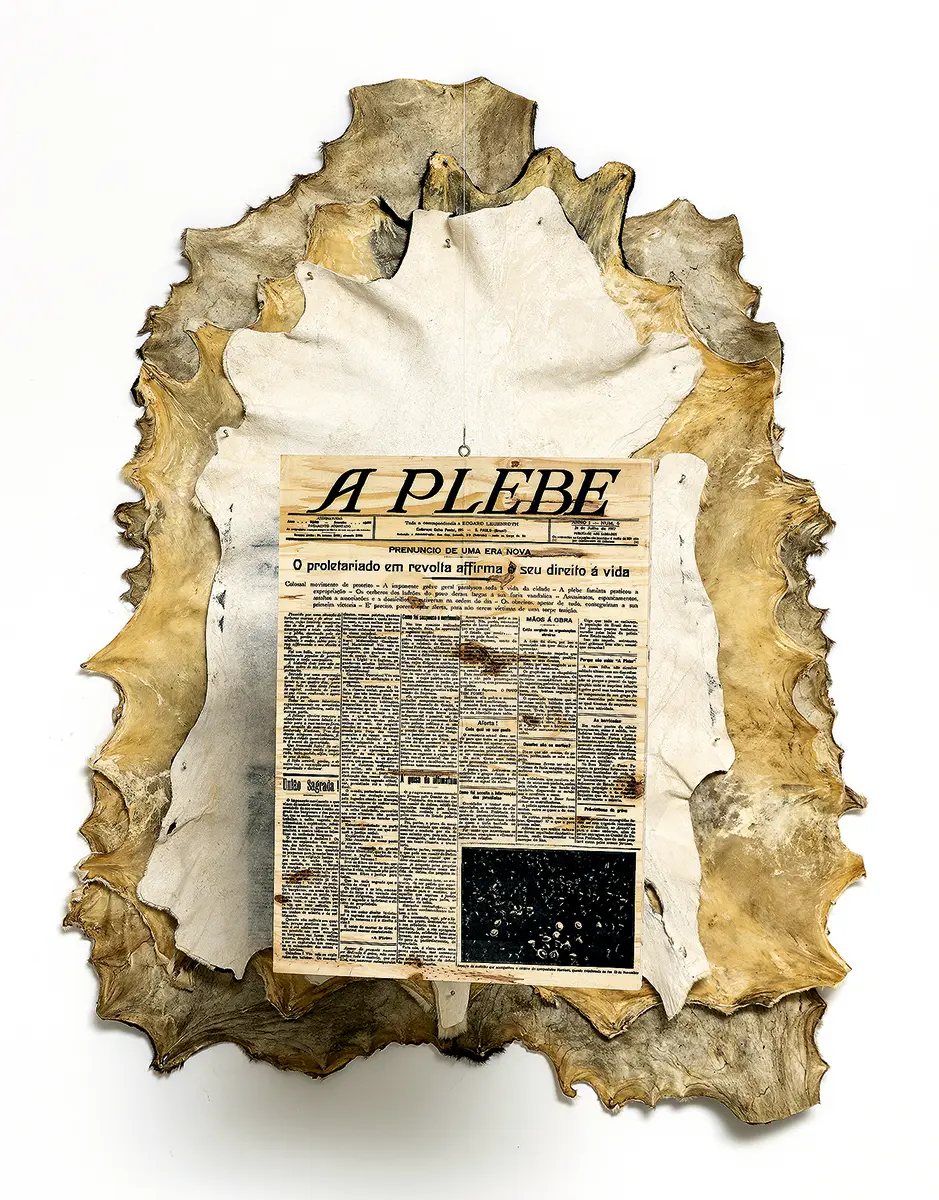
In this regard, he conceived Apólese do Apocalypse (Apocalypse Policy, 2018-2021), for which he transcribed, on check-writing paper, the letter by Pedro Vaz de Caminha, the scribe at the service of the discoverer of Brazil in the fifteenth century, considered “the country’s first document.” Here he shows us an effective result of grilagem, the term in Portuguese jargon for the artificial aging or falsification of documents, especially deeds of sale and properties. It is worth mentioning that the same letter in a previous work was exhibited inside an antique display cabinet to show how live crickets (grilos) eat away at the paper.5 In “Crapulocracia,” the document is now framed with the solemnity of a collectible object, not without commenting on the malevolence and subtlety with which the imperial governments proceeded to extirpate the country’s riches since the very beginning of the colonization era. The artist invites the public to illuminate each sheet with a black flashlight placed on one side of the work, and to examine the document with its meticulous calligraphy, in the manner of the 16th century.
There is also the environmental issue. Protesting against the recent fires in the Amazon, he employed ashes collected from devastated forests of this ecosystem as the substance for his sculptures and displaying them within a large glass inspired, as Quintela points out, by the cylindrical containers known as Petri dishes, where microbiologists analyze samples of small organisms. Here, the plates are supported by X-shaped legs that allow the viewer to rotate and analyze them as a scientist would. Already in 2016, the artist had used a similar format for a sculpture made with the toxic mud that, during an avalanche, the Vale mineral extraction company had allowed to spill into one of the most important rivers in the Minas Gerais region, spreading to the coast and causing enormous contamination both in freshwater hydric ecosystems and in the oceanic mantle.
It is not difficult to decipher Cuquinha’s works through their symbols and tropes. They are far from being mere images, however. They are complex productions that always refer to very current affairs, with their instruction maps, expanding their spectrum as a zone of interactivity.
NOTES
1. “See the “Zero Dollar” series (1974-1984) by his predecessor Cildo Meireles.
2. A field he launched perhaps with a reference to Das Kapital (Karl Marx, 1867).
3. The third of a trilogy of exhibitions dedicated to the theme of democracy.
4. This typology was first coined decades ago by the members of the Noigandres group (São Paulo, 1952), Haroldo and Augusto de Campos, and Décio Pignatari.
5. The piece in homage to the grilagem process was presented at the trilogy’s previous exhibition in a version like the one described here.