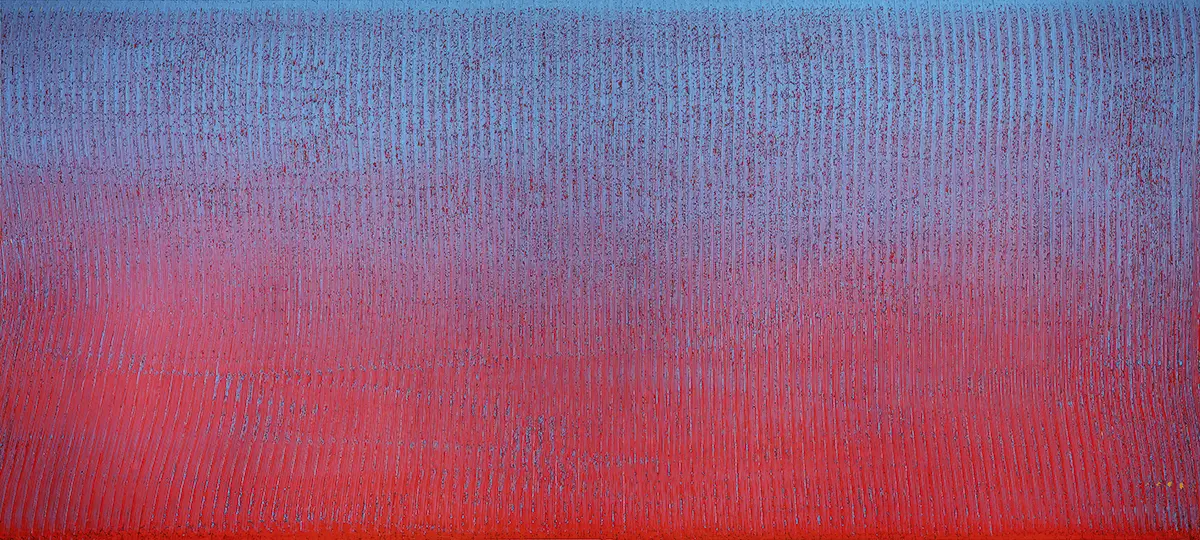
The exhibition Loriel Beltrán: Constructed Color, curated by Rina Carvajal, presents eight paintings made by the artist between 2018 and 2021. Constructed with bands of dry paint arranged horizontally or vertically on large flat supports, the pieces suggest structures, assemblages, or stacked objects in which color and line play a fundamental role.
Loriel Beltrán was born in Caracas, Venezuela, and moved to Miami, Florida, at fifteen. After graduating from Design and Architecture Senior High, he attended New World School of the Arts in Miami, where he earned a Bachelor of Fine Arts with a major in Electronic Media and a minor in Art History. While a student, he developed his technique almost by accident. At that time, he created objects from the overlapping layers of paint, which he chipped to obtain what he calls a “historical painting.” As he recalls, “back then, the objects had neutral tones, brown or beige, as they were made with paints that I found in dumpsters or samples that I obtained for free.”1
As an immigrant, Beltrán tried to situate himself in a new context. Miami was very different from Caracas, and his artistic exploration was directly related to that personal story he intended to narrate through his work. The objects made with layers of paint constituted his starting point, a grounded pole from which he began to develop it. He initially used small-format molds that he cut to bring the layers of color to a flat surface. In the same way, he experimented by dipping different elements in paint, including branches and fruits, which, when cut crosswise, allowed a glimpse of the different layers of color, generating sculptural objects. He eventually concentrated on bringing the layers to a flat surface by manually cutting the paint blocks.
As he worked on larger formats, he encountered technical limitations. He tried using turkey knives, ham slicers, and special saw blades but only managed to ruin the material. For that reason, he stopped doing this type of work for a while and dedicated himself to exploring other ideas and carrying out different projects. After moving his studio to the industrial zone of Hialeah in 2016, he got someone to make him the right equipment to cut the large blocks of paint that he had saved for years. Since then, he has created works following the process that he describes as follows: “I start with sketches of color ideas and a rough format of the works I want to make. Then I make rectangular molds into which I start pouring the paint, layer by layer. I pour in one color and let it dry for about two or three days before adding the next color. I repeat this process for a few months until the mold is filled. I take the block of paint out of the mold and install it on a cutter with a guide for a guillotine blade pulled from a hoist, while the paint is held by a pressing system of car jacks welded onto a steel plate. The paint comes out in strips which I glue onto wooden panels.”2
The complexity of the works goes beyond the technique and the time invested in their realization. Once the bands of paint are arranged on the surface, spaces of tension generated by the combination of colors can be seen. For example, by using contrasting tones such as blue and orange, a neutral field is created that shows how color is ephemeral and clearly structural in the case of these paintings. On the other hand, the combination of the strips and the selection of tones generate an optical effect in which the viewer participates. The work changes according to the perception of the person who observes it, if he stops in front of it, or if he walks around it.
The paintings’ optical effect and participatory nature recall the works of Jesús Soto and Carlos Cruz-Diez. However, according to Beltrán, it is essential to remember that these artists worked in a utopian and optimistic moment, experimenting with industrial materials and rejecting the past in their search for new modern methods. His approach is different. Not only does he see history as a repository of ideas, materials, and references, but he also produces an organic work that relates to Gego’s. Just as she makes the line tangible in works like Reticulárea (1969-1982) and Dibujos sin papel (Drawings without Paper, 1976-1987), he makes color tangible in his paintings. On the other hand, he is aware of the influence of North American artists such as Jackson Pollock, Mark Rothko, and Minimalism in general, fundamental in the history of art in the United States. However, it is the legacy of constructivism and its drive to conceive a vision in terms of the object and the object in visual terms that this show aims to review and redirect. According to Beltrán, “color oscillates here between a ‘mediated’ or visual state and a ‘primary’ or physical state; the constructed color asserts itself both as an optical event and as a structured material that can only belong to the realm of things.”3
NOTES
1. Loriel Beltrán, conversation with the author, Miami, 9 January 2022.
2. Loriel Beltrán, cited in Museum of Art and Design @ MDC, 2021, Loriel Beltrán: Constructed Color [pamphlet].
3. Ibid.