The lifestyles pervading contemporary societies were made possible, to a large degree, only by ever-expanding technological advances. technology, evolved in principle to reduce the need for physical exertion, increase utility, and distribute information and consumer goods, is nevertheless also the cause of many of the problems we face today, both locally and globally. From the climate change now threatening the very survival of the human species, to the phenomenon of liquid relationships that render feelings eminently fleeting, the contemporary world is witness to the pain and the delight of an existence filled with possibilities and effects, the most notable of which are the split between humanity and nature, and the distance between people, deceptively connected. A world that seeks to mask discrepancies, and only ends embodying the paradoxes of that which we call civilization.
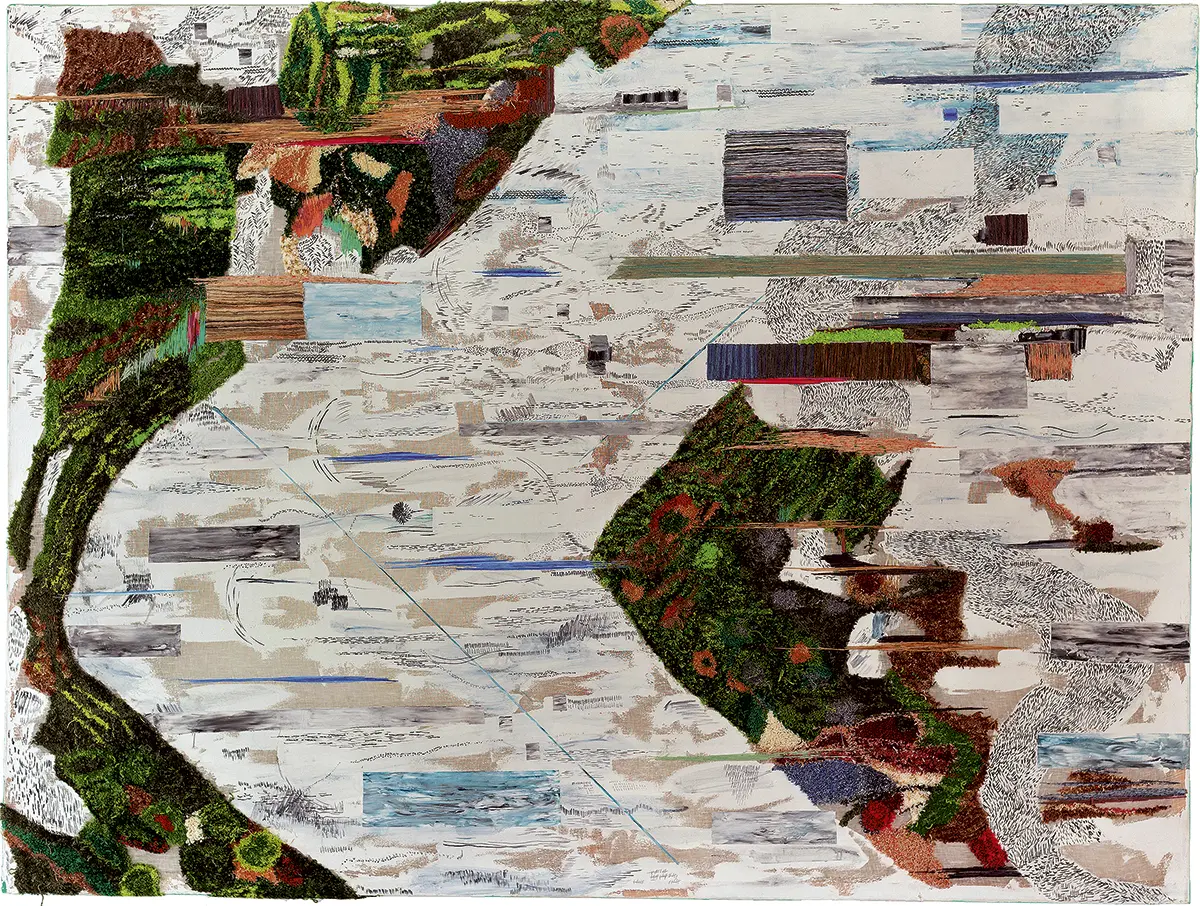
The Brazilian-based Italian artist Laura Villarosa trains a panoramic gaze on that scene of dissociation. She chooses the landscape for her topic without alighting on any one in particular; rather, she treats each more like a general perception than a specific place, even if her toned-down palette suggests a European setting, or at least a non-tropical one. The titles of her works refer to nature with words like wind, sky, or river, yet they keep open the question of whether the allusion is to a real spot or to a dreamed, or even desired, landscape.
The thinking behind Villarosa’s compositions follows a method aligned with painting, privileging concentrations of color and lines organized in horizontal sections, in a kind of figuration that is more suggested than determinative. The calm that these imagined landscapes possess counteracts the whirlwind of dangers and imbalances that characterize the contemporary world Time also appears undetermined, making it impossible to know whether these are remembrances of the past of possibilities for the future. No animal or human form inhabits Villarosa’s compositions, which imbues them with a tone between melancholy and serenity. In Jardim no céu rosado (Garden in the Pink Sky, 2021), for example, we can infer a garden only from the title, since the group of more “solid” shapes appears to hover over a diaphanous zone, or even to float above a body of water, instead of settling on the ground. The same semi-transparent texture is applied to the bottom part of the sky of the title, letting us see the white base on which the composition rests. The canvas is loosely attached to the frame, giving the work an element of motion and lightness; meanwhile, the threads that hang loose from the embroidered shapes have little in common with conventional representations of foliage or flowers, and actually resemble rocks. A fictional garden enveloped in an atmosphere of uninhabited silence, which could indistinctly be an idyllic spot and a post-apocalyptic scene.
Other landscapes also come across as undefinable, at the edge of abstraction, as in Céu rosado (Pink Sky, 2021), or play with image and meaning, as in Paisagem com mato (Landscape with Bushes, 2021), where a rectangle of embroidered lines is placed on a linen surface dominated by white brushstrokes and subtle tracings, like an inverted window.
It is important to note the materials and techniques chosen by Laura Villarosa, linen, cotton, and tulle, used as surfaces integrated into the work as compositional elements, with exposed areas that reveal the artist’s disposition to reveal her materials. Villarosa organizes the elements on that basis, combining paint (mainly watercolors and acrylics), embroidery, and knitting. The latter techniques are traditionally associated with women all around the world, adding an additional layer of meaning to the work as they bring into it the universe of the household (generally connected to the female domain) and debates about the boundaries between low and high culture, handcrafts and art. As a whole, the selection of works on exhibit operates as expanded painting; at times, artisanal materials are employed in the logic of painting, and at times, painting materials are employed in the logic of handcrafts. On occasion, lines and yarn form a color mass, and the brush is frequently used to trace lines that could be traced using thread. This appreciation for handcrafts can be read as the recovery of a decelerated time, a repertoire of practices that demand dedication and patience, as well as respect for ancient knowledges transmitted across generations. In response to the acceleration of life, Laura Villarosa’s work provide an opportunity for contemplation.