
Two Mexican artists, Francisca Rivero-Lake Cortina (Mexico City, 1973) and Carla Verea Hernández (Mexico City 1978), presented their first exhibition in Paris, titled Argent (Silver), at the Bendana Pinel Contemporary Art Gallery.
Lake Verea, a conflation of their last names, brings together two basic principles: creation and originality. The duo promotes the production of meaning, the emotion of the operator in restoration, and the physical relationship in the process as performance.
Advanced contemporary societies are characterized by their consumption of images rather than beliefs, as in previous eras, says Roland Barthes in Camera Lucida.
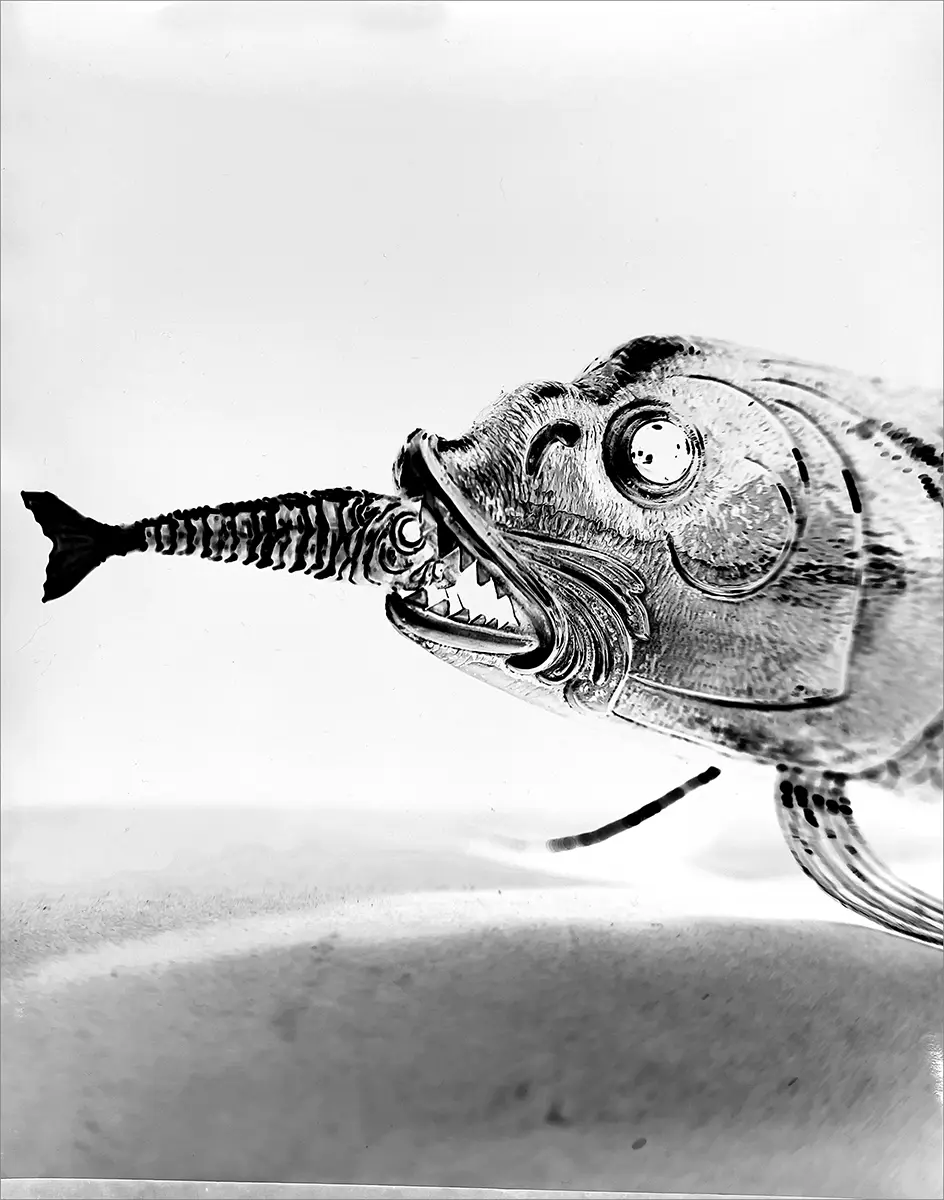
Today, both artists prefer cameras with outstanding optics and options that add flexibility, over cameras intended for the mass market, where practice is governed by electronics, curtailing unpredictability. Advanced society and artisanal production are as opposed as authenticity and falsity in belief. For that reason, focusing on the process that produces the artwork in order to achieve the visual communication it intends establishes a balance between technique and visuality.
The ancestral tradition of metalsmithing, silver utensils and objects, the hybridization of the Colonial era, and the resurrection of an artisanal practice and meaning or photography, are all expressed in this series, considered as aspects that make it possible to represent and characterize contemporary society and historical past.
A personal and a collective history are conjoined in the selection of objects. The period of reflection encompasses the 2020-21 interval, which prompted a climate of introspection. Thus instituted, the process is part of the visual reference, allowing the work to reveal information and generate emotions. The object and its image can be used as a research and documentation instrument in a social context. Photography becomes one of the culture’s essential elements.
The duo chose objects dating from the Eighteen Century to today, for the most part Mexican silver, on the basis of their own relationship to them. The photographs in this show are the first Lake Verea have captured using a refurbished Nineteenth Century camera.
The future of this art, in terms of the use of light and its contrasts, perpetuates the legacy of the Baroque. Adding to this is the history of the objects as such. In their medium dimensions, the unique items surpass the appeal they produce. Lautréamont’s poetics, which alludes to the presence of two or more antagonistic or separated worlds, is also thrown into the mix.
We are now in the vicinity of Caravaggio’s or Turner’s thought in connection to the object, its representation, and its revalorization. Another Baroque contrast of light and shadow is produced in the result. As if a complex Sixteenth- or Eighteenth-Century painting had been broken apart into fragments, we encounter details of light and shadow, positive and negative.
Lake Verea’s work originates in an almost theatrical action, a performance with stage-designed content. The shots in the original video show a prefabricated environment, almost a virtual reality. The camera obscura, doubly amplified in the photographic studio by the physicochemical contact between the object, the light, and the photosensitive paper. It is by means of the videos on the screen that the requirements of technique and presence are brought together. The atelier is also an extension of the camera obscura, and both artists are in a work session in front of the fetish object, stage symbol, chronometer in hand, demonstrating that this solid, personal selection of works is the result of a process. While performance in general moves towards the disappearance of the object, in this proposal both the stage and the action converge towards construction and representation. Viewer identification is prompted by filmic experience.
Discovered in an antique shop in Mexico City in 207, a “mammoth camera”, as the artists perspicaciously call their outsize Nineteenth-Century device, made of ground glass and outfitted with an apertureless brassware lens, was painstakingly restored, and in that way a discarded object became the scene main protagonist. Their previously proven experimental disposition and admiring attitude towards its mechanical precision and sharpness, drove them to manufacture the missing pieces and place a Linhof Master Technica 4x5 lens on the old housing.
Understanding the mechanics, aesthetics, and optical evolution of devices from the earliest days of photography is another one of Lake Verea’s objectives. Collecting, restoring, and using cameras from all eras has helped them formulate a theoretical discourse and a practice that results in some twenty works of art. Here the object-camera is also valorized as a conceptual result of technical expertise and imagination.
It is in the lived and shared intimacy of a dark room that the alchemy occurs; it is from the sensitive surface that the visible reemerges. The surrounding space, the dimension of the subject, are annihilated by each object’s reflecting nature. The resolution thus obtained, with a method whose basis and intention are artisanal, has surpassed in creativity the most technologically sophisticated device, and expresses what could be the indicia of a different archeology —a Twenty-First Century one.