It would be pointless to review the exhibition “The Sword and the Cross,” hosted by the Museo de Arte Español Enrique Larreta, without first addressing the space itself. The museum is part and parcel of the qualities to be analyzed since the show needed to establish a challenging bridge between a purely European heritage with a marked colonialist stamp and pieces by twenty-seven contemporary artists, all Argentinian and with an avowedly postcolonial frame of mind. In its website, the museum declares that its mission has remained the same since its foundation, on October 12, 1962: to defend, disseminate, and represent Spanish art, theatre, literature, and culture. Restored twice in recent years, it houses the collection of writer, diplomat, and collector Enrique Larreta, who sought to lay the foundations of Hispanic influence on Argentinian identity in his own home. It comprises religious and battle scenes, courtly paintings, weapons, tapestries, altarpieces, and furniture from Spain in the 16th to the 18th centuries, revealing the ideology associated with the Hispanic heritage and Christianity, and imposed since the beginning of the colonial period.
The exhibition, attended by a large number of visitors due to all manner of parallel activities since its inauguration, was conceived before the pandemic and proposed by Museo Larreta’s current director, Delfina Helguera. Well aware of the debate it would generate, she invited two external curators, Guadalupe Chirotarrab and Laura Códega, to prevent the personnel in charge of this heritage from having to deal with contemporary works that place a strain on the museum’s narrative. The outcome was very worthy and the reactions were all collaborative since the new readings activated in this process interacted with the objects in the rooms that are kept in the exact condition as the days when their owner lived in them. This game of contrasts tested the foundations of a widespread culture that has used images to “transmit moral foundations, sowing notions such as sacrifice, sin, guilt, and salvation, which in turn are still disputed by artworks,” as the wall text accurately stated.
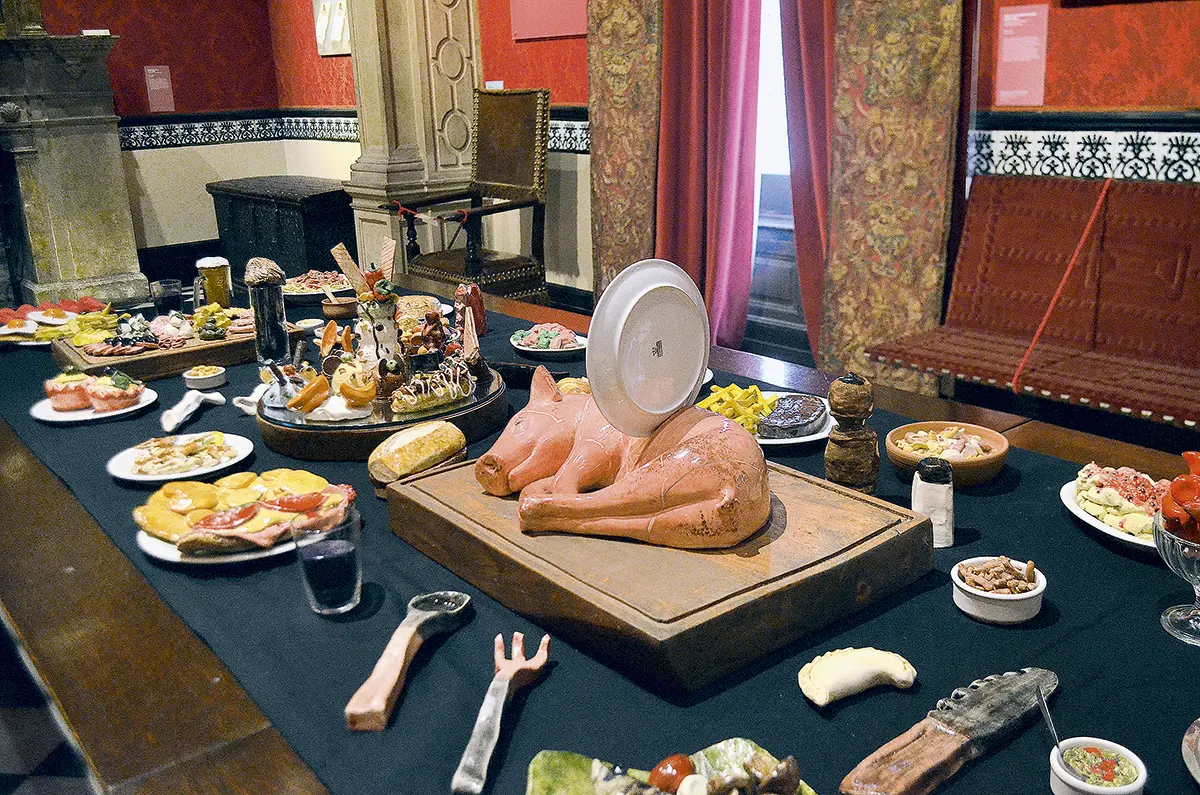
The curatorial proposal offered metaphors for certain axes that while focusing on self-referential visions, raised questions about changes in the uses of symbols, the structure of oppression, testimonies about guilt, violence against bodies, and desire. Produced from the 1960s to the present by artists of various generations and backgrounds, the 54 works were installed either in the heritage rooms, without imposing any major modifications, or in the temporary exhibition rooms with no traces from the past, in which case the main goal was to activate a series of counterpoints and coincidences between specific artworks. In other words, the original order and function of the heritage rooms was respected. For example, The Hardest Years, an installation by Nicolás Monti (1976), was placed on the large table of the dining room and consisted of a menu comprised of glazed ceramics and other materials. Although operating as a version of the Last Supper, the food displayed was typical of a local still life. As the caption acknowledged, “it fuses Amerindian and European cuisines, representing the hybridization of traditions.” In the central hall, Function, a large piece by Luciana Lamothe (1975), installed in the only space big enough to hold it, is a true war machine to be activated by hand. The barrenness of each one of its parts was set against the decorative profusion of the old hall: a strong metaphor for an omission so well constructed for centuries.
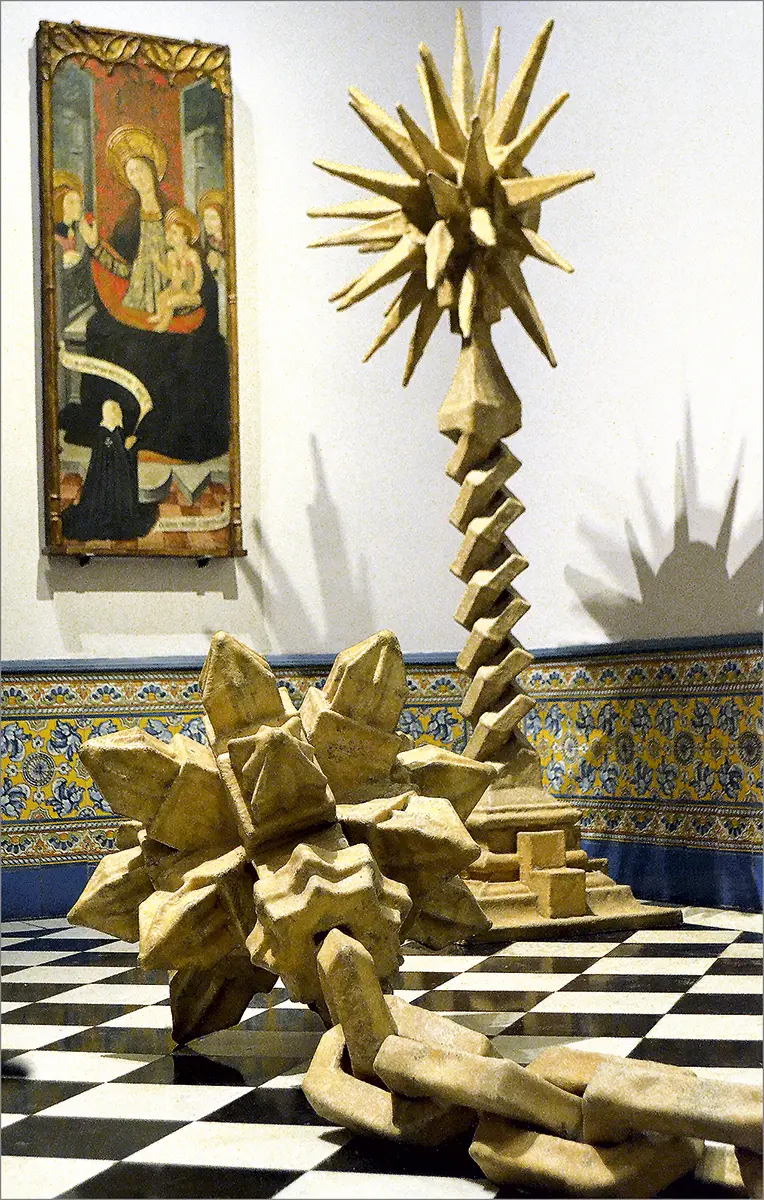
In the Oratory, a beautiful space with a checkerboard floor, the 17th-century altarpieces and the 16th-century Gobelins tapestry were curiously disrupted by two large sculptures by the recently deceased Norberto Gómez (1941-2021): Whip and Pyx, both made in 1984. It’s impossible not to associate them with medieval torture devices, although paradoxically they can also be perceived as liturgical instruments pointing to the dogmatism of evangelization, and yet Norberto simulated the hardness of the metal with resin and painted cardboard as a comment on falsehood. Two works were placed in the Zuleaga Desk Room, a charming and very well-preserved space. One was by Eugenia Calvo (Rosario, 1976), whose practice involves cancelling the utilitarian functions of furniture; the other one was El after del after (2020), a false altarpiece by Andrés Piña. Surrounded by colonial furniture with a profusion of decorative elements, Calvo’s metal structure shut down a small desk, and a three-level altarpiece by the young Piña depicted a story whose theme is an air disaster, with the cross re-signified.
In the corridor, an installation by Mariana Tellería (1979) featured pieces of frames arranged as crosses on a large wall; a delicate work by Pachi Giustinian (1981) was made with burnt powder as pigment; and Cristo en los enfermos (Christ Inside the Sick, 1993) by Santiago García Sáenz (1955-2006) paints a descriptive scene evoking the AIDS epidemic of the 1980s and early 1990s. Small works were interspersed here and there, such as Carola Beltrame’s (Tucumán, 1960) Polizeipistole-0497, a pistol replica made from a stone that is only found in Argentina: the pink rhodochrosite. Nearby and silhouetted in front of a large window, stood El atravesado (The Pierced Man) by Liliana Maresca (1951-1994), made of wood, bronze, and coral. The oneiric Bread with Knife by Fermín Eguía (1942), a four-legged bread traversed by a knife, is painted in fine detail. Associations between reconstructed remains are alluded to in works by Guillermo Iuso (1963), with the written phrase: How strong it makes me to reveal my weakness, shown alongside two large wooden altarpieces recreating scenes of the Virgin’s Assumption.
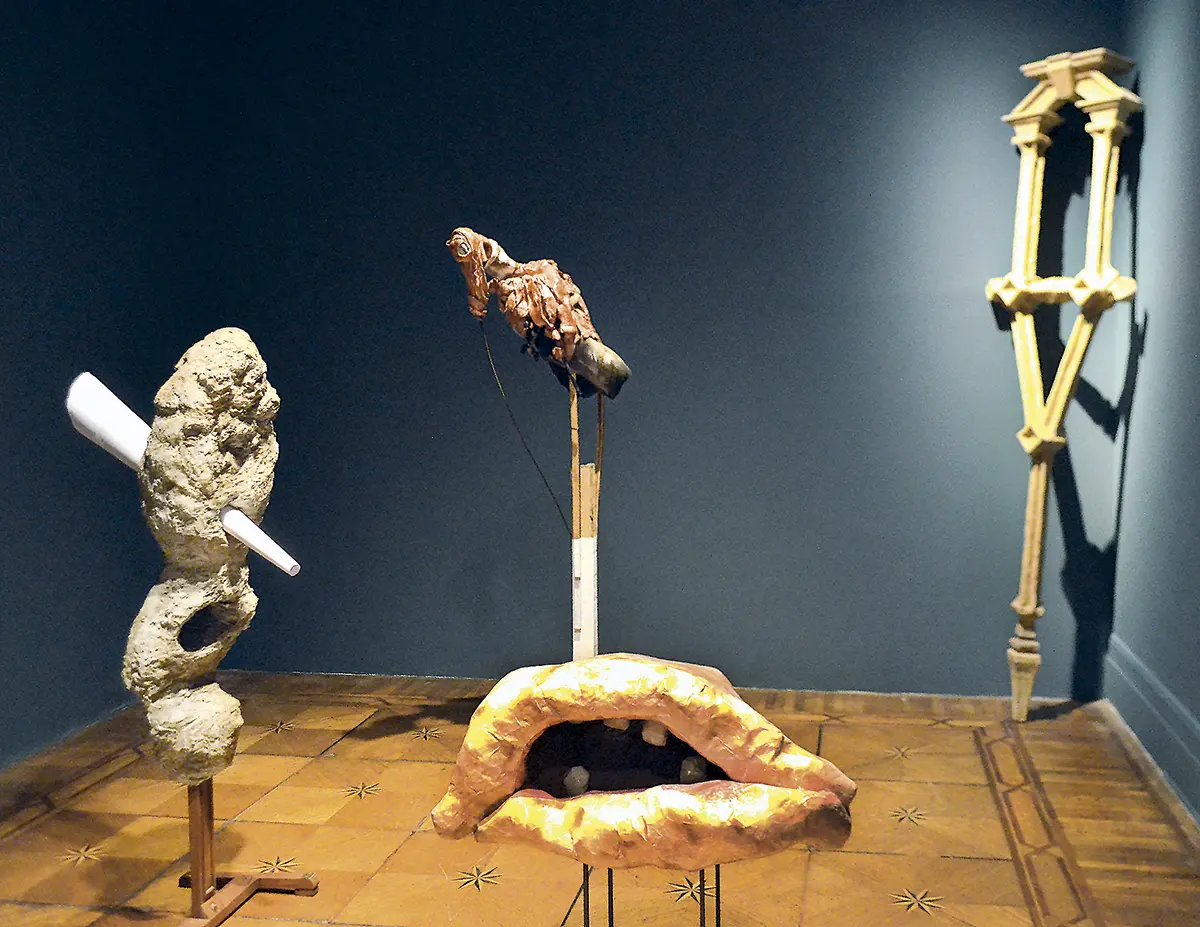
The physical body as a potential source of pleasure and pain, and the vulnerability of the flesh had an interesting exposure in one of the rooms arranged as white cubes. A remarkable counterpoint was sparked between works by Florencia Rodríguez Giles (1978), Miguel Harte (1961), and Carlos Herrera (1976), who place stress on representation by diverse methods. Rodríguez authored a large drawing with a profusion of details from his “Biodélica” series (2018); Harte’s Masa cerebral (Brain mass, 2013) is a three-dimensional work of pastel colors evidencing the destroyed functions of a softened brain; and Herrera’s He slept like the dead and woke up hungry, from his series “Lo infiel” (Infidelity, 2019-2020), dematerializes a bed and a possible body until both reverberate in the faint shadow on the wall where the work was hanging. The climax rose towards the end of the exhibition: where the bedroom once stood, also empty of furniture, works by three artists from different generations were placed together: an extravagant mouth isolated from its body, by Josefina Labourt (1985), and sinuous mixtures loaded with disrupted, magical meanings around the concept of human waste, by Diego Bianchi (1969), established a powerful dialogue with Crutch, Norberto Gómez’s beautiful piece whose materiality suggests the texture of bones, but whose form may be a metonymy for a classical column.
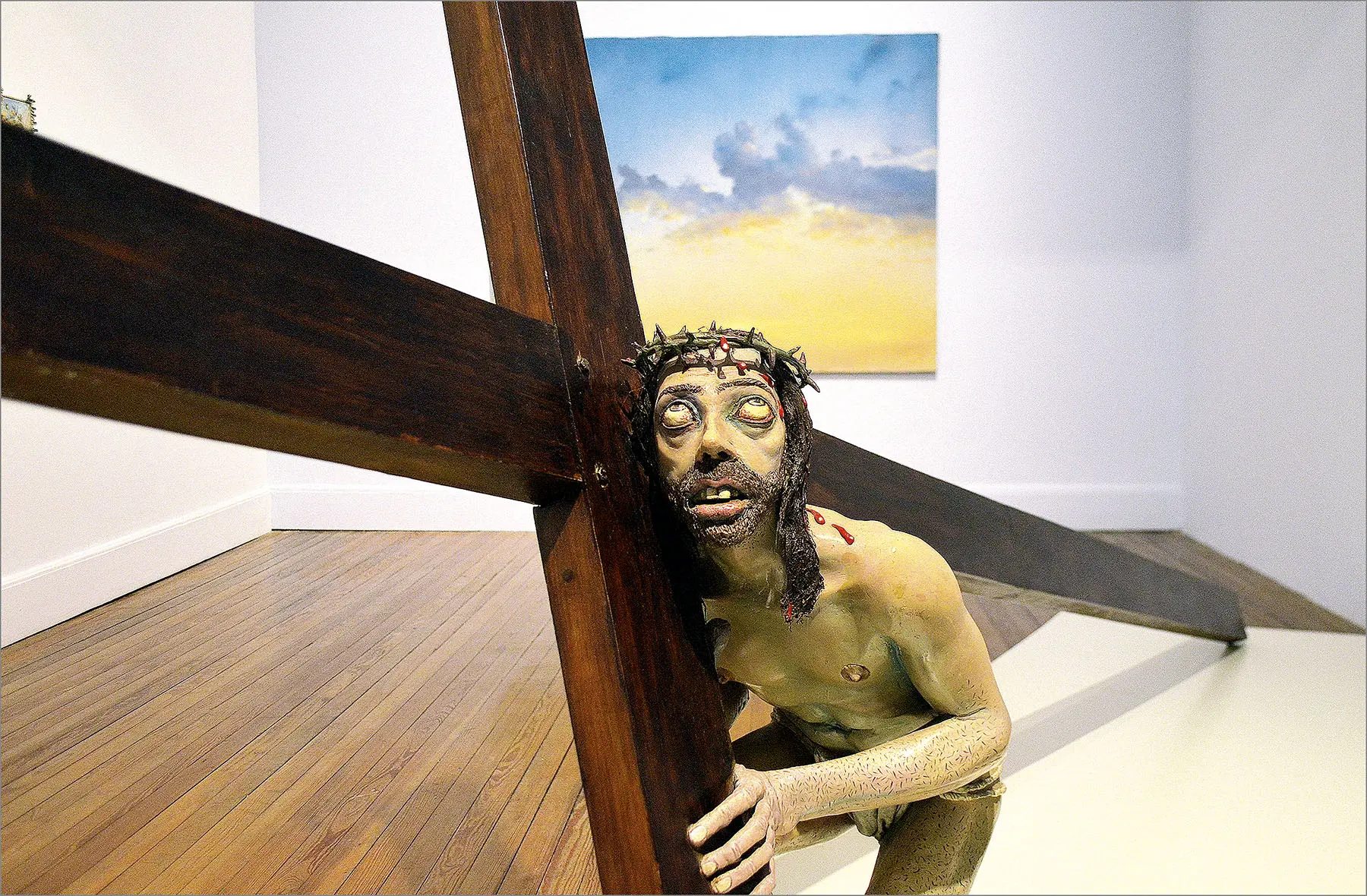
The Son of Man, the worldly and cartoonish Christ by Pablo Suárez (1937-2006), evokes baroque religious carvings kneeling under the weight of a large cross and following a seemingly irrevocable path, naked and somber in the face of a painful world. On one of the walls, a succession of small paintings by Guzmán Paz (1988) narrate scenes that may be interpreted as biblical stories from the stations of the Cross which can be found in church naves, but with an updated repertoire and a touch of kitsch. The sky painted by Oscar Bony (1941-2002) in a hyperrealistic key serves as a promise of salvation—a recurring idea in Christian dogma—and also provides an assuaging escape from an atmosphere of great drama.
* Photo: Leandro López. Courtesy Museo de Arte Español Enrique Larreta.