The art of Julio Larraz (b. Havana, Cuba, 1944) spans over six decades and is recognized for its unique subject matter, mastery of a meticulous technique, and poetic content. In his first retrospective exhibition in the United States, a chronological order traces his career beginning in New York, as a caricaturist for major newspapers in the complex social and political period of the sixties, through a practice that includes drawings, paintings, and sculptures made in New Mexico, Paris, Florence, and Miami, where he currently lives and works. In collaboration with the Julio Larraz Foundation and curated by Yuneikys Villalonga, the exhibition includes 85 paintings and drawings and ten sculptures that introduce key themes that have become familiar over the years. Arranged as a biographical narrative, the careful selection takes the viewer on an intellectual and aesthetic journey through time and place. The title of the exhibition: The Kingdom We Carry Inside, is an appropriate introduction to the artist’s conceptual, often surreal, inner vision that inspires the work.
Time is a constant in his work. Time stands still. Time is a mystery. Time is past, present, and future. In so many of his paintings, we are mesmerized by the details of familiar subjects: the lonely house, the moon, the sea, the people, and the object. What he does with his subjects removes them from the ordinary into a new dimension, often profound, always haunting. Created with the utmost attention to reality and painterly precision, every work demands careful analysis. Larraz is described as a master painter and works reminiscent of Goya and Rembrandt are showstoppers that demonstrate his prodigious talent, even before creating his more familiar themes. The character in The War, 1966, is an image worthy of a Baroque master. His admiration for Goya is still evident years later in Freedom Flight, 2021, with a migratory group floating over the land reminiscent of The Fates, 1820-23, from the Black Paintings that reminds us that migration, exile, and displacement are facts of life.
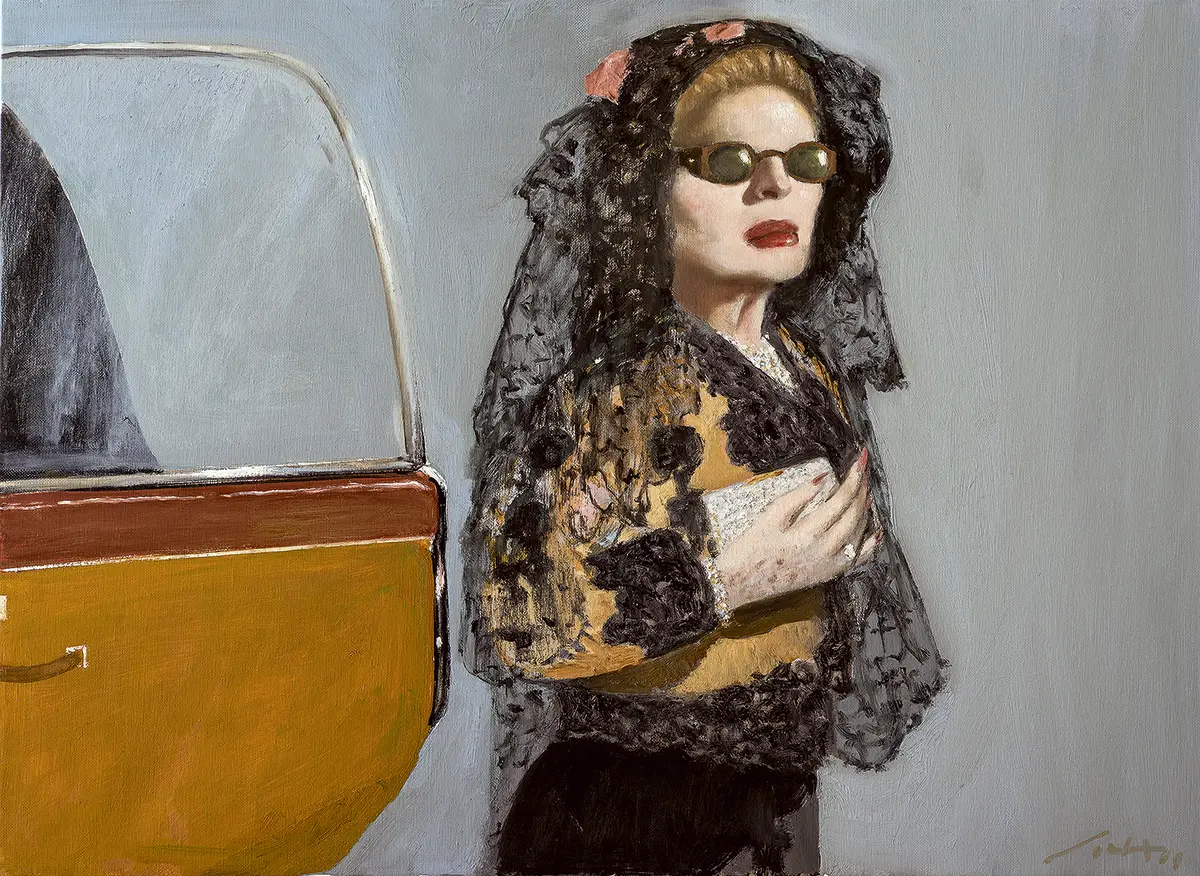
An impressive list of characters appears in the exhibition, from family to friends to political figures and the entirely imaginary composites that emerge from his unique personal and often humorous vision. One recognizes a hint of cynicism in works that display dictators and clergy flaunting their sense of authority, always with a sarcastic interplay among personalities and their surroundings. Juana Campamento is the madam of Havana’s infamous brothel, La Maestranza, where she presides in the work La Doyenne at La Maestranza, 2016. Larraz captures the severity of her posture and personality while also treating her role humorously. Part of the (fictional) decoration in her salon in Juana Campamento in the Blue Room, 2020, is a painting by Francis Bacon, an artist who he greatly admires. He also shows the madam brazenly approaching a church service, wearing a mantilla, the headdress of religious virtue, in Piety, 2018. The people he met over the years, or invented, often initiated ideas for works that strike us as remarkably believable or hopelessly false or surreal. In his imagination, The Lion Tamer, 1990, is in control, but lions do not have spots! Such tricks to subvert a message are typical. Like the magicians who frequent his visions, Larraz conjures up haunting vistas of land and sea. Throughout his life, Julio Larraz visited places that became part of his repertoire: deserts, mountains, endless horizons, and even fantastic views of outer space. From New York to New Mexico, to Paris, to Morocco, the people he met, heard of, or read about inspired him to create characters that, in his eyes, inhabit a parallel reality. In 1977, while in New Mexico, the famous “Roswell Incident,” an alleged human encounter with aliens that motivated stories and theories on extraterrestrial existence, was in the news. Larraz was intrigued with space, the moon, and the subject of alien abductions and included references to their presence, often subtle, in his visual vocabulary.
Sculptures can stem from a previous painting, or vice versa, as Larraz enjoys exploring the same subject matter in different mediums and from different perspectives for creative interpretations. From 1999 to 2005, the artist lived in Fiesole, Italy, and became involved with a foundry in Pietrasanta, with which he has continued to work. Although there are sculptures throughout the museum that play upon the elements of balance and distortion so important to still life painting, which he has also mastered in stunning works, the main gallery of the exhibition is dominated by a life-size bronze equestrian statue, Legend of the Hudson, 2007. The image of the Headless Horseman brings a smile and a fitting, often perplexing, ending to a remarkable visual experience.
A major publication accompanies the exhibition and includes an essay by David Ebony, which situates Larraz’s work within the contemporary avant-garde, with reproductions of 200 paintings, 50 works on paper, and ten sculptures for a comprehensive discussion of the artist’s accomplishments.