
The solo show “JAHD Throwback” in collaboration with Estrany-de la Mota Art Advisors, reviews a select group of pieces that José Antonio Hernández-Díez (Venezuela, 1964) conceived over two decades. Each one articulates a clear discourse that sharply and playfully condenses the notion of cycle. His various metaphors insist on the “condemnation” posed by the cyclical as an overriding force.
This retrospective show brings together photography, drawing, and sculpture as alternatives to the loop series that characterized his video works since the end of the 1980s. Hernández-Díez is part of the generation of heirs of Nam June Paik, who not only conceptually probed the repetitive means of communication, but also used the plasticity of the medium as a discursive tool.
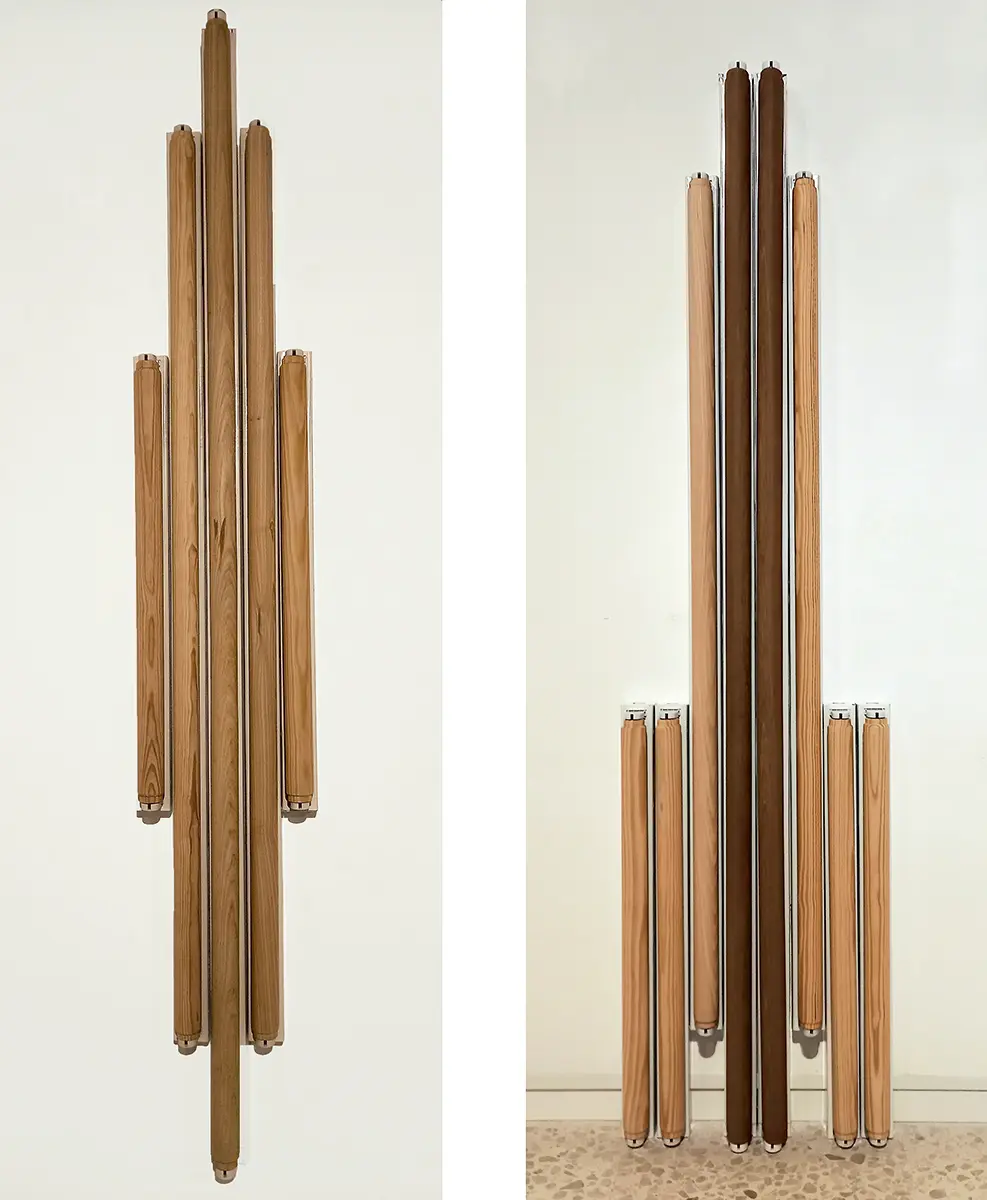
Hernández-Díez questions the futility of repetition ad nauseam and the subsequent consumption of “goods” or concepts; he opposes mass production and therefore subverts the cost-benefit logic. Proof of this is that “JAHD Throwback” is made up entirely of unique pieces, most of which required complicated industrial production methods. Let’s take, for example, the expensive mold he built in a workshop on the outskirts of Caracas to produce a few giant methacrylate nails. One of these, titled Un solo dedo (A Single Finger, 1998) was exhibited on sandpaper, ironically symbolizing everything superficial and disposable, and motivating us to reassess the concept of “single-use plastics” twenty-four years later.
Aware of the need to reflect on the impact of industrial processes that began more than two-and-a-half centuries ago, Hernández-Díez resorts to universal symbols such as the ouroboros: the snake that bites its own tail. The eternal cycle acquired mechanical connotations when vibrant and seductive snakes of all sizes and colors slithered through the gallery spaces, strangled bicycle wheels in Two Levels (2007) and My Last 360º (2007), or arranged themselves on an assembly line in Dynamic Team (2007).
Many works convey underlying ideas that the artist leaves to our free interpretation. The weight of the “era of mechanical reproduction” always remains implicit; an era where each individual is a node in the gear that articulates and imposes a great mass production and organization system at any cost.
With refined irony, Hernández-Díez radically reduced his famous skateboards, leaving only the ball bearings. In the series Le genou de Claire (Claire’s Knee, 2005), he dissects the concept of “gear,” a symbol of technological innovation. The assemblage shows bottles of industrial lubricant required to soften the friction caused by labor exploitation. Le genou de Claire is paradoxically made up of different digital prints intervened directly with graphite to turn them into unique pieces. The manufacturing of these parts does not appear to be a laborious task.
I find it interesting to link the photograph entitled Thinkers (Mao) (2000), which was part of this show, to the curatorial premise of “JAHD Throwback.” Logically, the pernicious and negligent industries “operated” by the most populous nation on the planet brought serious consequences during the Mao era (1949-1976). How contradictory that a power of such magnitude systematically manipulated demagogic policies that promoted new births (to obtain more labor in the name of the massive steel production, for example), only to later enforce strict policies of birth control. Mao’s deranged campaign of forced industrialization, inspired by the Soviet model, multiplied the hands that would work in the factories, but also the mouths to feed in the People’s Republic of China; and if one thing is certain, it is that people do not live on ideology or steel. The famine killed between 30 and 40 million peasants in rural areas (1959-1961) while the government decided to divert the scant harvested food to the main cities, and even export it.
With a large strangled spoon, titled Searching for Vice and Without Money (2000) the artist seems to be asking: Why make it this big if it can’t feed the masses? This piece narrates the fable of two brothers who used the spoon in different ways: one of them became a heroin addict; the other, Uri Geller, captured the attention of hundreds of viewers of his illusionist show when he bent the spoon with his mental powers in the 1970s. Hernández-Díez underlines how Geller became famous by repeating the same routine over and over again.
The First Time I Saw You (2004) is also noteworthy. The striking minimalist piece is made of aluminum, aseptic and cold in contrast to its content: the intimate eye contact between two people a few seconds before their paths branch off on opposite escalators. Hernández-Díez was inspired by the architecture of a well-known Caracas shopping mall and honored this instant in the cyclical movement of life.