Jorge Pedro Núñez belongs to the intermediate generation that traveled to complete their training outside the country. Born in Caracas in 1976 and living in Paris, after graduating from the École Nationale Supérieure des Arts in 2006 he began to participate in group and solo exhibitions in France, Switzerland, Korea, and Brazil, among other countries.
In 2011, he presented his first solo show, “Inevitable and Obvious”, at Periférico Caracas, curated by Jesús Fuenmayor. There he exhibited a body of works that he defined as “archetypes of déjà vu art; something already seen over and over again,” referring to the Venezuelan artistic context. Toying with abstraction, while humor and affection prevailed, Núñez alluded to famous works by Alejandro Otero, Nedo, and Duchamp, among others. The exhibition operated as a bridge between his country of origin and his artistic references. If the autonomy of art contemplates the rewriting of its history from a critical perspective, Núñez’s work makes its postulates visible by contrasting elements and by transferring the viewer’s attention to details that aim to exalt marginal narratives that are very distant from the prophetic purity of geometric abstractionism.
Throughout these years, Núñez has built a visual language in which this transgressive critique prevails as an alternative to the normative intentions of modern art, seen as a paradigm of the pro-development scheme and its orthogonal visuality.
He recently presented the solo show “Outside, the air had a liquid texture” at Carmen Araujo Arte, curated by Sandra Pinardi. Through the ten works on display, Núñez’s acumen and drive to maintain a tense relationship with the canon were evident.
The title of the exhibition, he tells us, refers “to a heavy climate, with a dense, polluted and, at the same time, fluid atmosphere. A personal physical sensation of the pandemic that influenced the making of these pieces and accentuates the idea of landscape present in them”. And he adds: “I have always had an interest in painting, but with a critical and physical distance; in these works, a pictorial activity relates to workshop experiments with liquid materials that also belong to sculpture”. Núñez is referring to how the drippings and brush strokes of the Playones, which seem improvised and carefree, are in fact part of a long fabrication process of molds and castings.
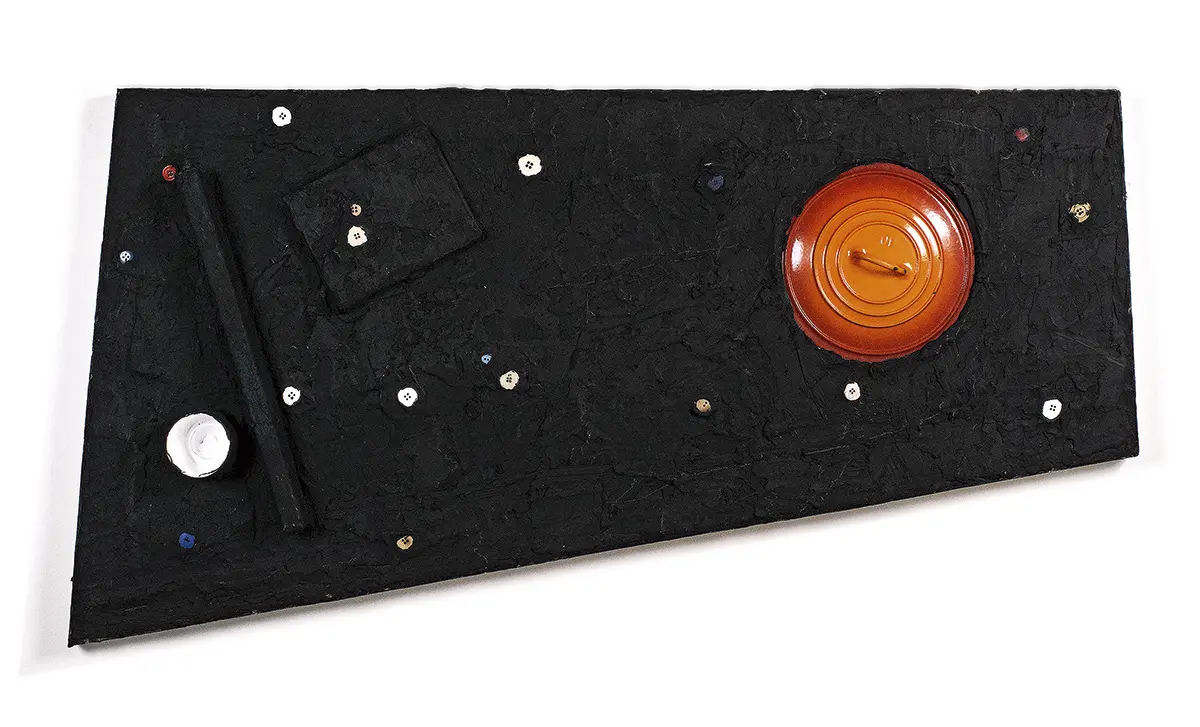
Magnetic field I and II are much bigger and therefore project a stronger presence in the exhibition space. A relationship with Russian Constructivism is immediately apparent, specifically with Malevich’s 1915 Black Square, and also with the installation images that accompanied Rodchenko’s 1920 essay Everything Is Experiment. One cannot help but crack a smile upon realizing that the circles and elements on the plane are everyday objects taken out of context: buttons of various sizes, the lid of a pot, metal rings, all adhered to a black background made of a material thick and viscous in appearance, similar to asphalt or to layers of some waste product: “elements of painting to which I wanted to give an excessive dimension,” explains the artist.
Monolith I and II are glass columns attached to the wall and through which small windows peek out, which could be identified as cell-phone screens. Once again, the powerful and disconcerting image of obsolescence reappears. The same happens with Space is Only Noise: two angled plans show one side with the texture of viscous material and the other with cell-phone screens. The title helps us understand that our spaces are plagued by the noise of those dense and heavy voices coming from all our cell phones, traveling through the air and polluting it.
Playones I, II, III and IV was perhaps the more familiar series to the viewers, due to their references to Armando Reverón. These works are light in appearance and pale in color. For Núñez, they constitute a contemporary reflection of the medium; sculptures masked as paintings; pieces that can be read from the sides due to the complexity of the production process.
“The exception proves the rule” is a forceful dictum that seems to acquire an irrefutable certainty in the recent works of Jorge Pedro Núñez. The premise according to which deviations, breaks, allow us to understand the stability of reality, which has become the norm, is a hypothesis we can extract from the pieces presented in this exhibition. Precisely the forms that contravene the norm are those that trigger thought; those that question, from an equivalent language, that which makes conventional reality immutable. But isn’t everything related to the actions of people and their environment marked by change?