
Mongrel, Jorge Pardo’s latest exhibition, curated by Rina Carvajal for the Museum of Art and Design at Miami Dade College, functions in continuity with his previous work. The show consists of an installation resembling the inside of a domestic space, once again underscoring the artist’s interest in architecture and design.
At the center of the room is a round carpet in green, ochre, and orange, with eight modernist chairs, red in color, arranged equidistantly around it. The placement of the chairs sets up the stage for a dialog devoid of pre-established hierarchies, where each participant could occupy an equal spot.
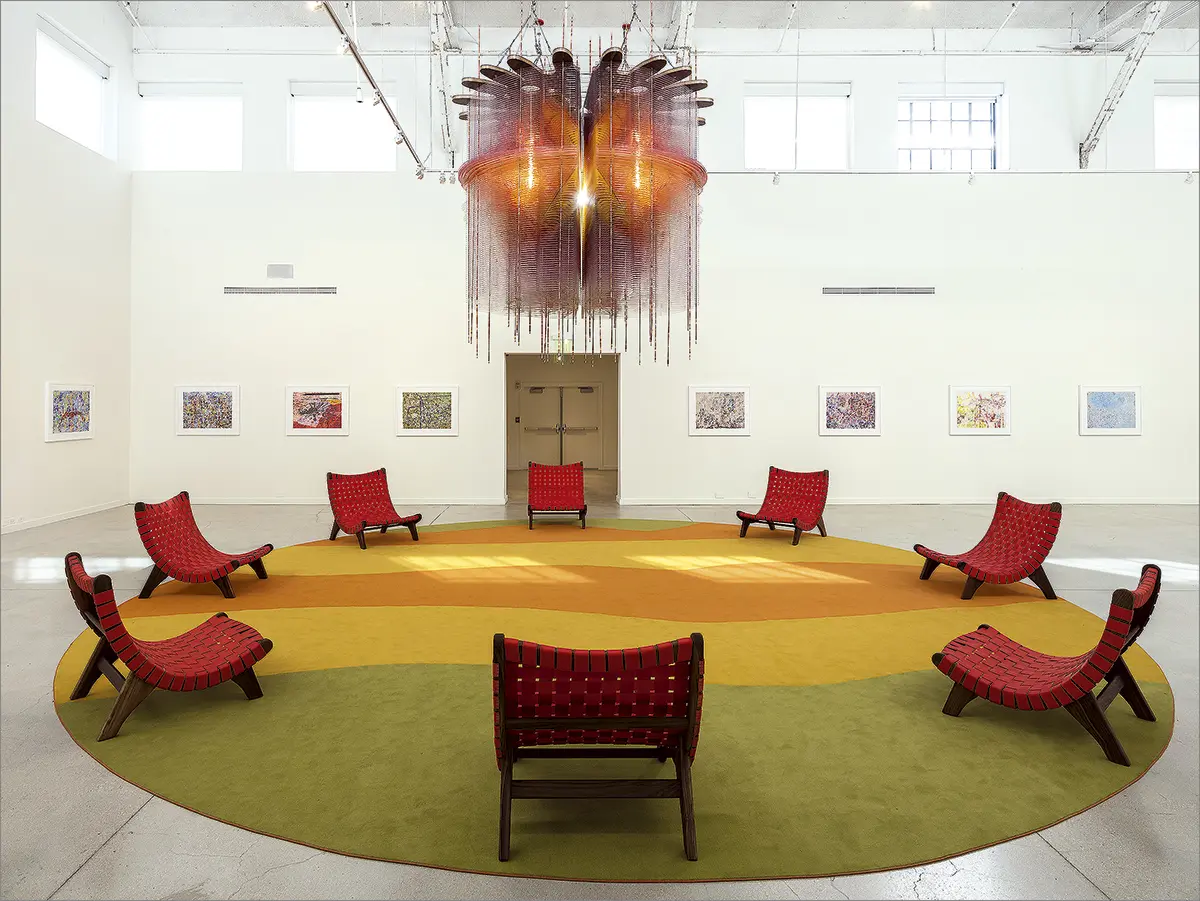
The main component of the installation is a large chandelier, which becomes the focal point of the “room”, right above the carpet. The chandelier can be seen as a sculpture comprised of numerous individual elements assembled together, all designed by Pardo on a computer and then laser-cut according to his specifications. Once lit, the chandelier shines in multiple colors.
The walls around these elements contain several two-dimensional, multicolor artworks, hung at equal intervals. The scene is perfectly proportioned; all the elements have been arranged in a spatially well centered, balanced manner, following basic principles of interior design.
The room’s modernist style also makes reference to a specific era and region. The chairs are reminiscent of the boutaques that were especially popular in Cuban and Latin American living rooms in the 1950s and 60s. The chandelier puts us in mind of the custom, common across the region, of lighting interior spaces in a dramatic fashion.
While Pardo often avers that his training is not as an architect, but as an artist, his interest in architecture has evidently driven him to explore the possibilities of combining space and aesthetics. He carries this interaction to its highest point and uses it as a platform for commenting on political and social issues. Architecture becomes an ideal medium for such commentary, as its expression already contains those indicators, both explicitly and implicitly.
The physical location of this exhibit has a particular emotional charge for Pardo, given the previous use of the space. The building now housing the Museum is known as Freedom Tower, and in the past served as the reception and processing site for Cuban refugees. For the artist, it represents a confrontation with his memories of the moment he became a migrant, precisely in that location. He confesses there is a conflict between what he remembers and what he knows of that moment. In a way, this exhibition helps him elucidate between them.
The two-dimensional works on the walls give an idea of this process. The semiabstract images look like a fuzzy puzzle, with parts that fit together perfectly yet fail to define a figure or shape. Some of the initial images were taken from personal photographs and other sources that allude to the process of becoming uprooted, and especially to the case of Cuban immigrants. The Cuban exile was doubly forced, since they were not able to bring anything with them. Things as personal as family photographs and other such mementoes had to be left behind. Here, Pardo uses such images and their connotations as his starting point, using software to alter them until they are rendered almost unintelligible. He also incorporates other components, such as artworks that were significant in his professional training. These “visual collages” were printed on paper and hand colored using pencils. The process involves a conscious manipulation that mixes colors and shapes to produce a different result. In this way, Pardo presents us his memories as an amalgam of motions that emerge through the veil of remembrance.
The title of the exhibition, Mongrel, refers to Pardo’s view of his origins and identity. The word is generally applied to dogs of undefined race, admixtures of many. In an interview, Pardo explained the term saying that all who come from the so-called New World are, one way or another, the result of the mixture and demographic variety of the region’s population. In that way, he strips the term of its negative connotation and brings it into the human context, prompting new ways of reading its social resonances.
Visually and conceptually, Mongrel summarizes Pardo’s memories of this space and of his relationship with it. Those experiences meant a definitive point of departure in his personal history. Pardo speaks to us about uprooting and estrangement, referring to a moment in history that altered the life of many, demarcating a before and after.