After her first solo show at the Centre Pompidou in 1982—and having won the Prix de la Photographie in Paris in 1988, and the prize at the International Photography Encounters in Arles in 1991—it took ten years for the work of Graciela Iturbide (Mexico, 1942) to be exhibited again in France. The retrospective hosted by the Cartier Foundation presents a selection of black-and-white photographs from the 1970s to the present. If the French public knew her, above all, for her work with various indigenous communities in Mexico, they are now discovering pieces of the last thirty years, which are less or little known. Those of fleeting moments, of “inhabited” tropical flora, of magnified everyday objects, of unusual associations, of pure architectural geometry, in images where the human presence has disappeared. “Right now,” said the artist, “what attracts me is to work on the elements. It could be said that, more than a drift towards abstraction, it’s about a greater concentration of symbols.”
Iturbide needs no introduction as she is one of the greatest photographers not only in Latin America but also internationally. She was trained under the friendly and complicit gaze of her influential teacher, the great Manuel Álvarez Bravo. With him she learned to look at the city differently, to pay attention to details, to wait patiently in order to capture the moment, because, as he often told her: “There is time, there is always time.” Next, she became interested in marginalized indigenous communities and their rituals, and then traveled to the United States, Europe and, especially, India, a country she visited five times, but always maintaining a profound interest in her native country. And this is how Graciela Iturbide conceives the photographic act: “To go out with my camera, observe, capture the most mythical part of man... and then penetrate the darkness, reveal, choose the symbolic...”
The title of the exhibition, “Heliotropo 37,” takes us to the address of her house-studio in Mexico, built by her son, the architect Mauricio Rocha, who also designed the hanging of this show. On the ground floor, the two rooms of the Cartier Foundation, framed towards the street and the garden by immense glazed panels, are occupied by high rails separated by a narrow space that allows light from the garden to filter into the interior. As soon as one enters the room on the left, the photographs reveal a gaze that differs from the one Graciela Iturbide had accustomed us to: her interest used to be focused on human beings, on their bodies and faces, on their expressions and rituals, on their daily life, and on the unique relationships between animals and people. The medium-sized photographs, made in Belgium, don’t have any captions; only the place and date they were taken, written in sand-color on the floor. In this ensemble, sorted by affinities, the gaze lingers at “the inanimate world” of cities or gets entangled in electrical cables, an abandoned staircase, serial fans, fragments of cement, dead fish gathered like knives... That which is “nondescript” or “devoid of quality,” non-human objects or subjects, possess aesthetic value, become worthy of attention, and acquire the status of symbols. We are enthralled by her sense of framing; by the role of space, which sometimes (almost) becomes the protagonist of the scene; by pristine settings where time seems to have stopped. And although Graciela Iturbide’s photography may seem “rational” or “irrational” due to the juxtaposition of thematic and compositional elements—whether we find it poetic, humorous or anecdotal, or that it creates improbable or absurd encounters—it finds its identity and its qualitative force precisely in its humanity, even when it’s at the service of a context that could be described as “abstract.”
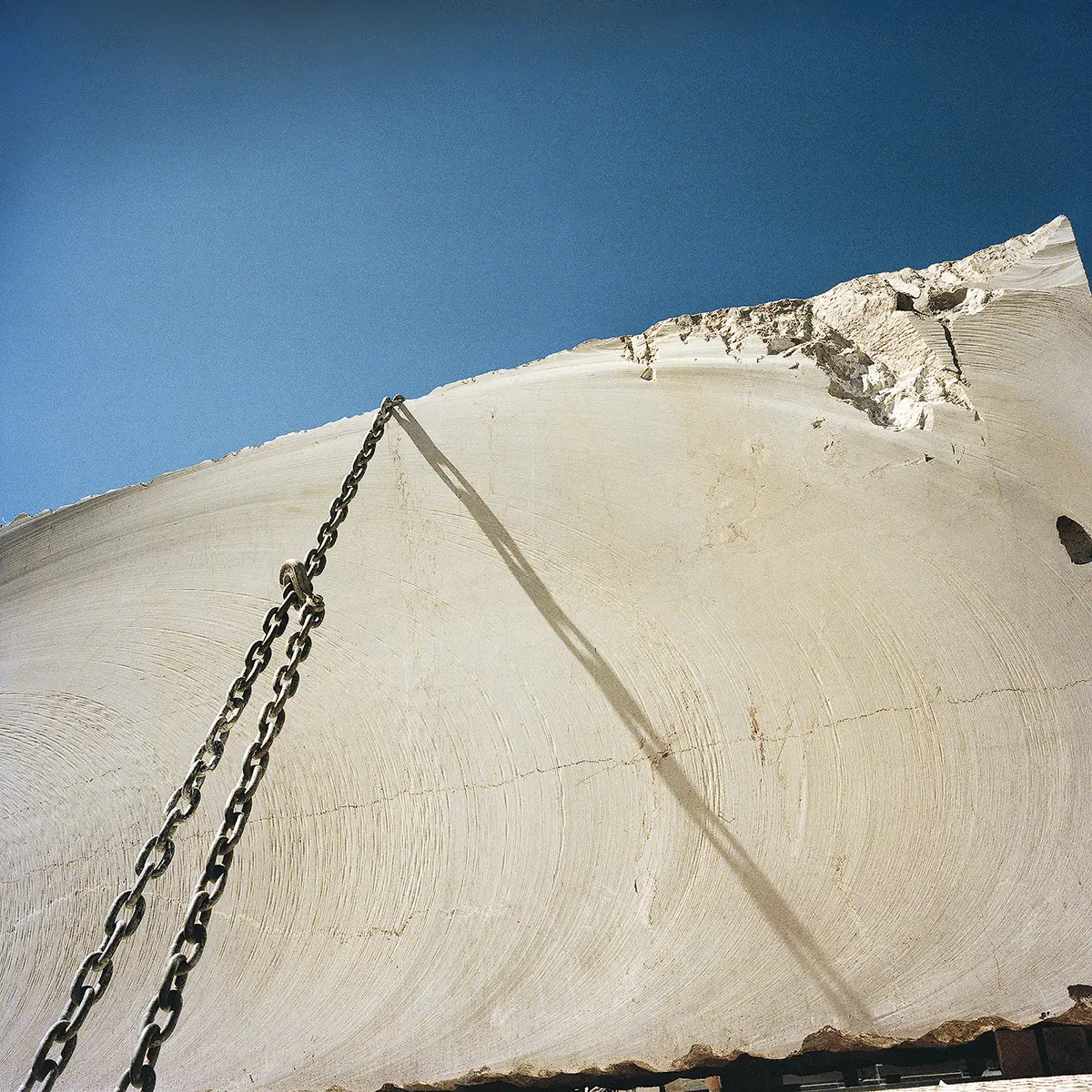
Examples of this are Cagliari (Sardinia, 2010), where a tree gets caught in a net, and Khajuraho (India, 1998), where we see a bird in flight next to a jacket hanging from a branch. In The Tightrope Walker (Tula, Mexico, 1982), a board with a painted acrobat hides half the carcass of a car, while a piece of tent allows us to imagine the proximity of a small rural circus. Two mysterious images caught my attention. Coyoacán (Mexico, 2006) shows a wall pierced by several holes (in reality, heavy-caliber bullet holes) and a shadow in the right corner. The photographer has given us the key to the mystery: for this self-portrait she photographed the wall that witnessed the first attack against Trotsky (by Mexican communists, on May 24, 1940). As for the second photograph, Backbone (Mexico, 2000), a body dressed in white is floating, its head turned toward the water. At first glance, one might think of a “white Ophelia” (evoking Rimbaud’s), but then we realize that the character’s left hand is taken by another hand, which suggests a baptism or a purification ceremony. In Varanasi (India, 1998), a sign with a pair of eyes announces an eyeglass seller, confirming the complicit choice of theme and homage to her teacher Manuel Álvarez Bravo. In the second room, “Naturata,” there are amazing photographs of cacti, cared for and protected, held by ropes or wrapped in veils, burlap sacks or plain newspaper. They were taken at the Oaxaca Botanical Garden (Mexico, 1996), which the photographer calls the “Hospital for Cacti.” This section also displays the only full-color photographs in the exhibition. They were made, at the request of the Cartier Foundation, at the alabaster and onyx quarries of Tecali, near Puebla, in 2021.
We are still on the ground floor, entering Graciela Iturbide’s home-studio (with full-color photos and videos of her work as a photographer). Next, the space is divided by the same high rails and is dedicated to older, smaller-format series shot in India, Argentina, and Ecuador. This is the tribute to indigenous Mexico in a series entitled “Ceremonies and rituals,” many of which made the photographer famous: the Chalma pilgrimage, with penitents disguised as skeletons; the bloody goat sacrifices in the Mixtec region (1993); the midwives and transvestites of the Tehuantepec region (Juchitán de las mujeres, 1979); the portraits of indigenous people, the series of the Sonoran Desert (1979), or the Chicanos of Tijuana (1986). Everything seems extraordinarily full of life, although, on occasion, death makes an appearance. The photographer has neither the intention nor the desire to work as an ethnologist. She does not seek the authenticity or the rigor of scientific testimony. What she is interested in is finding, around the corner, what she is looking for; to dwell on the simple things of daily life. Poetry and humanity merge in her photographs, where there is never any intention of judging her subject, but rather a patient, tender, and complicit observation coupled with her fascination for the other. On the occasion of this exhibition, Graciela Iturbide tells us that her images are related to her own dreams and that ultimately for her, photography is a ritual.