
Curated by Marta Dziewańska and Abigail Winograd, “Welding Madness” is Colombian artist Feliza Bursztyn’s first retrospective held outside her native country. With more than fifty pieces, including sculptures, videos, photographs and archive material, this exhibition was hosted by the Museum of Susch, a small Swiss village.
The exhibition constitutes a journey through twenty years of production by Feliza Bursztyn (1933-1982): starting in 1959 with her first exhibition of gouaches at El Callejón Gallery in Bogotá, until 1981, when she produced her series “Color:” car cans destroyed by clashes and coalitions.
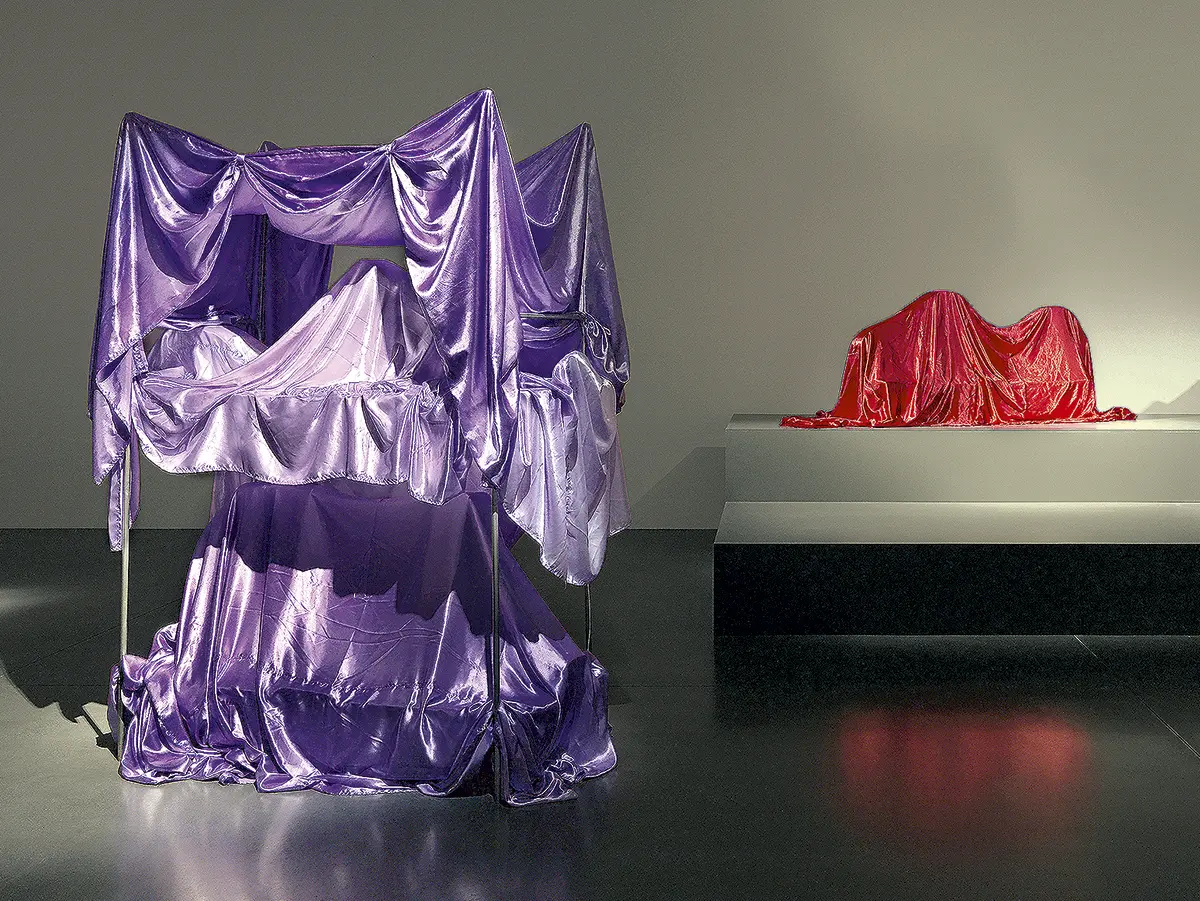
On display are delicate scrap metal or mini-machines arranged on regular pedestals, and made from materials such as typewriter bits or rusty nails; as well as larger pieces installed directly on the ground, such as Flower, built with car bumpers, and Homage to César, a cube of metal sheets pressed together. Also present are several of the twenty-seven “Histéricas” (Hysterical Women), made with aluminum strips and turntable motors that produce an unbearable noise and with which Feliza rattled the Museum of Modern Art in Bogotá in 1968. The rest of the works are not necessarily presented in a chronological way. Beds or Cujas (1974) are cots with motors covered by satin fabrics, where sex is as much hidden as it is revealed. Finally, the visitor is witness to a reassembly of the five sculptures of Baila mecánica (Mechanical Dance), a major piece in the author’s production, first presented at the Garcés Velásquez gallery in 1979.
The exhibition constitutes a great effort to gather and disseminate the production of a fundamental Latin American sculptor who suffered an unexpected death: a heart attack, months after her arrest in 1981, which led to her exile and to her work slipping into oblivion. In this sense, rescuing Bursztyn’s work is an urgent task to which this exhibition undoubtedly contributes. This endeavor began with a few exhibitions at the start of the 21st century, Pablo Leyva’s donation acquisition of her pieces to the Tate Modern in 2014, and the inclusion of one of her “Beds” in the “Radical Women” show curated by Andrea Giunta and Cecilia Fajardo-Hill for the Hammer Museum (Los Angeles), the Brooklyn Museum (New York), and the Pinacoteca de São Paulo (Brazil) in 2017-2018.
I must to point out that in the press kit and curatorial texts, two approaches are considered to be decisive when analyzing Bursztyn’s career: her Polish-Jewish ancestry and labeling her as “a pioneer of kinetic art.”
The first aspect corresponds to the institution’s character. The Susch Museum was founded by Polish investor, philanthropist, collector, and billionaire Grażyna Kulczyk, whose photo and biography appear at the end of the show’s press release, and whose family has taken a keen interest in Polish-Jewish ancestry. In fact, in 2012 her ex-husband, Jan Kulczyk, made an unprecedented monetary donation to the Museum of the History of Polish Jews in Warsaw. The second aspect corresponds to a specific interest of these curators: their research on kinetic art. An exhibition curated by them, together with Dieter Roelstraete—titled “The Other Trans-Atlantic: Kinetic and Op Art in Eastern Europe and Latin America. 1950s-1970s” (Moscow and São Paulo, 2018)—constituted a dialogue between Eastern European and Latin American kinetic artists. However, labeling creators such as Lygia Clark or Hélio Oiticica as kinetic left several Brazilian art scholars unsatisfied. For instance, Clark hated no one more than Vasarely and his followers, the Venezuelan kinetics.
Therefore, the curatorial discourse somewhat distorts Bursztyn, who, more than an artist of Jewish-Polish descent, was a Colombian sculptor closely linked to the left. Moreover, Bursztyn, like Clark or Oiticica, is under no circumstances a precursor of kineticism. European kineticism is related to concrete art, Madí or Venezuelan kineticism itself, movements that never posited the committed sociopolitical allegories and theater that run through Bursztyn’s work. Her arrest and fatal exile from Colombia in 1981 are not accidental.
A superficial reading of Latin American artists is risky, especially because it leads to problems related not to the discourse, but to the staging. The current version of Baila mecánica differs from the one presented in 1979. Comparing the current installation with photographic and film documentation reveals that the times, the lights, the movements, and the protagonists’ clothes are so different from the original version that it constitutes another work; one that does not even reflect the Brechtian character of Baila mecánica, its misery and drama. Besides, although the reconstruction of lost installations is extremely useful, these can never be presented as originals. The “new” Baila mecánica, assembled with pieces taken from the Tate, is far removed from the original.
Aside from the texts by curators Marta Dziewańska and Abigail Winograd, the catalogue— a welcome publication in English that will contribute to the dissemination of the sculptor’s work—will feature essays by Cecilia Fajardo-Hill, Camilo Leyva, Lucas Ospina, Sylvia Suárez, Gina McDaniel Tarver, Lynn Zelevansky, and Julia Buenaventura.
Note: Although this review is based on careful monitoring through photographs, videos, and curatorial texts, I did not visit the exhibition.