The exhibition The Swaying Motion of the Bank of the River Falls (2021) by Chilean-born Brooklyn-based Felipe Mujica presents a project produced in collaboration with Florida’s Miccosukee tribe. Known for his large-size fabric panels or “curtains” that operate as sculptural objects and functional architectural interventions, Mujica developed this site-specific installation to be presented indoors and outside PAMM’s building on Biscayne Bay.
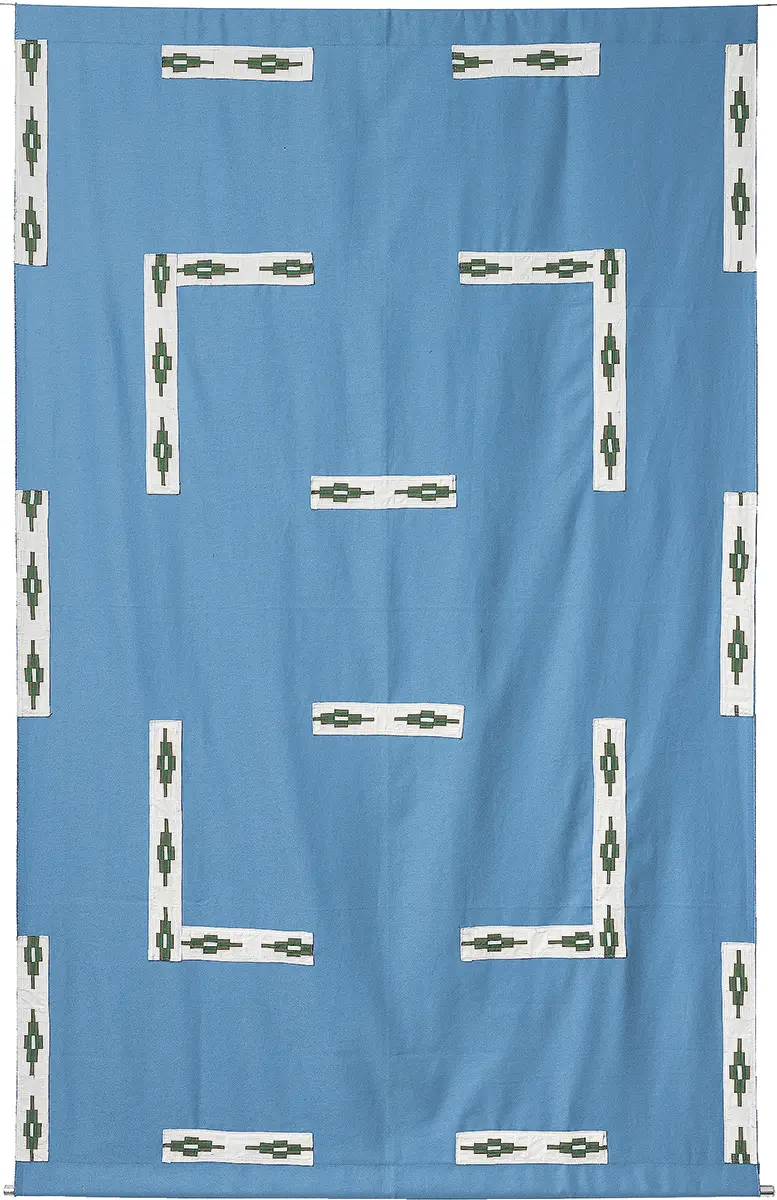
The artist accidentally began using fabric as a medium when preparing a show in Santiago de Chile in 2006. As he recalls, “I was experimenting with video at the time, and I needed to obscure the space, but I decided not to use a typical black curtain, which I thought was too serious.”1 He decided that using a colorful fabric would work better, so he commissioned a seamstress to make it. Once he installed it, he had an “aha moment,” and as he explains: “All of a sudden I had in front of me a beautiful artifact, permeable architecture, a drawing in space, with color and forms.”2
Interested in geometric abstraction, Mujica started to decorate monochromatic banners with sewn designs inspired by European abstract artists, including Alexander Rodchenko and Paul Klee. He later realized his practice was conducive to establishing dialogues with popular and indigenous cultures through collaborative and socially engaged projects. Building connections with groups outside the dominant Eurocentric field became a fundamental aspect of his practice. For the 32nd São Paulo Biennial (2016), he worked with a Brazilian embroidery collective and produced large curtains stitched with triangular patterns. Two years later, for Mexico’s XIII Bienal FEMSA (2018), he worked with the Wixárika artisans from Zacatecas, who introduced him to the Huichol beading tradition.
On the occasion of the invitation he received from PAMM to carry out a commission that constitutes his first individual project in a museum in the United States, Mujica was introduced to one of Florida’s Native American artistic traditions, the Seminole and Miccosukee Taweekaache (tah-wee-GAH-chee), which means “design” in the Mikasuki language.3 This patchwork style, made from skillfully sewing colorful horizontal strips of fabric, dates back to the beginning of the twentieth century when hand-cranked sewing machines were introduced to Seminole and Miccosukee women. Each band of fabric features two-colored geometric patterns following the principles of transformational geometry, a process used to create abstract designs using translation, rotation, and reflection of different geometric forms. Traditional Miccosukee Taweekaache patterns are inspired by legends and stories as well as natural elements which give them names such as “Fire,” “Rain,” and “Storm.”4
To create the installation presented at PAMM, Mujica partnered with Miccosukee artist Khadijah Cypress to produce 20 banners inspired by the tribe’s cosmology. Sewn on earth and blue-toned colored fabrics, the “curtains” represent several motifs commonly used in traditional patchwork such as “Fire,” “Big Storm,” and “Bird.” Mujica takes their meaning a step forward by giving the installation an interactive character. Visitors can experience the tribe’s cosmology at a multi-sensorial level while walking through the installation, touching the pieces of fabric, and sinuously swaying the banners which are loosely suspended from the ceiling. The changeable nature of the installation allows visitors to transform the space and play with the fabrics’ color combinations. The public is given complete freedom as there are no determined paths. Everyone can explore the installation visually and physically, making it a truly sensorial experience.
By incorporating Miccosukee traditional designs into this new series, Mujica continues to collaborate with local communities and integrate what is considered “craft” or “popular arts” into his work. He also expands his research on the history of geometric abstraction beyond the Eurocentric parameters, creates new dialogues, highlights the work of tribal cultures, and explores new sensitivities regarding the metaphysical exploration of the natural world.
NOTES
1. Kristina Foster, video interview with the artist. Cited in “Curtain call for Chilean artist Felipe Mujica,” Financial Times, November 26, 2021. https://www.ft.com/content/b86dedf1-69a8-4012-8859-f4844eff3a29
2. Ibid.
3. https://www.floridamuseum.ufl.edu/sflarch/collections/seminole-dolls/patchwork/
4. Ibid.