At the start of Utopías de lo inmaterial (Utopias of the Immaterial), an exhibition of works by Venezuelan artist Federico Ovalles (Caracas, 1972) at Elvira Moreno Gallery, we walk along the entire length of the wall to our left, as if entering the gallery for the first time. Intervened by the artist, that wall transformed into a sea of concrete on which three objects (with references to the domestic, to the traditional: wood and wicker) seem to float adrift. The entryway, which can be transitory when one is harried to access works located in spaces that hierarchically demand greater attention, is already a forceful declaration of welcome intent. Those objects, which transform the sea of cement into a pictorial sculpture (or a sculptural painting), resemble a chair, the roof of a house, the remains of a basket: vestiges of different forms of life, flooded by the construction material; trapped but seemingly subject to erratic motion, they bring to mind the islands in Thomas Moore’s Utopia, a point made in Francisco Arévalo’s curatorial text. In this case, the floating islands are in a stage in which the traces found in utopia are those that speak of its failure.
As Nydia Gutiérez’s text points out, concrete, as a symbol of modernity, makes reference to the inhuman scale of the urban and architectural development that took place in Latin American countries (and in Venezuela in particular): outsize avenues; visually exhausting public spaces; buildings that promised a better, modern, prosperous tomorrow, the very idea of progress serving as the foundation for all those structures. With such modernity as a horizon (European in its roots, long established in North and South America), Ovalles dismantles discourses and ways of making art, and contributes, from the visual arts, to a debate about disillusionment that interrogates and revises the real reach and impact of a historical era that is more and more submerged in the abysses of the past, but whose scars nevertheless remain clearly visible and palpable across the social fabric, the economy, and the environment.
The works on display in this exhibition ingeniously pursue a back-and-forth between speaking of personal, local, and historical contexts, and the conversation they achieve is richly nuanced in terms of times and spaces. In analyzing, for example, Edro hexagonal I and Edro hexagonal II (2021), we could talk about dispossession as a constant metaphor for Venezuelan migration, in particular, or for migratory movements all around the world, in general; yet, we unavoidably take a step back and consider as well the salvage and deployment of traditionally rural materials, such as wicker and burlap, also used by arte povera artists in the Twentieth Century (think of Manuel Millares, Jannis Kounellis, Mario Merz, to mention but a few). Nevertheless, Ovalles places them, beyond matter as such and beyond the pictorial, in a cultural and ancestral universe besieged by the very sea of cement we were welcomed by. These works are not an ode to the materials in themselves; what we encounter here is not the notion of the readymade, but a return to roots, to the fragility of the material, to the threshold of immateriality.
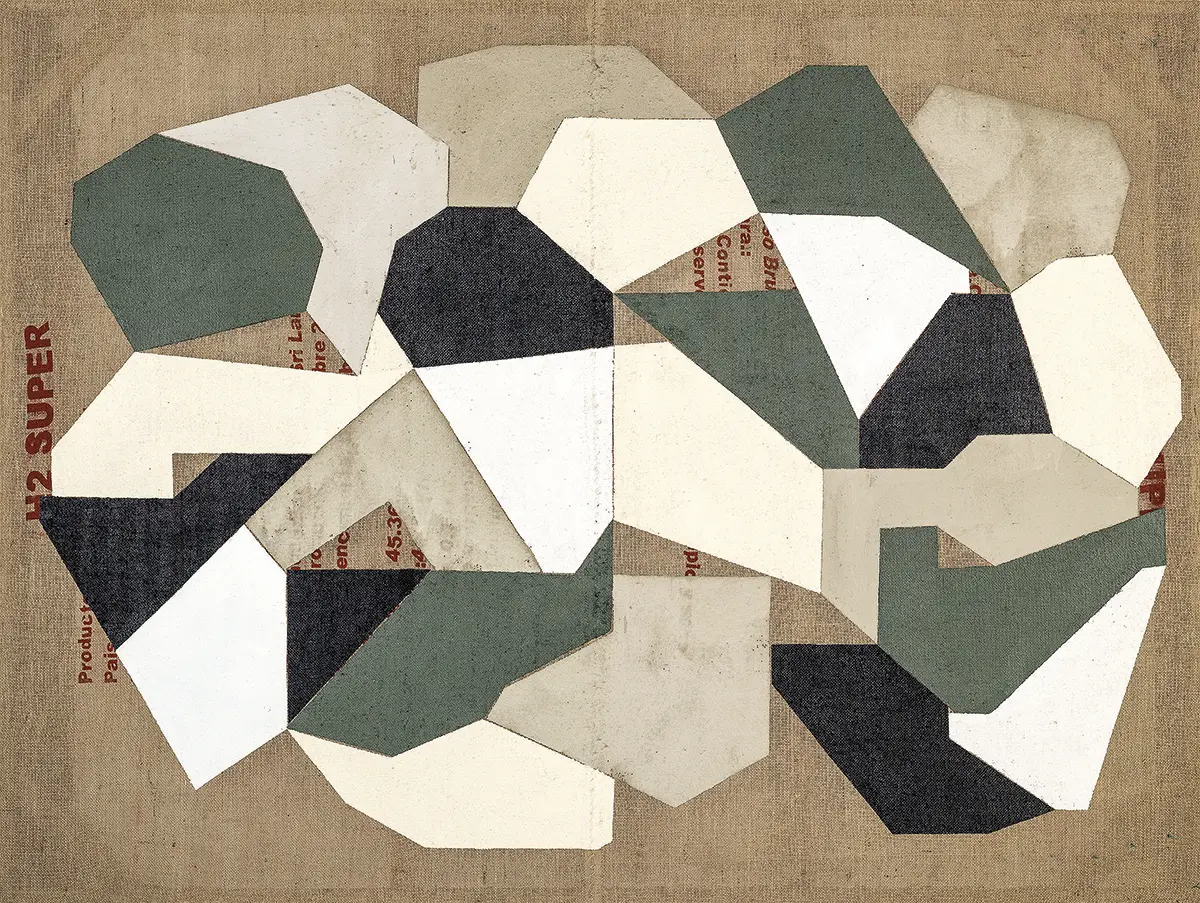
In works like Surface matter 2021 (#15, #17, #4 and #13) or Cargo is matter #1 (2021)—which also use the burlap from coffee sacks—the planes, colors, and materials that were emblems of the language of modernity are subverted by an organic relocation, a personal appropriation of color. Mint-green, pale rose, earthen red, gray, white, black, gradually generate intuitive planes and disclose a possible narrative that emerges from the relationships we strive to establish. Superimposed to the insensible rationalism of abstraction, of industrial geometry, is a process of form-gardening—which in some cases nevertheless can remind us, on the other hand, of the rectilinear arbitrariness of the maps that resulted from Nineteenth- and Twentieth-Century wars. Such traces of modernity are brought forth only to be subverted and disrupted. Ovalles refers to reality in allusive, unforced ways, in order to anchor events that can serve as the basis for elucubration. In this case, such an event is signaled by the installation Zumaque 1914-2021, which refers to Venezuela’s first oil well, as the artist explains. Everything else, we can thread ourselves based on the objects fibers, pieces of wood, paintings, and concrete. This critical yet playful revision and the contemporary dialog with old masters—such as the venerated Dadaist Kurt Schwitters, very much present in works like Deconstrucción Karive (Karive Deconstruction, 2018) or Sustratos 5 (Substrata 5, 2018)—are able to involve the viewer well beyond mere aesthetic and technical contemplation. Ovalles signals the possibility of us transcending the legacies of the past on the basis of critique, humor, and inquiry, to establish new connections for the generations to come.