Throughout his career, Fabián Ugalde has devoted himself to formulating questions with his art. Questions that point out the conventions and assumptions of what can be defined as current in contemporary art, and which have allowed him—with resources that resemble those of political cartooning—to highlight the paradoxes and illusions between the transitory and the permanent, in the terms in which they have accelerated and at the same time gotten caught like flies—whether electrified or electrocuted, I don’t know—in the web of the referential.
I am thinking of his formal transcriptions and reflections around recent works of art as emblematic as they are controversial, such as Jeff Koons’ Balloon Dog or Andy Warhol’s Marilyn Monroe, which carry forward—between what I intuit is a combination of playfulness and research—to the formal outlines of the abstract in his earlier work, where he plays with figures, resources, and allusions to American cartoons of the 1930s and 40s (his 2015 exhibition Fallas de origen, at Enrique Guerrero), and on the basis of which he posits—with humor and rigor—the borderlines, as faded as they are immanent, between the figure, its abstraction, and the various readings it prompts, be it formal or political.
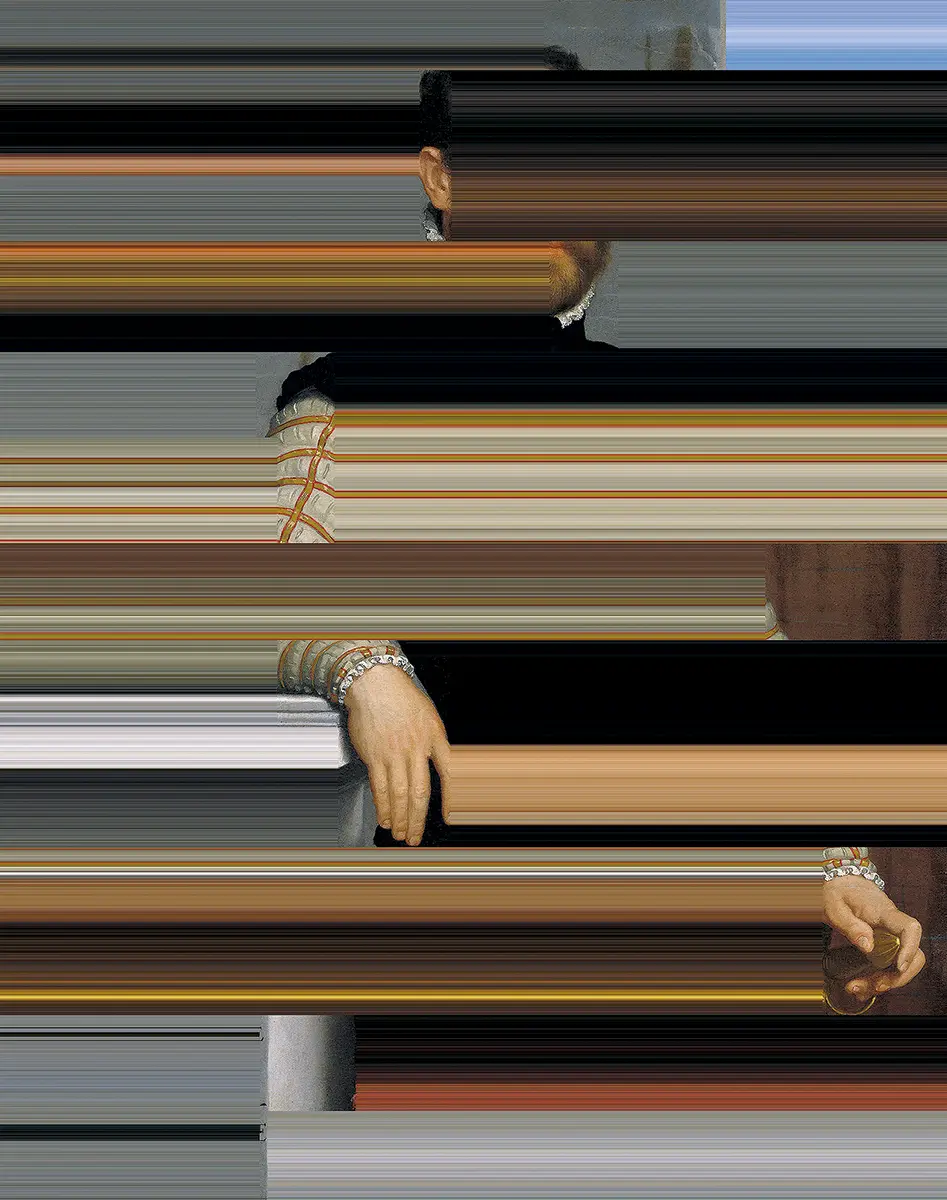
The very title of Ugalde’s latest exhibition, Anecdotario del teorema (Annals of the Theorem), comes across as a riddle. It does not tell us what theorem this is, whether Pythagoras’, Fermat’s, Bayes’, Passolini’s, or his own; it does not provide any more information than the sole statement of what a theorem means, and even that only on the basis of events, circumstances, and accidents connected to it. Both the geometric lyricism of the large-format paintings made with vinyl ink on plasticized canvas and the formal dismantling of emblematic artworks and artists such as David, Vermeer, and Raphael, made by means of ink injection on paper, speak eloquently—in the media used as well as in their execution—of Ugalde transgressive vocation, in the mold of the artists cited, and even—still in his sight—of more recent conventions—in terms of figure and representation—that he equals in time—if you will, and above all, in iconographic terms—to David’s Napoleon and Koons’ Balloon Dog. Ugalde’s work inhabits the narrow haven where Gant Wood’s American Gothic and Walter Lantz’s Woody Woodpecker coexist interchangeably. All figures end up in abstraction.
Equalization is always violent, especially in political terms (even if in economic terms, everything always is, or can be, a commodity.) Ugalde’s subversive vocation with regards to the formal starts from the circumstance—agreed upon in his trajectory as an artist—that signs, their referents and allusions, can be said by unsaying—ah, the paradoxical conventions of meaning—on the basis of the disassembly of their parts by means of geometric formulations. The tension that results, for example—both in composition and conceptual terms—from cutting up and arranging the layers of various segments of David’s Napoleon in a mirror-like set up, confirms his formal intuitions; it brings them to the fore for an audience that may or may not see on the canvas something more than Napoleon Bonaparte and his white horse, which comes to provide a stencil for the breakup of the reds, blues, and ochres that define and articulate—evidently—the very figure of Napoleon, transformed into a grid of chromatic counterpoints that tend—dynamic—to form squares, triangles, and circles that emulate, in the terms in which Fabián Ugalde’s work is—above all—a formal reflection put together on the basis of the essential abstraction—if we may describe the forms and their dynamics in that way—of signs and cultural gestures, and runs in parallel—full of connecting vessels—to his more explicitly geometric aspect—again, according to ultimately political conventions—in the interplay of patterns through which he constitutes narratives very similar to those he proposes on the basis of this appropriation of the work of Great Masters (these being as well—highly likely—the appropriation of the work of more recent masters, or better yet, climates) in terms of patterns, in which he plays—always a provocateur—with the double meaning of the act of reflecting—insisting on symmetry and its ghosts—as something done in front of a mirror, or otherwise.