Esteban Ramón Pérez, born in the US West Coast to a family of Mexican immigrants, represents with peculiar clarity and intensity the inheritance of the concept of family that characterizes Mexican culture. He began as an assistant to his father (the equivalent of a Renaissance apprentice helping his Master). The artist’s father was an upholsterer, which already sheds light on a pathway that Esteban Ramón Pérez was not to ignore. His earliest studies in the field of art drove him in the direction of painting. A few years later, he obtained a Master’s Degree, from which merged as a varied artist prone to synthesis, with an understanding of the forceful profile of his inheritance, as well as stylistic, historical authority, along with personal and social projection. Esteban Ramón Pérez is a multifaceted and multidisciplinary artist in the broadest sense of the term. His Baroque leanings are essential and irreverent, historical, comprehensible and contemporary, be it in reasons, techniques, processes, materials, or essences, as corroborated by the title of the exhibition, which brings to the fore the patriotic content of Mexico’s National Seal.
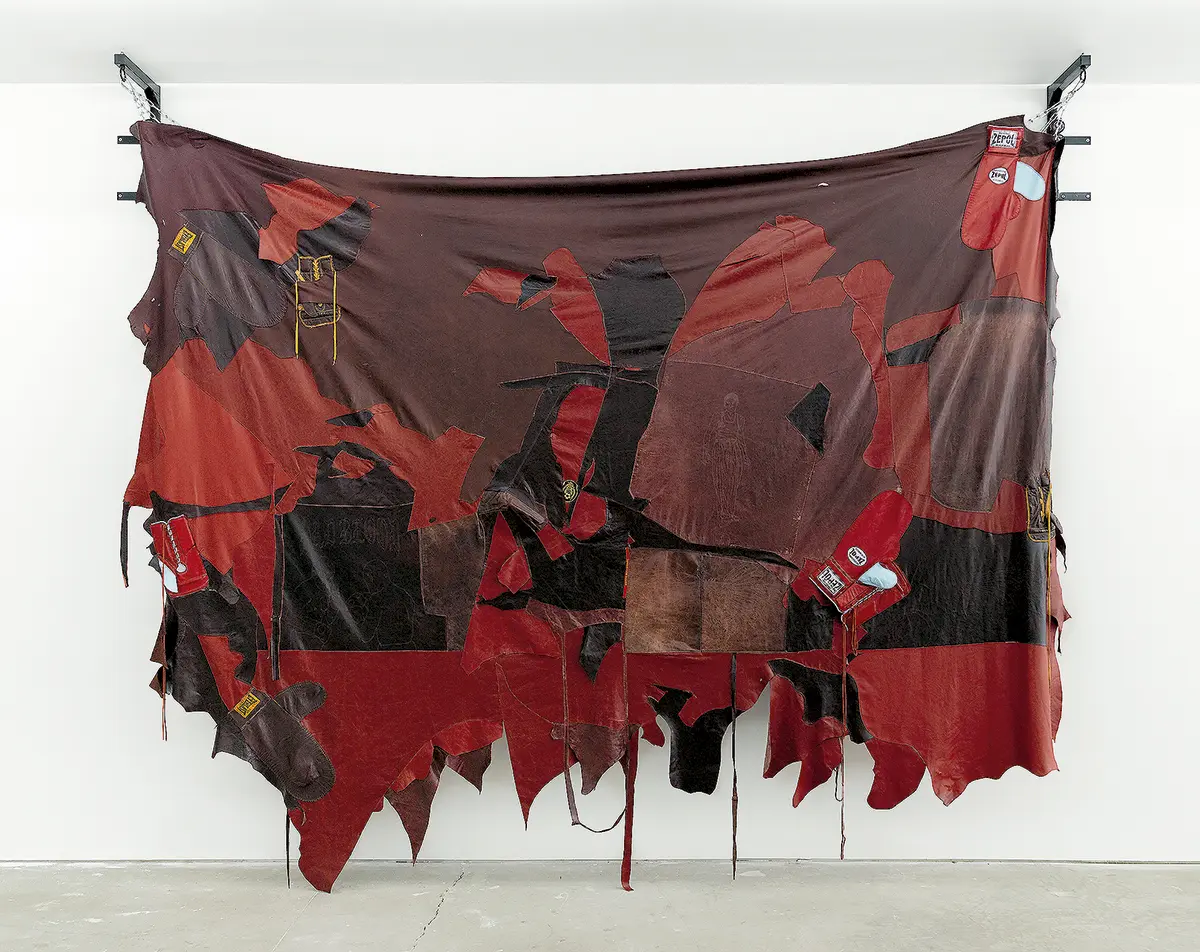
Cutting shapes for upholstery drove him to move from a certain figuration to geometry and to irregular outlines. Pelts possess the curvatures that come from the animals’ bodies, which Pérez gradually transformed into squares or rectangles, intent on covering pillows and backs and armrests of armchairs. Traditional upholstery practices do not use cutouts. In pop and socio-peripheral upholstery, cutouts are included as part of zig-zagging societies that reveal the anti-classical, like the cutouts of a society of shifts and adaptabilities. This could all be summarized in the expression “you make do with what you have,” often expressed in Mexico with the untranslatable word rascuache. The cutout is a special world for both father and son, and it is in that vein that Pérez works now, albeit not exclusively. Other valences of animal skins and feathers populate his works, connecting with various struggles, indigenous references, distinctive recognitions. The correlation between animals and magic traditions, between contemporary society and the surviving indigenous cultures intertwined with secular migrant cultures—intensely connected to the Chicano element—is made manifest in Esteban Ramón Pérez’s creations.
In his work of the COVID-19 years we perceive airs that connect with the winds of a variety of primitive cultures with a concise elegance of textures. Some of these works go on the wall in medium and major formats, framed and unframed, with and without support, until they are expressed in self-sustainable objects.
The practice of the cutout from a very early age—with or without a pattern template—has opened Pérez’s works unmeasurably up to irregular formats articulated with zones of extremely light symmetry. Moving from industrially cut wooden control bars to the use of pieces of tree branches, ribbons, and horns that hold various parts, Esteban Ramón Pérez even includes metals of various uses to ratify the interweaving of varied applications and socio-historical allusions. The manners in which the artist gradually modified his way of conceiving, creating, supporting, and displaying his works include the alternation of rigid and soft, natural and rascuache materials.
These works that don’t go close to the wall respond in unison to the meaning of union and separation. In that regard, we must mention that the main referents are “the scissors” and “the stitch”, the greatest factual presences in his work. Esteban Ramón Pérez expands his creativity into that world of primitive originality that responds to the desire of rescuing small, ignored disrespected, mistreated populations anywhere in the world. His expression is populated not only by the indigenous element, but also by the Chicano aspect, of which he indubitably partakes. The lowrider experience was also a part of his childhood, and those undulating rides in expanded automobiles invoke certain ornamental chrome-plated forms that occasionally appear in his soft works (which could be deemed Chicano): tapestries, banners, signs, and social maps. What predominates is not orthogonality, but a kind of free will; the sewing machine appears to be traveling on a lowrider through the pathways of diverse geographies. The semi-undulating separation of those “social maps” provides simultaneous perceptions of and allusions to the poles cited up to this point.
“I am still an emerging artist,” Pérez says, humbly. He has exhibitions and participations already programmed in a variety of destinations. The closest one is a solo show at Charles Moffett Gallery. In Esteban Ramón Pérez’s works, stone-gray, cement-gray, and various earthen hues and colors coexist. The warm zones move in the direction of orange and wine-red tones. In his velvet, we find tonalities of artificial and iridescent vibration. Plain fabrics predominate, although there are surprising appearances of flower-print or stripped materials. Skins, the lowrider, feathers, velvet, certain metals, especially in the self-carrying objects; pieces of trees and fragments of our heterogeneous societies underscore this Chicano neo-Baroque that opens up a path of renewal for large parts of Latin American culture.