A rigorous painterly discipline and an inquisitive spirit of permanent exploration are the indelible marks of Eduardo Sued’s work, as demonstrated in the recent exhibition Ousadias Cromáticas (Chromatic Boldness), which brought together nearly forty previously unseen artworks and was on simultaneous view at Danielian Gallery and Cassia Bomeny gallery, in Río de Janeiro. Curated by Vanda Klavin, who has accompanied the artist’s career since the 1980s, these two exhibits offer a broad, retrospective, and considered view of Sued’s long trajectory, characterized by a constant quest for chromatic refinement and formal complexity.
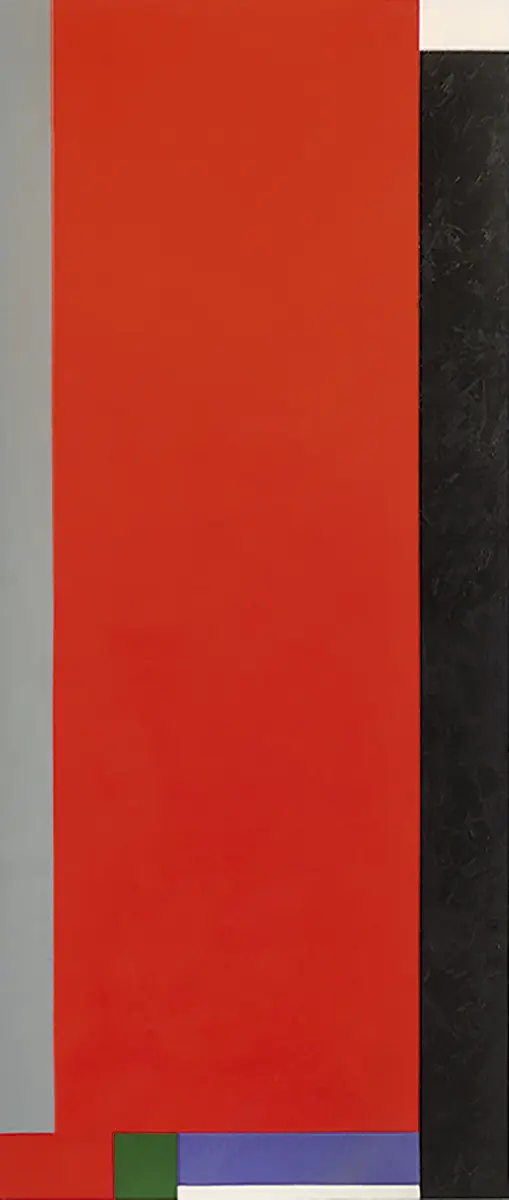
On exhibit at Danielian were works from the 1980s, a period when Sued developed an orchestration of black areas, with vibrant color bands divided into unequal segments. These are large-format works with geometric structures and bolder chromatic contrapositions where proportions and colors are altered. At Cassia Bomeny Galería, the selection focused on vast grays and silver hues, which bring forth a different kind of luminosity, more constrained accents: the gray colors of dawn or dusk, diverse in nature for the lower and more opaque tones, a subtle contrast with such tonalities and a chromatic identity all of its own, with its own light value.
From the start of his career, Sued was after a systematic and intense production. Born in Rio de Janeiro in 1925, the son of a Syrian immigrant family, he studied at the National College of Engineering, but dropped out in order to devote himself entirely to the visual arts. Opposed to the rigidity of traditional and academic norms, he preferred freer workshops and experimented with a variety of techniques and languages. In the 1950s, Sued worked as a draftsman in Oscar Niemeyer’s office, and later he traveled to Paris, where he frequented the La Grande Chaumière and Julian. After returning to Río in 1953, he was a regular at the studio of Iberê Camargo (1914-1994), where he worked on engraving on metal and later became the painter’s assistant.
In the mid-1960s, Sued’s interest in large color areas and his quest for greater plasticity drove him to concentrate increasingly on painting. He was not associated with a movement or school and remained aloof from the debates of the era in Brazil: the Concrete/Neo-concrete dispute of the 1950s and the debates around New Figuration in the 1960s. Although started out as a figurative painter, by the 1970s Sued had definitely opted for geometric abstraction, moving in the direction of constructivism and developing his work on the basis of his study of Piet Mondrian and the Bauhaus.
Sued’s independent spirit found reflection in his poetics, influenced by great masters yet made singular by their characteristic boldness. This can be appreciated in canvases of whose “monumental” dimensions were outside the norm for Brazilian art, in which elements are projected outside the space of painting by means of a precise, and unexpected, structuring. That motion towards the outside of the pictorial space is present both in large, almost monochrome painting-panels and in works that emphasize a vibrating tension between different color fields, organized according to an unstructured geometry to create a frantic rhythm where the flat surface seems to pulsate.
Over the years, the artist experimented with many variations in his work, always starting with the idea of mathematical exactitude, allied to a sober interplay of grays and blacks, or to think brushstrokes and raised surfaces, among other pictorial gambits, such as vertical and horizontal lines that confound the gaze with their singular motion.
Allowing himself empirical exercises, Sued also opened a space for surprises, such as the cutout elements, the masks, and the extraneous materials that gradually came to be included in his painting, as he flirted with a brutalist aesthetic. In some works, Sued appears also as a forceful colorist, especially when he opts for the use of bold blues, yellows, and reds, or well-settled ochres and blacks, or his innovative grays and silvers.
The point of articulation between vigor and lyricism in Sued’s oeuvre resides on his unique ability to capture the characteristics of the long concretist tradition in Western art and folding it into his methods as a way of interrogating the boundaries of painting as such. As he constantly explaining that math allowed him to cultivate, from the beginning, clarity of thought, discipline, and precision in the making of art, the defining sign of Sued’s work is found in that very paradox: rigor allied to creativity. His work never crystallized in preconceived structures; it was always the result of uncertainty and experimentation. The accurate reflection on the relationships between light, surface, space, and time that characterizes his painting is indicative of Sued’s permanent search for the solution to pictorial problems. This attitude, working in tandem with the artist’s sensibility, made him into one of the signal names in Latin American constructivism.