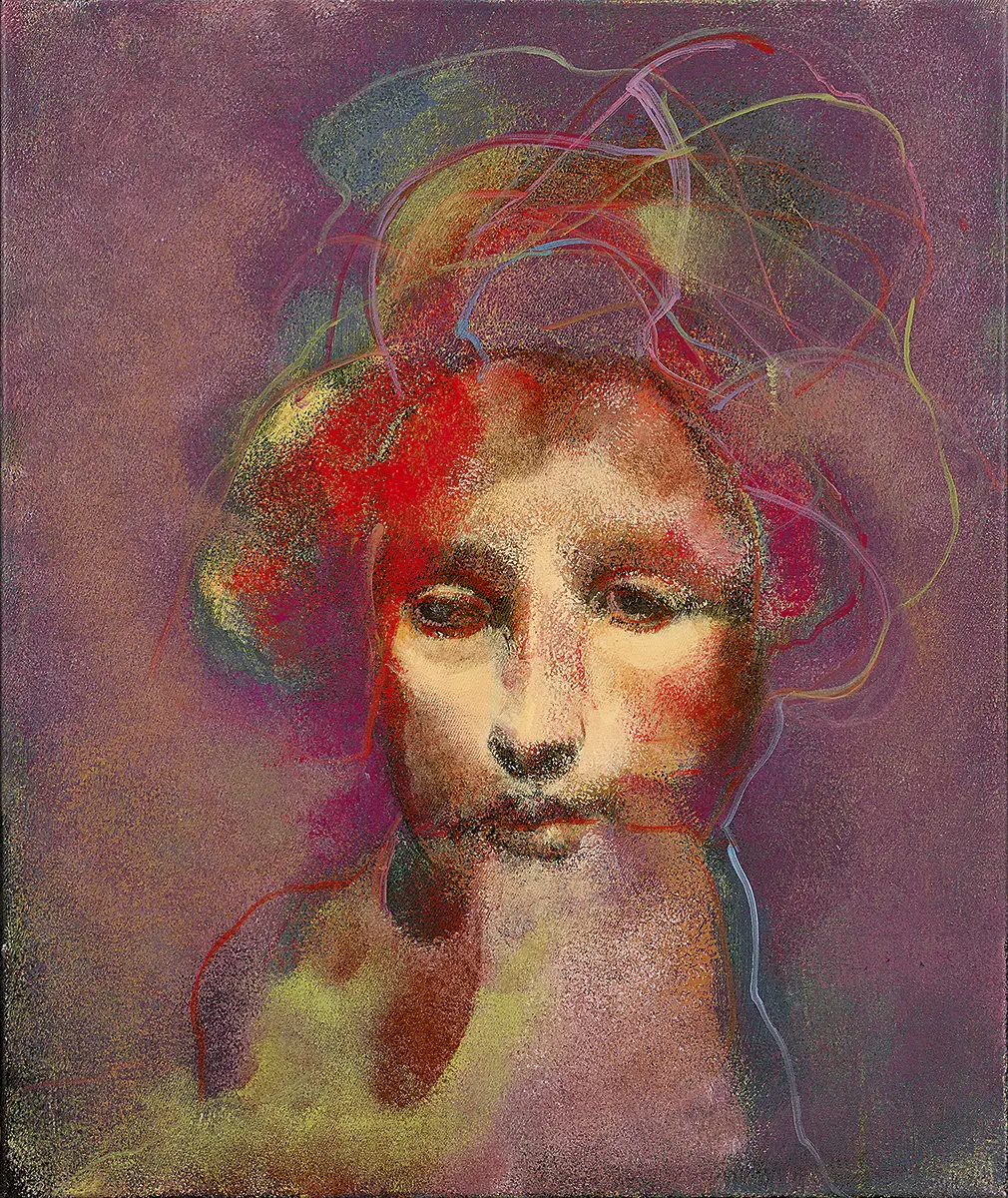
“El otro rostro” (The Other Face) was the solo show by Édgar Sánchez (1940), one of Venezuela’s most important artists and who for several decades has been a leader of the figurative tendency in Latin America. The show was recently hosted by Freites Gallery in Caracas, and curated by art critic and researcher María Luz Cardenas. The face and the human figure have been recurring subjects in Sanchez’s painting throughout a long journey of research and reflection on the creative act. As a result, magnificent expressive techniques within an aesthetics of figuration have placed him among the best in his field. The curator stated that “his rigorous craft is so refined and precise that it becomes a luminous expressive attribute. His exquisite technique is based in his unique sense of design by contrasting lights and shadows, in his ability to structure his images with color, and in his skillful composition of forms and textures.”
Since the beginning of his career, he has been interested in the human figure, especially the face as an expressive display of humanist gestures related to the Self in contemporary society. As a consequence, he has carried on a systematic exploration of disparate techniques. In the 1970s, he distinguished himself as a pioneer and protagonist of the well-known and historically fundamental “Drawing Boom:” a strictly Venezuelan movement led by large group of young artists who helped advance the country’s art history. Institutions, museums, and galleries devoted to disseminating this movement created salons and biennials with their respective prizes—many of them awarded to Édgar Sánchez—as well as innumerable group and solo shows, and comprehensive publications on the extraordinary development of drawing in the local scene. During that decade, Sánchez’s skillful black and white drawings were faultlessly made with techniques like charcoal and gouache; pencil, graphite, and ink on cardboard; gouache and crayon; and chalk, pencil, and crayon on paper, some of which are illuminated with a landscaped chromatism of low temperatures.
During the 1980s, he continued to work on his “faces,” but also became interested in other genres such as natural and urban landscapes. He arrived at “El otro rostro” with a well-worn theme and, nevertheless, enunciated a change in his approach to facial gestures and their formal behavior. For example, in the 1980s he had produced a series entitled “Skin and Landscape,” focusing only on segments of the face—the full mouth and its corners, or the nose and eyes—which occupied the center of the picture and spread out of it. Separated from the whole, these segments achieve quite dramatic effects, not only for their forceful representation, but also for their technical prowess, especially the remarkable “orange peel” textures, indentations, dimples, and colors, which could be described as tortured, given the contrasts between light and shadow, a formal resource that Edgar Sanchez handles with mastery. These artworks’ questioning of the contemporary human condition demand the viewer’s full attention. Another important example, clearly an antecedent of “El otro rostro,” is the series of silkscreens titled “Paisaje de la memoria” (Memory Landscape, 1981). They portray nobody’s face, timeless, without models; a collective face represented by remembered images for a drawing, and also for a painting for which he stood out as a virtuoso of chromatic draftsmanship, as he does with the works in the 2021 exhibition.
On this subject, for the gallery’s press release Édgar Sánchez stated that he is interested in describing “with thoroughness a visual fact, where each groove, feature, or scar belongs to a strict order meant to create an atmosphere… as a result of the interpenetration of opposing situations. The climate produced is beautiful; I’m interested in that form of beauty. I am aware that my motifs are not conventionally beautiful, but they are surrounded by a very beautiful plastic surface.” Indeed, they are not “portraits.” The artist abandons the deftness of the conventional portrait to focus on direct expressivity. Strangely, the anatomical complexion of his current faces is not at all like those of the past: set in hazy atmospheres and differing shades of color, they seem to arise from the depths of the pictorial space and merge with their surrounding colors, so that we are able to analyze their chromatic formalism and refractory rigor in terms of the purest aesthetic essence of figurative representation.