
The MAMM’s Sound Experimentation Gallery (Lab.3) is a space designed for the exhibition and experience of sound art, and of creative projects that use sound as their main artistic material. Since 2015, it has been the host of artistic projects in such fields as sound landscapes, microsound, electronic music, acoustic ecology, and bio-art. Interweaving these fields, Bogotá artist David Vélez (1973) presents Un último día perfecto (A Last Perfect Day), setting up a cultivation inside the space for plants to develop in an artificial habitat, supported along by the installation’s light and sound elements and by the active, affectionate participation of the public. Permaculture, sound art, and scientific speculation converge on this proposal as poetic instruments, projecting possible pathways to generate symbiotic connections between human beings and their natural environment. Vélez’s project is part of an exhibition cycle that focuses on humanity’s relationship with nature, viewed from a variety of standpoints.
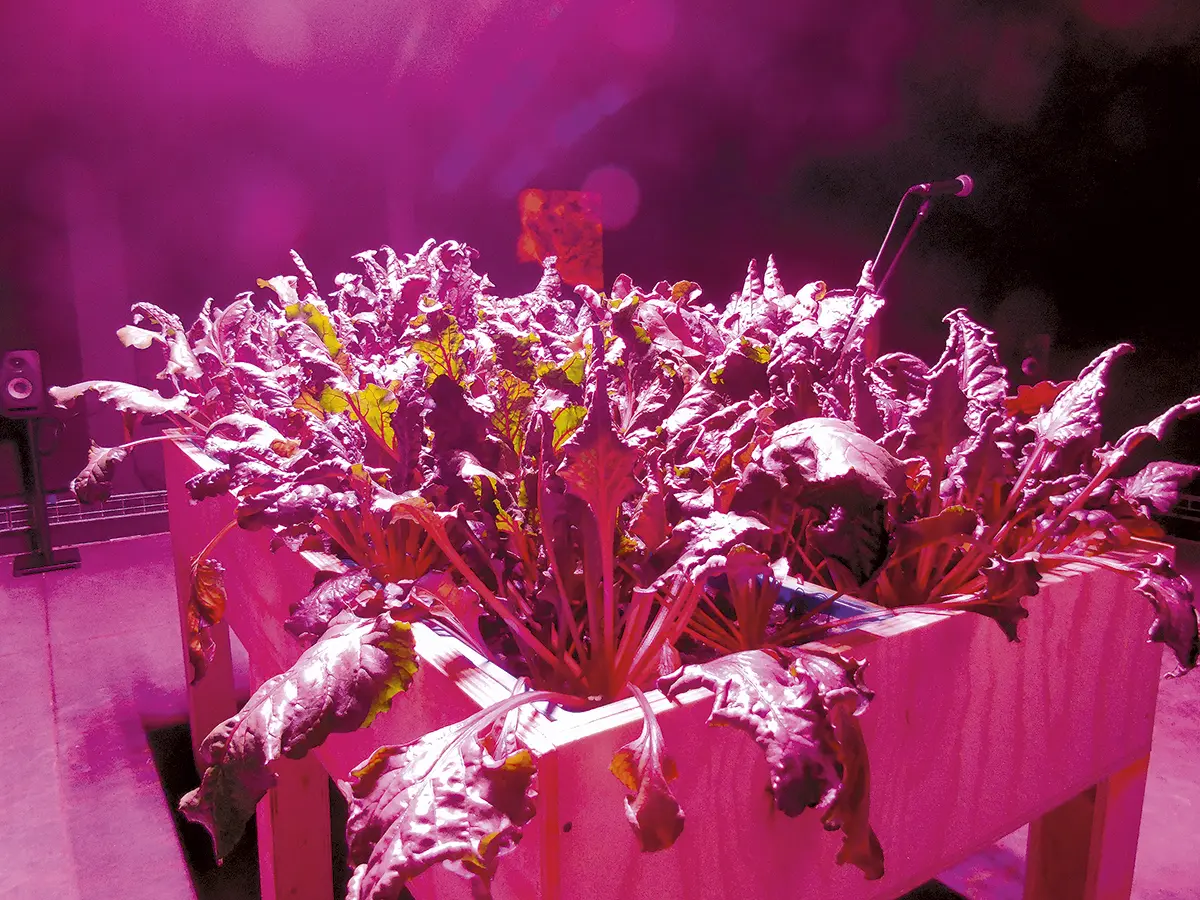
Vélez’s installation creates a space for contemplation, listening, and knowledge, and is comprised of four main elements. As a starting point, the project uses astrophysicist Carl Sagan’s idea of a “last perfect day” arriving with the end of the world, five billion years into the future. Vélez uses this as a metaphor to signal the conflict that exists between human culture and its natural environment. The central element is an orchard comprised of six plastic baskets arranged on a table-container that raises them to a height of approximately one meter. Over the course of the exhibition, a crop of beets grows there as symbolic actors for possible practices and symbiotic relationships between man and nature, capable of stimulating the emergence of an ecologically sustainable culture. As the symbol of such a potential communion, Vélez selected beets—used today in varied scientific investigations in fields such as neuroscience and solar engineering—because of their high nutritional value. For his project, this plant represents the power of permaculture and of ecological awareness as catalysts of change in our relationship with the planet.
Above the crop, shedding zenithal light, is a lamp that stimulates the plant’s development inside the gallery, in 12-hour cycles of light and darkness. The lamp was created on the basis of a light recipe that combines lightbulbs of different colors and intensities, intended to mimic sunlight according to the beets’ need.
On a side wall is the third element in the installation: a screen presenting a looped video of the Sun as it rotates on its axis and irradiates its energy into space. The red sphere, occupying the right side of the screen, connects with the scarlet light and the plants purple and reddish hues to generate a warm, spectral environment inside the exhibition space.
Finally, the installation is completed by its sound component, which plays the dual role of enhancing the ecosystem that supports the plants and opening a communication vessel between the public and these living beings. To that end, Vélez creates a sound atmosphere by means of two systems with specific functionalities. On the one hand, a set of eight-channel amplifiers that surround the crops along the edges of the exhibition space, reproducing a theme composed of sinusoidal waves and other acoustic elements. On the other, a microphone located across from the crops, open to participation by the pubic and connected to a transducer arranged directly above the containers, in contact with the soil and the roots. The combination of these two audio systems invites, in a speculative manner, the generation of emotional and sensible connections between all participants in the ecosystem. While the musical composition was created to speed up the growing of the plants and enhance their biological systems, the human voice, resulting from the public’s participation, connects the project with traditional cultural practices that see talking to plants as salutary. It bears noting that existing research, of interest to Vélez, indicates that plants do possess a particular sensitivity to sound and vibrational stimuli.
The exhibition as a whole is welcoming and hypnotic. The reddish light that slowly fades to leave the periphery of the rectangular space in penumbra, produces a visual effect on the crops, which seem to germinate strange iridescent plants. Adding to this, the sustained buzz of the sinusoidal waves, bothersome at first, becomes calming as the body adapts to the environment. Meanwhile, the experience of talking to the beetroots through a microphone is disconcerting at an auditory level, since the source of the amplification is not readily identifiable, which produces the sensation of hearing one’s own voice inside one’s head. In other words, the sound seems, rather than expanding into space, to be converging on the speaker, who in consequence is hearing what the plants feel.
Lastly, it must be noted that a detailed observation of this work reveals an entire natural ecosystem, with colonies of tiny insects, butterflies, and worms that join the artificial domain constituted by the technical infrastructure, the museum personnel, and the visitors themselves. This encounter underscores the problematic system circumscribed by Vélez and invites us to reflect about our cultural practices and ways of consumption, as well as the near future. As a colophon to the exhibit, the beets will be harvested and consumed by the MAMM team, closing the cycle inherent to the vegetable cultivation.