“Encapsulados domésticos. Contenedores” (Domestic Encapsulations. Containers) is the title of Consuelo Gómez’s solo show at the recently opened Mmaison gallery. Her present sculptural work continues to explore the possibilities of public spaces and utilitarian objects, already evident in her earlier pieces. By way of example, suffice it to recall her exhibitions “Cinturón rojo” (Red Belt) and “Lirucas”, both from 2011, where she revealed her interest in investigating urban spaces in Bogotá, such as Las Cruces neighborhood, where she analyzed not only the place but also the objects that shape its characteristics, for example, with her intervention at Las Cruces Market Square (VII Luis Caballero Award, 2013). Her work Mesa franca evidenced her intention to identify the created object with the intervened space.
She has thus revealed a penchant for exploring and appropriating a wide variety of forms, designs, materials, and techniques, and proves to be adept at examining apparently discordant materials and diverse historical archives—since objects tell stories—and at delving into projects that refer to the domestic and the everyday, but which acquire another dimension through her interventions in order for us see these familiar objects from a new perspective.
In her search for sculptural properties of popular utensils, Gómez makes the viewer think about their aesthetic possibilities, stripping everyday objects of their conventional meanings and looking at them from other perspectives that may include the humorous. She subtly deconstructs the ordinary function of the objects she chooses and invites us to stop and think of new meanings that will remove them from their usual setting.
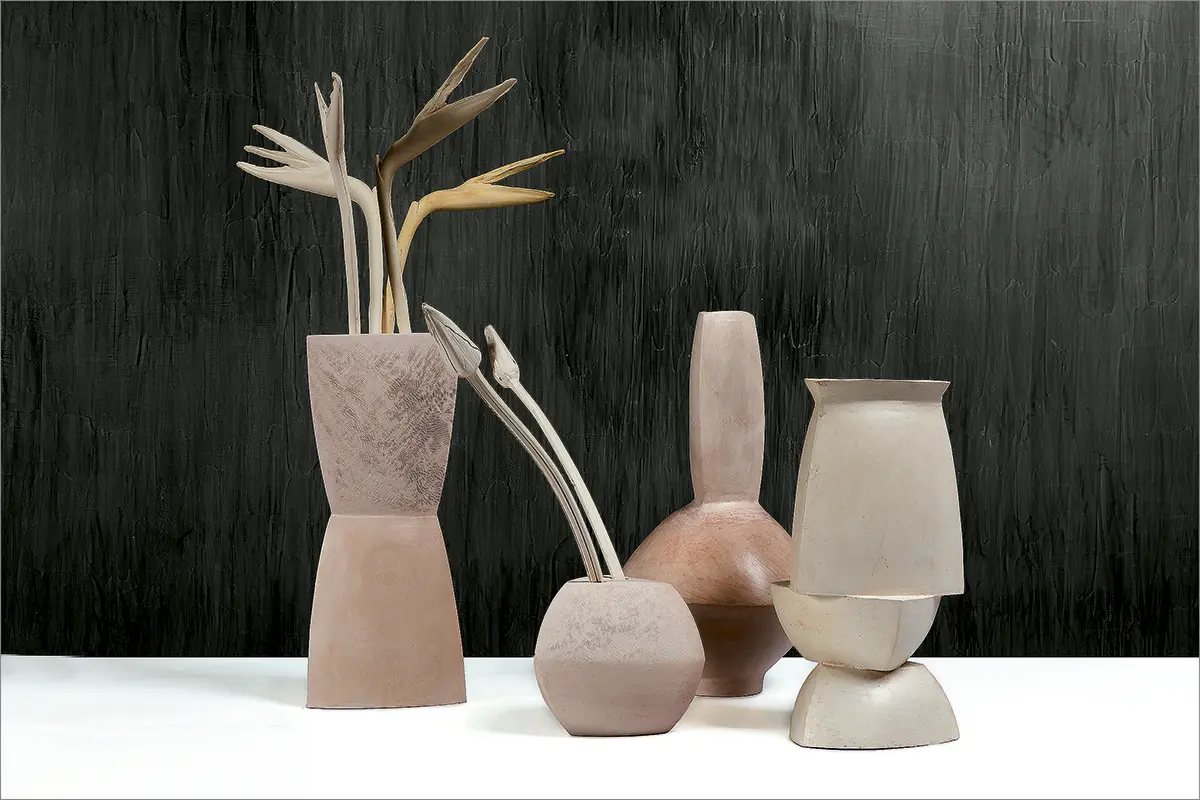
Evidently, Gómez has the ability to vary her choice of materials according to her sculptural proposal. Wood, metal, glass, stone, and gold thread are some of the elements used in previous works. In “Domestic Encapsulations” her preferred material is barbotine: a mixture of water and clay with an almost liquid consistency. She seeks to avoid the traditional use of clay, which involves manipulation by the artist to shape the forms. For the creation of this exhibition’s works, the liquid was poured on molds, which where then baked in ovens. In the artist’s words, a kind of “exquisite corpses” emerge, resulting from the curious relationship between everyday objects that lose their original function and their serial character.
Barbotine has the peculiarity of being a material that has been used since the 18th century. During the Industrial Revolution, it was key for the mass production of industrial goods for domestic use, which the British placed on the world market, fabricating objects that were totally identical and distanced from any reference to craft.
Ever since she worked in Jaime Téllez’s ceramic workshop, Gómez began to question the use of traditional models to make cups, vases or bowls, and started to assemble them in such a way that the initial objects, utilitarian and made for massive consumption, became unique. By connecting them, they acquire new forms and shatter the notion of function that they had as individual objects. She achieves this by coupling different objects together when their material substance is still malleable. The initial pieces, intended to be made industrially, become forms for which there was no previous draft.
Pieces that never cease to amaze and that break with the aforementioned sculptures are the ones based on the flowers called “birds of paradise,” which the artist chose to create sophisticated artworks where nature has a strong presence. This was also the case in her exhibition “Canto XVI” (2013). Reflecting on landscape, she cast a meter-high cactus in bronze: a surprising sculptural piece that mimics nature by presenting it—like the flowers—in all its forcefulness and refinement.
Gómez’s sculptures bring to mind works by previous artists such as Constantin Brâncuși or Barbara Hepworth, key figures in the development of sculptural abstraction. At the same time, the fact that they are not enameled and no color has been applied to them—keeping the color they naturally acquire when the baking process concludes—is a possible homage to the finishes of the Cundinamarca artisans. Once again, for Gómez it is possible to establish links between the methods of industrialization and the persistence of craftmanship, conceived through a sculptural mode of thinking that highlights the value of the new and unique forms this artist is creating by connecting both processes.