Trying to get as close as possible to his unique style, “Testa: projects and other games” at Del Infinito Gallery entailed a particular challenge since the architecture of the exhibition space contrasted with some creations that maintain the spirit of works-in-progress. Clorindo Testa (1923-2013), architect and visual artist, was adept at conceiving his work as a dynamic game, fusing experimentation and concept. The main room brought together paintings, sculptures, installations, and works on paper. A complementary room presented mockups and drawings on paper of projects that had been “rejected” or were never materialized. His wife and daughter created a foundation to preserve his legacy, and some of the works on view had never been shown in a gallery space. And there was an interesting plus: one of his working tables, which shows the countless traces left by time. On it laid a series of unpublished drawings on paper, allowing us to perceive how his ideas took shape in the intimacy of his studio.
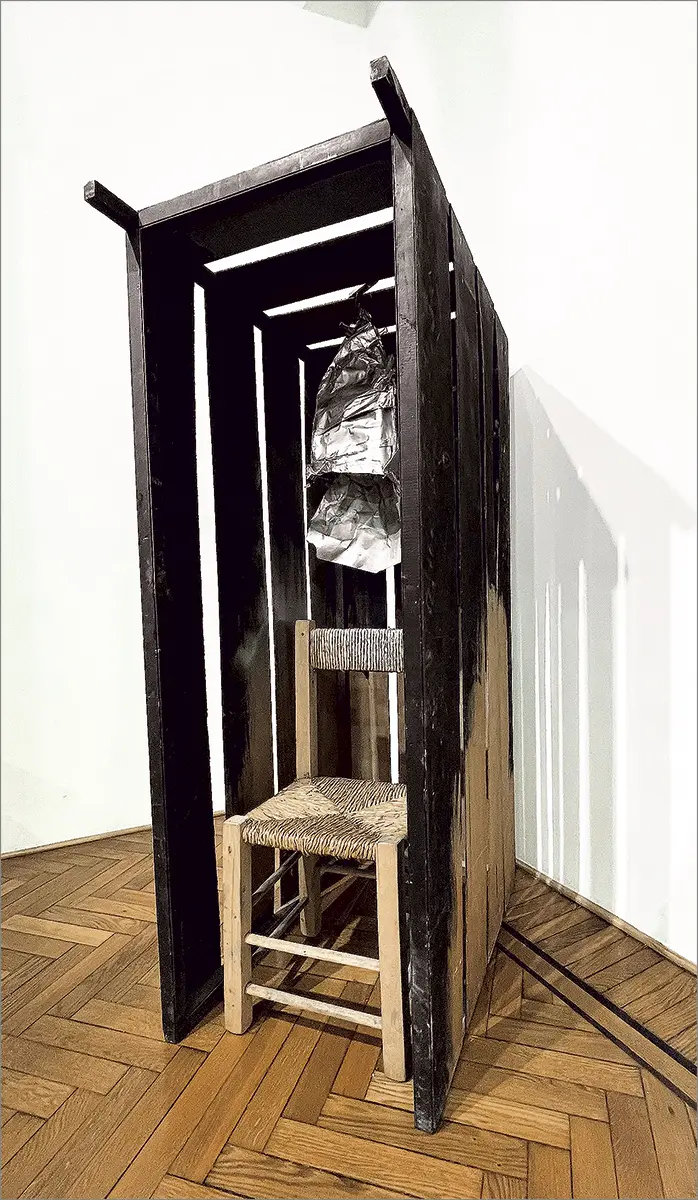
Six days were required to install a bracing system: curious structures commonly used in architecture to support walls and ceilings, and which Testa resignified by transferring them to another space as part of his concept of “bracing” culture through the work of artists. With the same idea of metaphorically transcending the purpose of what is destined to be only temporarily useful, the installation Obispo muerto (Dead Bishop, 1989), made with paper, wood, and aerosol paint, shows us a recumbent silver body that refers to the inventory drawn by bishop Martínez Compañón from the Viceroyalty of Peru, who at the end of the 1700s sent to Spain drawings depicting the customs, fauna, flora, clothing, and current affairs, minus the human suffering and enslavement behind all that. It is linked by resemblance to a second piece, Confessional (Living Bishop): a chair enclosed in a very limited space over which hangs The Bishop’s Miter, made of brown paper and painted in silver: the color of the metal that was extracted from the Peruvian mines and taken to Europe. In the main room, Cage with dogs (1997) plays with a detail that not everyone is aware of. The artist himself described it: “I placed three dogs, one of which had six legs, but no one noticed it. From this, one may infer that even though people change and strange things emerge, nobody will be surprised. Everything adapts to the times.” If he were alive, he would surely have a lot to say about these pandemic times, the speed with which everything changes, and the time the spectator takes to pay attention to details in another one of his games, loaded with his characteristic insolence.
Some works on paper and inks produced the same year of his death bear the captions “the city must be very orderly” and “the drawings must be very meticulous,” phrases that operate against the rhythms of the written words, as if shaken by an internal tremor. Among the “rejected” projects, some are largely signed by Oscar Lorente and Juan Fontana, the master’s disciples who also worked in his studio. They are true examples of Testa’s aesthetic presence: models and ink drawings of the Loma Negra building (Torre Fortabat); the Fira of Barcelona; an ecological housing of renewable resources submitted to the first National Contest of Sustainable Houses in 2009; a 1998 urban-planning project for Nordelta; and the colorful and multivolume auditorium sketched in 2013 for arteba. “He made a point of entering as many contests as possible, he was always surrounded by architects and young students, and he liked to work as a team,” according to someone from the gallery who accompanied him on many occasions. Some of his emblematic works can be seen in Buenos Aires, such as the imposing National Library, designed in a brutalist style and built in 1971, and the Andreani Foundation building in La Boca, his posthumous work: a conceptual reassignment that kept the façade but gave way to a series of spaces that reflect the neighborhood’s tenement-housing aesthetics, with its vibrant colors.