In Micaela: la sangre de todas (Micaela: The Blood of Them All), artist CJ Chueca leans on an emblematic figure in Peruvian history in order to engage the country’s social and political present. At the center of the exhibition is Micaela Bastidas (Tamburco, 1744-Cusco, 1781), a celebrated hero of Peruvian independence. Bastidas was a counsellor and comrade-in-arms of Tupac Amaru II, her husband, in the great Indian rebellion of the late Eighteenth Century, based in the Cusco region, considered as the starting point of the long process of the emancipation of what was at the time the Viceroyalty of Peru and an inspiration for independence struggles across Latin America, which ended with the public torture and execution of the couple and their children in Cusco’s main square.
Chueca sets up her interest in Bastidas on a dual frame: on the one hand, time, presenting her exhibition on the bicentennial year of Peruvian independence (2021) and also in coincidence with the specific day in which Bastidas is commemorated (November 4); on the other hand, geography, exhibiting in the Cusco gallery Vigil González. In this way, Bastidas, an empowered mestizo woman with indigenous, African, and Spanish roots and an iconic figure for anticolonial struggles, born over 278 years ago, emerges as a contemporary—and permanent—claim about the capacity of women (and men, and genderqueer persons) to fight for better living condition, confronting all forms of oppression and exploitation.
Chueca’s project is comprised of four parts. Three are on exhibit in the exhibition itself, each presented independently in one the gallery’s three spaces, and the forth is the public program Sesión de retratos Las Micaelas (Micaelas Portrait Session), held on two dates, one in Urubamba’s main square and another in Cusco’s main square. At each session, Chueca painted quick watercolor portraits of local women and girls depicted as Micaela Bastidas, while conversing with their sitters about her figure. In this way, the artist sought not only to inform about the national hero, but also to foster among women in the community an identification with Bastidas, symbolically setting in motion her return in a way that echoes Tupac Amaru II’s final words: “I shall return, and will be millions.”
The exhibition approaches its subject in a way that is both descriptive, by means of figuration, and metaphorical, especially by means of color and materials. In the first section we find a painting in red tones titled Micaela lavándose las heridas en el río (Micaela Cleans her Wounds in the River), which presents Bastidas with her back to the viewer but her face turned, gazing at us, and the installation Cuerpo en Cusco (Micaela) (Body in Cusco [Micaela]), a wall made of broken bricks onto which white paint has been poured (red and white are the colors of Peru’s national flag.) This wall, with holes that may bring to mind a firing-squad execution (although Bastidas was garroted), alludes to Bastidas’ public execution in Cusco and the role played by her struggle and her sacrifice in the foundation of the Peruvian republic. On exhibit alongside these artworks is a ceramic serpent decorated with geometric patterns. This sculpture, titled Mestiza, symbolizes a clash and fusion of cultures, the serpent being a representation of evil in Catholic iconography and a figure associated with wisdom in Andean traditions, as the literal meaning of the Quechua word amaru.
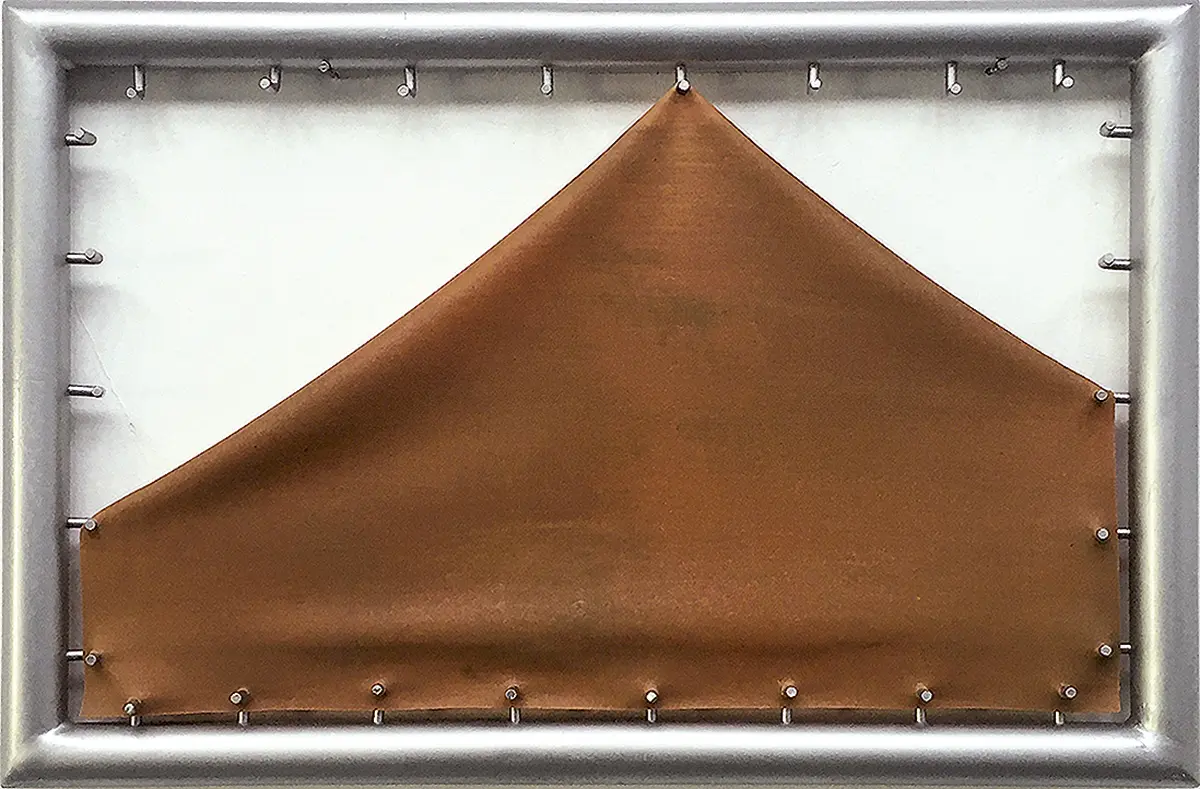
In the second room, Chueca uses the shedding of skin as an image of rebirth. A group of latex skins, partially mounted on aluminum frames, form the outline of a mountain in the series Apus (a Quechua word that means both “mountain” and the mountain-spirit that protects a community —TN). On the floor we find serpent skins that evoke the idea of renewal and connect the amaru with the latex mountain gods (apus).
The key features in the third exhibition space are the color blue and the representation of water, as in Transmutada (ACC) (Transfigured [ACC]), where Bastidas’ figure can be discerned inside a whirlpool, or Unu Kalpay, which depicts a waterfall. The title of the former suggests the hero’s transfiguration into water, but adopting the shape—and the power—of a whirlpool and a waterfall.
Through these parallels and evocations, CJ Chueca not only highlights the contemporary presence of Peruvian history, but also presents the anticolonial struggle as something natural that calls on us with its unstoppable force.