In the last decade, Brooke Alfaro has been a kind of sleeping giant among Panamanian artists. After representing his country in the Venice Biennale and receiving such honors as First Prize at the 3rd Biennial of the Central American Isthmus, Alfaro limited himself to sporadic appearances in a handful of group exhibitions. Now we know why. His most recent solo show, Gracias a Dios no fue peor (Thank God It Wasn’t Worse), covered the galleries at the Museo de Arte Contemporáneo (MAC) in Panama like the flooding that follows the overwhelming of a dam, with works accumulated over thirteen years. Curated by Mónica Kupfer, the exhibition remained open from September, 2021 through January, 2022, and featured some 53 works of art in a variety of formats, produced between 2008 and 2021. Among them, small paintings (called icons), oils, and large-format pastels.
Several truths emerged from the exhibition. I would not say, for example, that Brooke Alfaro is a revolutionary of form. Save a few exceptions, his painting seems to me to be correct, almost academic. His technique comes across as highly polished, and behind the distribution of color and light, one perceived the hand of a master artist in perfect control of his skills. Yet Alfaro’s is not an art of lightweight discourses; it is just that the weight does not come from aesthetic refinement, or from the tidiness of his paintings, but from the realities he engages with.
I would describe Alfaro’s representations as somewhere between social-satire cartoons, Géricault’s portraits of mental patients, and Hieronymus Bosch’s The Garden of Earthly Delights. Complex constructions populated in equal measure by the harsh reality of many sectors of Panamanian society, Judeo-Christian symbolism, and the History of Art. All these narratives, while seemingly proceeding from different paths, coexist harmoniously in Alfaro’s work, as facts of one single cosmic matter.
The work that gives the exhibition its name is an extraordinary example of this: what remains of a nude woman raises her emaciated arms to the heavens in supplication, while a giant shark takes her away between its jaws in the middle of a darkened, furious ocean. Above these images, the title that crowns the work: Gracias a Dios no fue peor (Thank God It Wasn’t Worse). The complete and undeniable gratitude of those who have lost it all is only one of the narratives present in this work. In the cartoonish, sordid representation we perceive, set at the same level and in ways that only good art permits, the voice of someone who mocks determinism and passive attitudes in the face of tragedy.
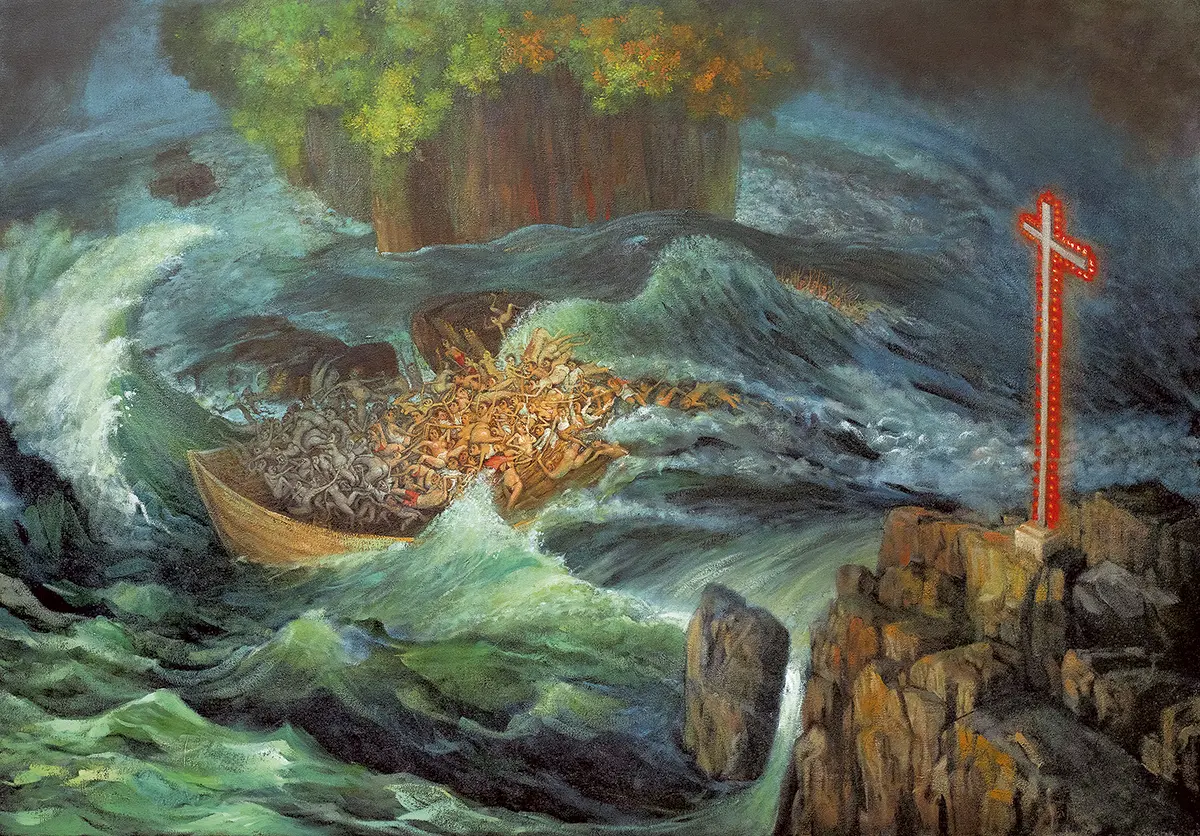
This multifaceted harmoniousness will be a constant practically throughout the entire show. Many of the Iconos (Icons, 2005-2006) mentioned above, for example, mark an exquisite point between the divinity of religious imagery and the most mundane, earth-bound representations. Most of them are fully nude women who display their asymmetrical bodies with an almost playful insolence, against a gold leaf background that distinctly resembles the codes of Christian iconography. Thus are the hieratic Madonnas of so many chapels enriched with new layers of humanity, as earthbound aspects of everyday life are consecrated. This intention, characteristic as it is of Bakhtinian carnival, contaminates practically the entire exhibition. In works like Archipiélago (Archipelago, 1998-2008) and even more so in Divina (Divine, 2020), the typical organization of Renaissance altarpieces is very much in evidence. Meanwhile, others, like La tierra tembló y el mar enfureció (The Earth Shook and the Sea Was Enraged, 2021), engage with biblical mythology, contextualizing it into a globalized, post-pandemic reality.
Through those pathways, another truth confirmed by this exhibition is that Brooke Alfaro is, above all, a methodical observer of his quotidian reality. The exaggerated, often surrealistic distortion of his characters’ features, far from introducing fantasy elements, hardens the realism of a visceral and violent discourse, which connects directly with previous periods in his career. The hyperbolic figures he portrays in outsize pastels of strident colors, as in Sabor del papel (Taste of Paper, 2021) or Rojo (Red, 2014-2016), find their points of contact with the prostitutes of the Casco Viejo he had already memorialized in such videos as Buscando (Searching, 2003). And scenes like those in La batalla del Cerro Trinidad, 1527 (The Battle of Cerro Trinidad, 1527, 2020-2021), along with their direct references to iconic fragments of art history, prompt memories of the marvelous video installation Nueve (Nine, 2003), which Alfaro projected onto two buildings in the slums of Barraza during the Ciudad Múltiple public art exhibition.
Swaying between jubilation and upheaval, between relief and anxiety, Brooke Alfaro’s characters prove that the value of the art we are confronted with here goes beyond mere aesthetic considerations. Their beauty is of the kind that blossoms only in the richness of chaos, in the complexity of human turmoil. “I see only infinity through every window”, reads one of Baudelaire’s verses, and in a way, the poet’s words echo still among these works.