The Bronx Museum of Art’s AIM Biennial is proven itself invaluable to New York City’s artistic and cultural landscape as well as beyond it. Like any biennial that brings together local and international participants, the exhibition has introduced relatively unknown artists who later achieved more visibility. In this sense, the AIM Biennial helps dispel any provincialism that in New York City, its only Manhattan where art and its discourse is engaged. The AIM acronym stands for artist-in-the-marketplace and though it may seem that this descriptive is more suitable for an art fair rather than a biennial, it distinguishes itself from other similar large-scale New York City exhibitions such as the Whitney Biennial, the New Museum Triennial, El Museo Del Barrio Triennial, and the Queens International. Further delineating itself is that the Bronx Museum biennial is preceded by a residency in which participating artists are awarded an AIM Fellowship and mentored by professionals in what is often overlooked in residencies in New York City and elsewhere: finance, law, management as well as other tools germane for artists to navigate their burgeoning careers. The roster of artists included in the previous four AIM Biennials or the AIM exhibitions who’ve gone onto establish themselves is quite impressive and to name a just few: LaToya Ruby Frazier, Firelei Báez, and Sarah Oppenheimer. And furthermore because the AIM Biennials are often independently curated from Bronx Museum personnel, the curatorial framing of each iteration is completely new.
For 2022, Bronx Calling: Fifth Aim Biennial consisted of 68 artists that spanned a broad scope of media including painting, sculpture, work-on-paper, photography, video, and performance. The presentation by curators Ian Cofre and Eva Mayhabal was generally well installed and the dizzying roster of artists from many parts of the world gave the biennial a welcomed heterogeneity. Themes embodied in the artworks were also varied: some articulated issues around identity, others explored biculturalism and migration, others were topical in fleshing out specific contemporary events, and some engaged history or were self-reflexive and biographical and, of course, there were a mixture of these. Artists that seemed more oblique regarding the above narrative frameworks included painter Ricardo Cabret and his tonal, geometric abstractions that teeter on the precipice of representation.
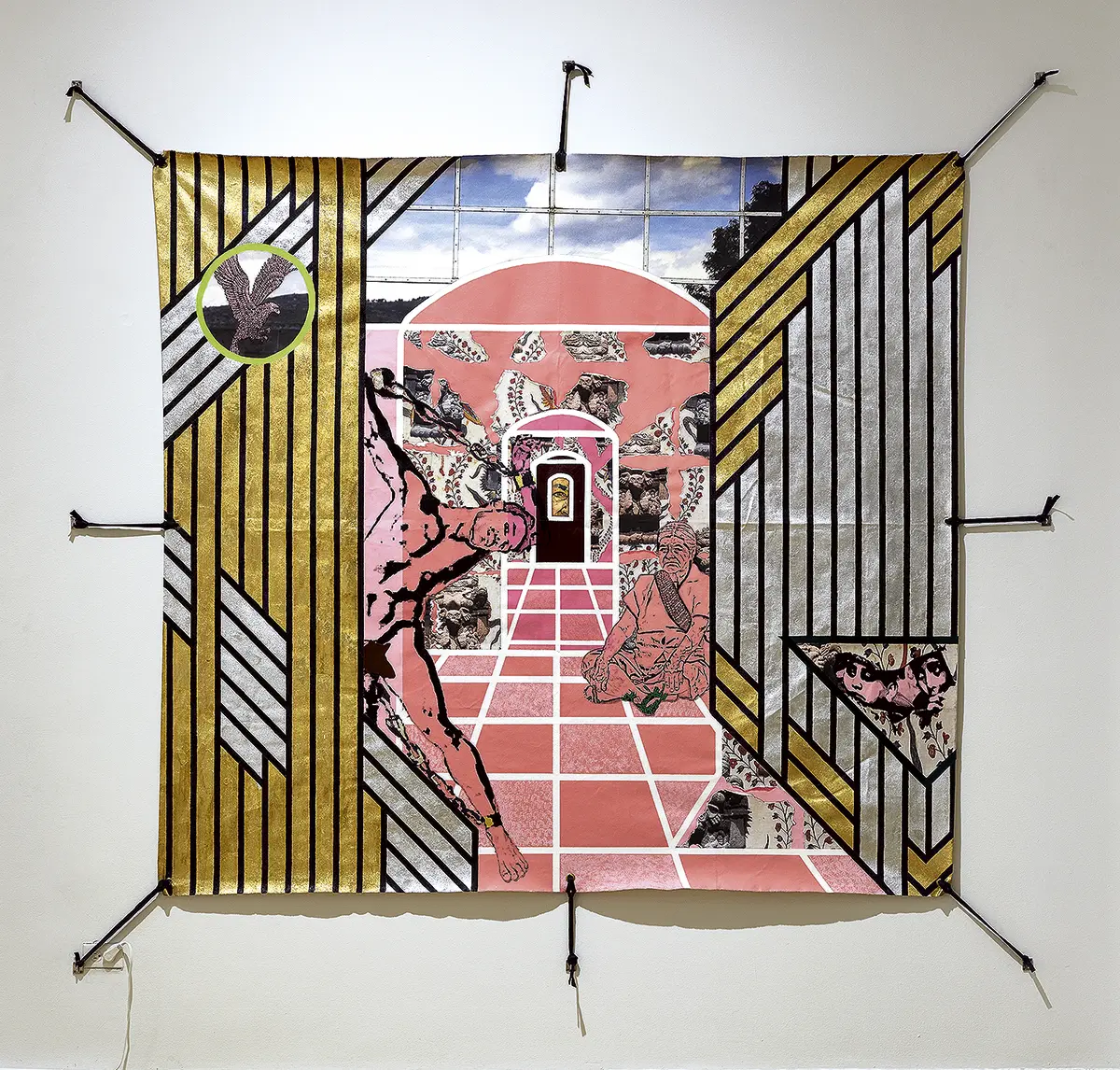
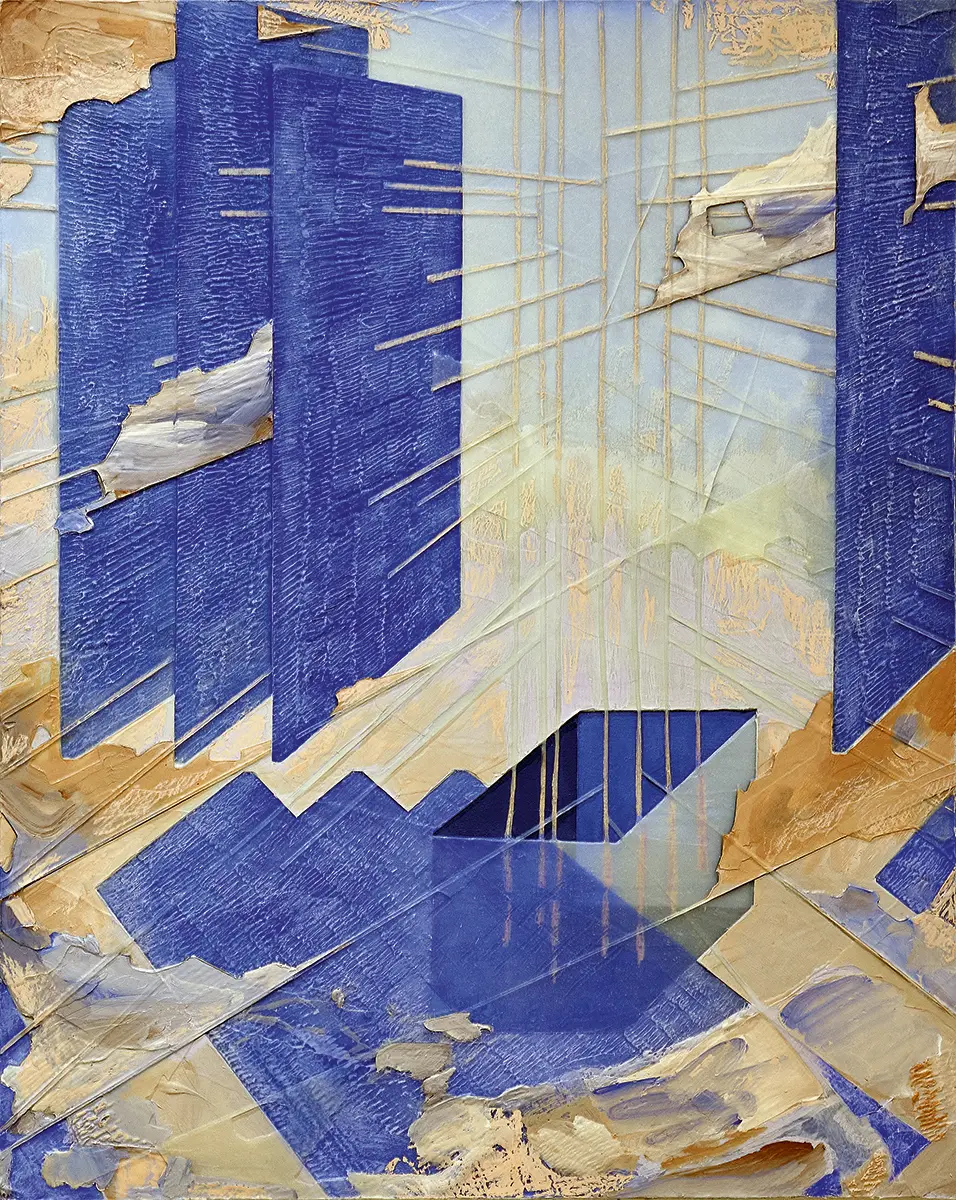
In Ataque del intermediario (2021), Cabret’s planar painting made with gel polymers, marble dust, and acrylic and intricately executed is imbued with references to digital technologies, coding, as well as Constructivism and the Bauhaus respectively vis-à-vis El Lissitzky and László Moholy-Nagy. Blue rectangles are suspended in the middle of the Cabret’s canvas and interspersed with lines that bisect them all the while amorphous, cloud-like shapes seem to idlily float by. In the center of the painting that is not unlike some computer landscape rendered analogically, is something resembling a box. Its affect is not unlike the obelisk in the intro to Stanley Kubrick’s 2001: A Space Odyssey. I could not dispel the possibility that another of Cabret’s painting addressed his homeland of Puerto Rico, for his Tierra Destruida (2021) alluded to a dichotomy of trauma and arcadia ciphered through an elegant palette that pleasantly rubbed up against his painting’s title. Painting in general was very well represented in the biennial, but just as formally and conceptually expansive as Cabret’s was the interdisciplinary artist Gabino A. Castelán. Castelán’s mixed media “painting” titled Our Mothers Have Not Abandoned Us (2021), is a multimedia work of gold leaf, paint, collage, and other materials, and though this adamantly situates it into a register all its own, grommets of which leather strips woven through them affixed to the wall gave it an ostensibly sculptural palpitation. Like Cabret, Castelán’s composition has a strong use of planarity in the guise of the grid and geometry. These forms historically have been the province of high modernism; think Piet Mondrian, Kazimir Malevich, and even later Neo-Concretism, for example. What Castelán does, however, is not something theosophic or gnostic like the former two, but like the latter his grids have a myriad of sociopolitical associations alluding to displaced motherhood that looms like absolutes, archetypes, or some other totemic apparitions. Other artists incorporated painting too, as was the case with the multimedia piece by Catalina Schliebener Muñoz.
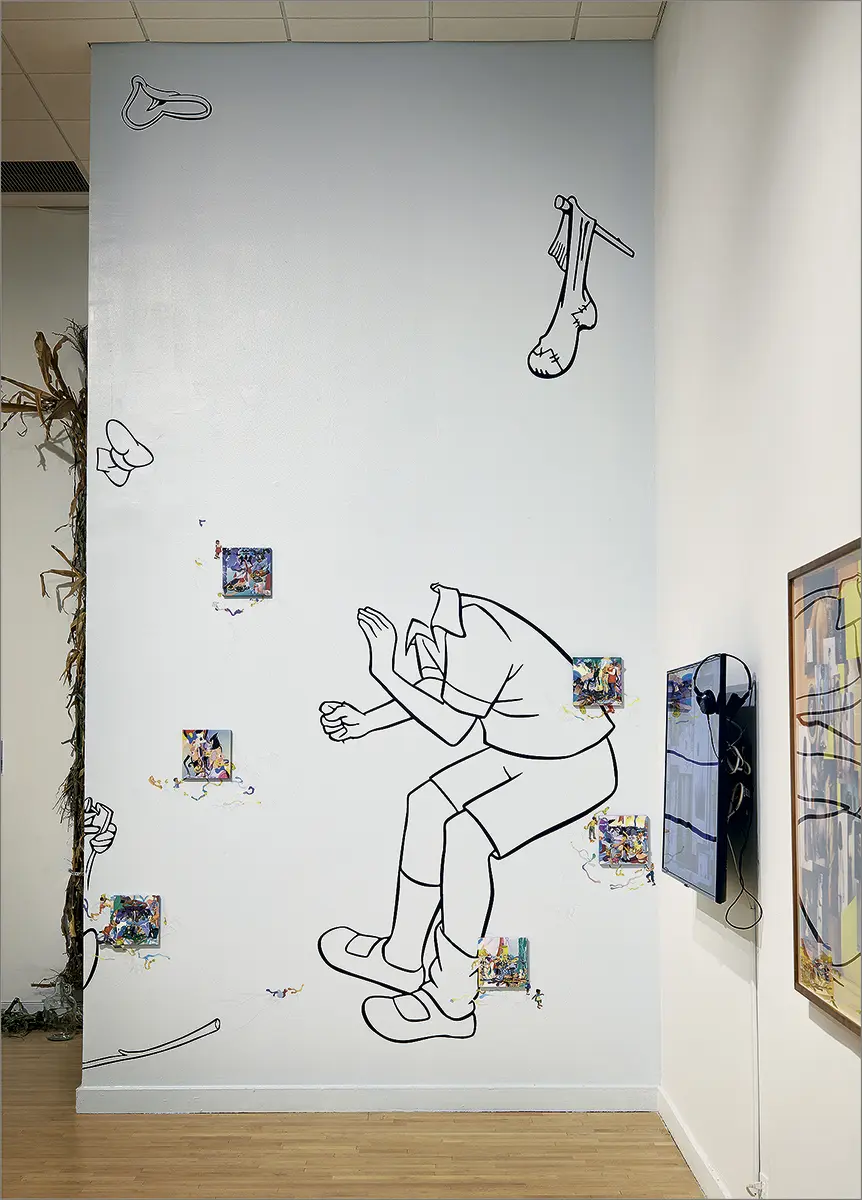
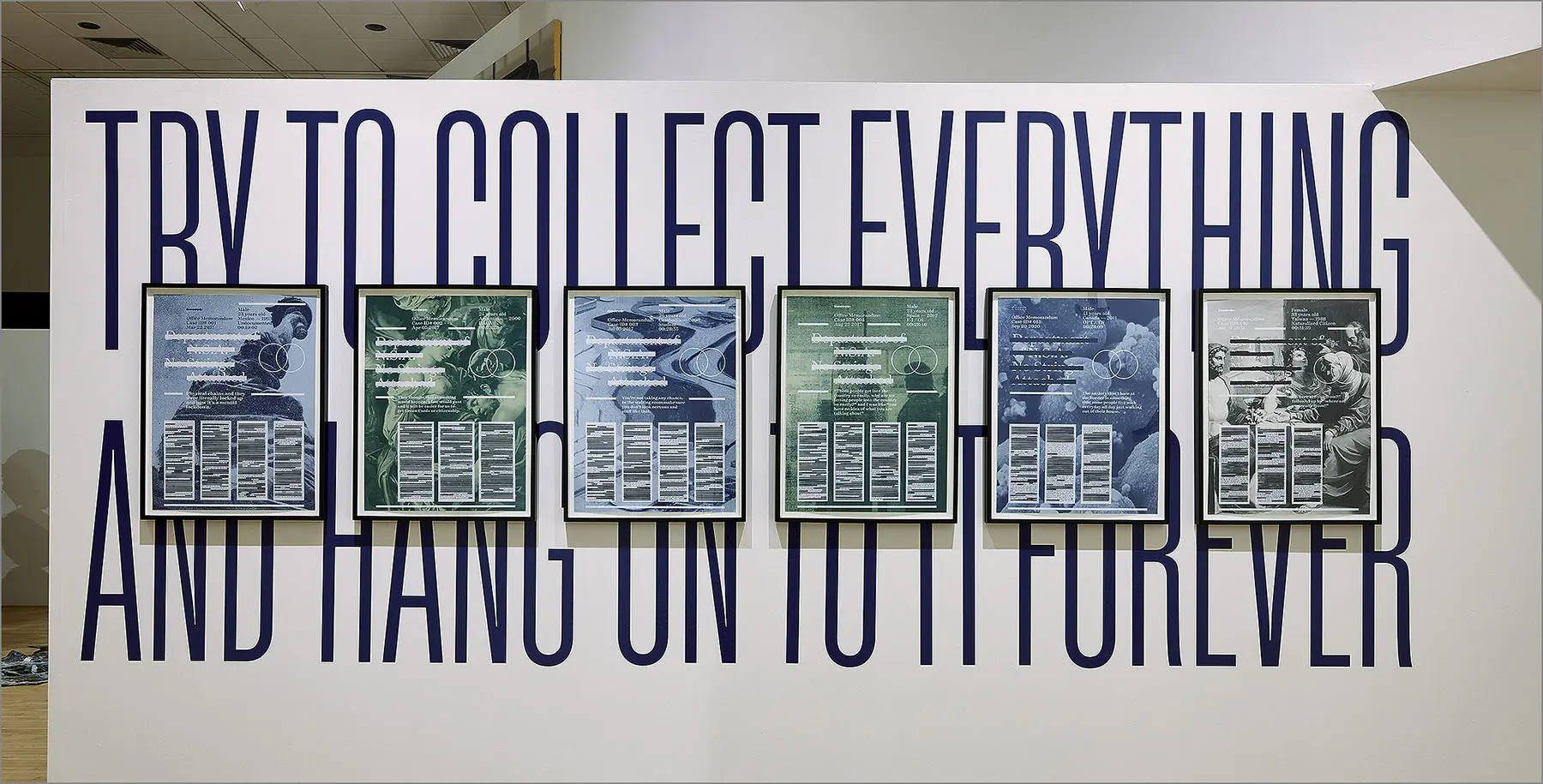
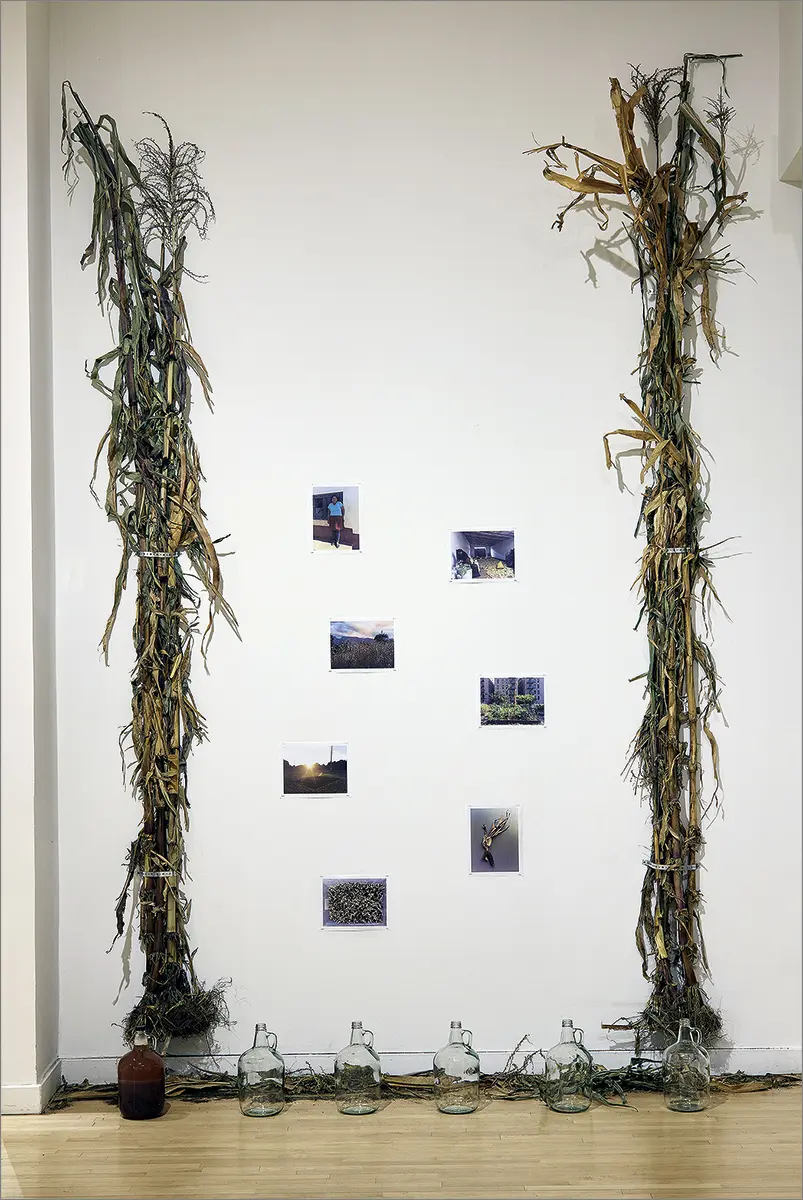
Muñoz’ site-specific installation titled Satanic Panic series (2020-21) consists of a broad array of formal elements deftly composed on the Bronx Museum’s architectural interior as if by some other-worldly, and if you’ll allow devilish hand? Incorporating collage, paint, vinyl, and graphite on one wall that wraps around onto its other side, the work had a mesmerizing quality and evinced Muñoz’ cultivated artistic imaginary. Its subject matter was just as heady: working with quotidian imagery of childhood trauma of broken domesticity and familial normativity, these were further complicated in using the Satanic panic accusations of individuals in the 1980s as cultural backdrop. Though the accused were eventually released from prison, they were convicted on testimonies of pre-school children who were later found to have been coaxed in their fictional recollections of abuse by Christian, homophobic therapists. Other installations that were equally as engaging were from Carlos Jiménez Cahua and his brilliant Artifacts from Chicha de Jora (2021). The installation entailed photographs of the eponymous Peruvian alcoholic beverage made by pre-Hispanic, Andean indigenes and now manufactured contemporaneously with modern technology. Thematically the artist voices interesting dichotomies via Native Peruvian signifiers with those of the present day: of indigenous culture and cooptation, of South and North America, of colonized and colonizer, of outsider and insider. The photographs were bracketed by maize stalks on either side, for maize is the alcohol’s fermented ingredient. Actual chicha de jora was also used in the installation which transformed it from not only an optical artistic experience, but to equally an olfactory one. Another installation incorporating digital reproduction as well questions of transnationalism was Rodrigo Moreira’s Office Memos (NSA-No Strings Attached) (2017-21). The USA’s National Security Agency’s acronym was wryly transformed as trope about gay immigrants and the experiences they have in the USA. Using what appears to be ubiquitous office memo letterhead, Moreira’s installation had a seemingly humorous element in its title yet was dreadfully existential in conveying immigrant anxiety of getting caught up in bureaucratic cogs of endless interrogations made even more problematic with xenophobia and homophobia.
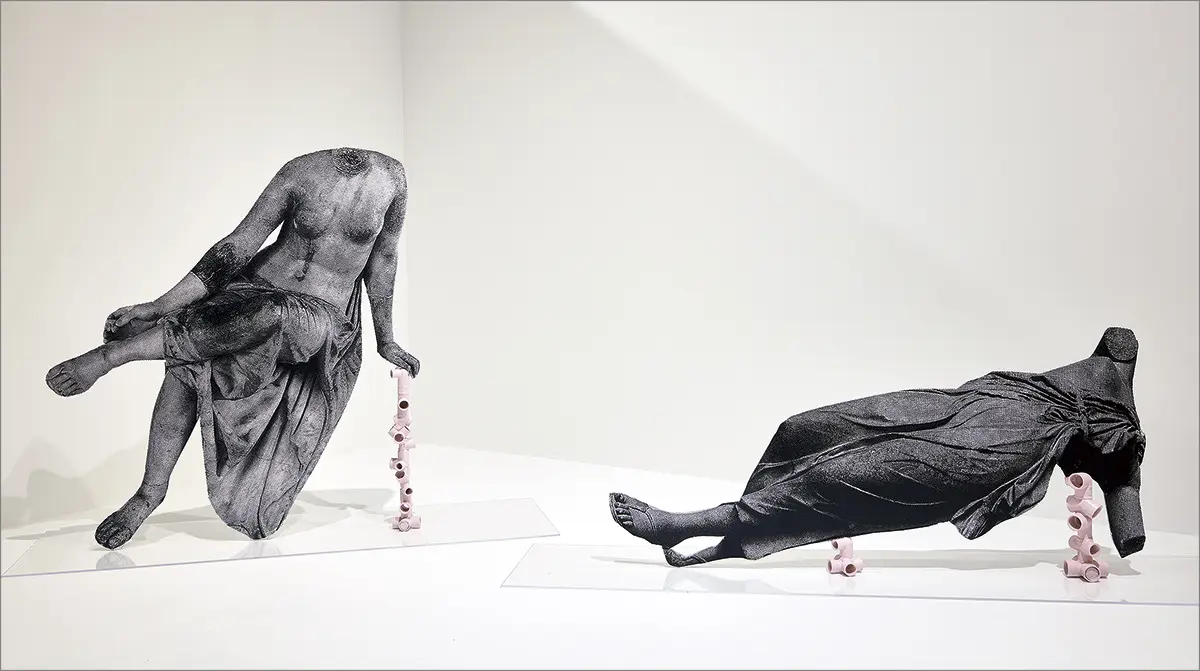
There were so many great works presented in the biennial in numerous genres including photography, video, and sculpture of media such as Luciano Pinchiero’s exquisite pair of life-size Greek Maeneds made from Sintra and propped up by plumbing female elbows made from PVC. Pinchiero’s critical historicity of recontextualized readymade hardware was in dialogue with Vanezza Cruz’ cathartic Imaginaciones de la diaspora: Artefacto: serie #1/ Desde el olvido del mar (2021). The materially dense sculptural installation of “jute mesh filled with metal mesh, artificial and artist’s hair, bubble wrap, beaded items, jewelry, seashells, moss, twigs, zippers, plastic crystal shards” and so much more, lamentably cited human cargo thrown overboard during the 400 years of the Atlantic slave trade, and is an apt encapsulation of the imperativeness of the 2022 Bronx Museum of Art’s AIM Biennial. Like Ms. Cruz’ installation that demands the past be confronted at all costs, New York City museums need to come to terms with their own skeletons of corruption including unethical business practices of their board members; repatriation of illegally obtained, non-European artworks to their owners; employment equity so that their personnel reflect the racial, religious, ethnic, and sexual and gender diversity of their art-viewing publics; as well as having the courage to take chances by exhibiting and supporting artists like Ms. Cruz and the other AIM biennial artists. Thusly the Bronx Museum of Art’s AIM Biennial should be the benchmark these Manhattan institutions should follow. I won’t hold my breath; but in the meantime, it’s a quick subway ride to see the many incredible exhibitions the Bronx Museum of Art has to offer.
* Photo: Argenis Apolinario. Courtesy: Bronx Museum.
New York-based independent curator and critic.