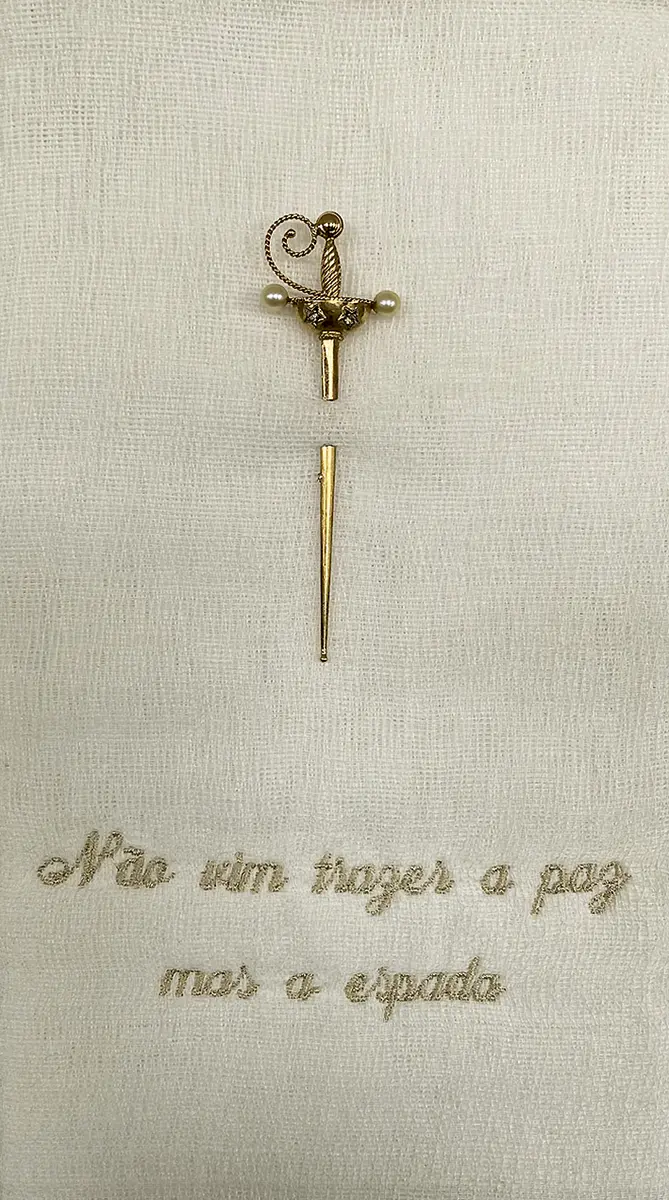
The work of art that gives this exhibition its title is framed and measures 26 x 16 centimeters. Within the contours of the frame is a gold pin in the shape of a sword, with two pearls and two gemstones, set on surgical gauze. A quote from the Gospel of St. Matthew is embroidered on the gauze: “I came not to send peace, but a sword”
Curator Francisco Carpio notes that this work can function as an icon or votive offering, not only because of its aspect and format, but also because of its symbolic reach. Also prominent here, rituality is a characteristic of Beth Moysés’ oeuvre, and on this occasion, it once again combines with her feminist position to produce a formally delicate work of art that is nevertheless potent in its postulates and content. I understand that the selection of the biblical verse denotes a combative feminism, aligned with the movement’s contemporary activist bent, yet the exhibition as a whole operates with subtlety on the basis of a suggestive poetics very much of its own.
In line with the creative interests that Moysés (São Paulo, 1960) has sustained along her twenty-year career, the production on display here features elements such as the recourse to textiles, the use of the color white, and an engagement with the issue of domestic violence. In that sense, it may be useful to understand that gospel quote in its full context: “Do not think that I have come to bring peace upon the earth. I have come to bring not peace but the sword. For I have come to set a man ‘against his father, a daughter against her mother, and a daughter-in-law against her mother-in-law; and one’s enemies will be those of his household.”
In the video titled 129 en llamas (129 In Flames), the presence of the mouth, with its strong psychoanalytic charge, is presented alongside metal bobbins that allude to the beginnings of the feminist movement. This work connects with a metallic crib also containing bobbins, allusive to childhood, to genealogies, and to female universes. Along similar lines, the body reappears as a material witness of the mother-child bond in works like Ombligo (Navel), from 2021, a cube-shaped block of marbled resin that calls to mind and mimics umbilical anatomy in order to symbolize the connection to the mother, as well as the magnificence of the beginning of life.
A standout among the video and photographic records of Moysés’ performance is Aurora (Daybreak), from an action in Madrid in 2019.
The artist walked along city streets with a number of women, in silence and in the almost ritualistic solitude of the early dawn, stopping at landmark spots for women’s history, such as the goddess Cybele fountain that has been a key rallying area for the feminist movement since its earliest days in the city; Montera street, a hotspot of prostitution; or the Monastery of Las Descalzas Reales, a convent for cloistered nuns. The flag the artist carried during the walk is also on display in the exhibition, as testimony and extension of her action.
Many of Moysés’ works engage the issue of domestic violence from a collective standpoint. Just as in Aurora the artist does not move towards the realization of her poetic action all by herself, in her performance series Las malas muertas (The Bad Dead), the actions are performed by a group of companions whom the artist provides with a paraphernalia leaden with symbolism, which allows her to set in motion rituals of healing and purification or for expiation of violence: white tunics, turbans, flowers, banners. This recourse to companionship seems to have a therapeutic intent and transmits a feminist message: “I am not alone”; “we are not alone”. As the curator accurately puts it, these are Moysés’ genuine “female weapons”: “sharpness and sword, idea and brio, determination and aplomb, and with them she presents her latest exhibition project, inhabited by a determined and committed attitude that is both belligerent and full of reason.”
No vine a traer la paz, sino la espada (I came not to send peace, but a sword) is an exhibition with many layers of meaning linked together with great sophistication and delicacy. The body of work on display here is dated between 2019 and 2021; thus, the circumstance of the pandemic could not be absent. It is visible in Yo, el cielo: en el aislamiento (Me, The Sky: In Isolation, 2020), an 80-piece polyptych presented in the back room of the gallery. It is the logbook-like photographic register of what the artist saw from her window during the lockdown period. In this way, the personal coexists with the public and the collective, in profuse and suggestive ways. Starting with her own body and her memory from her bedroom window, and expanding into the city streets, the artist brandishes her sword in order to stir sensibilities and thoughts.