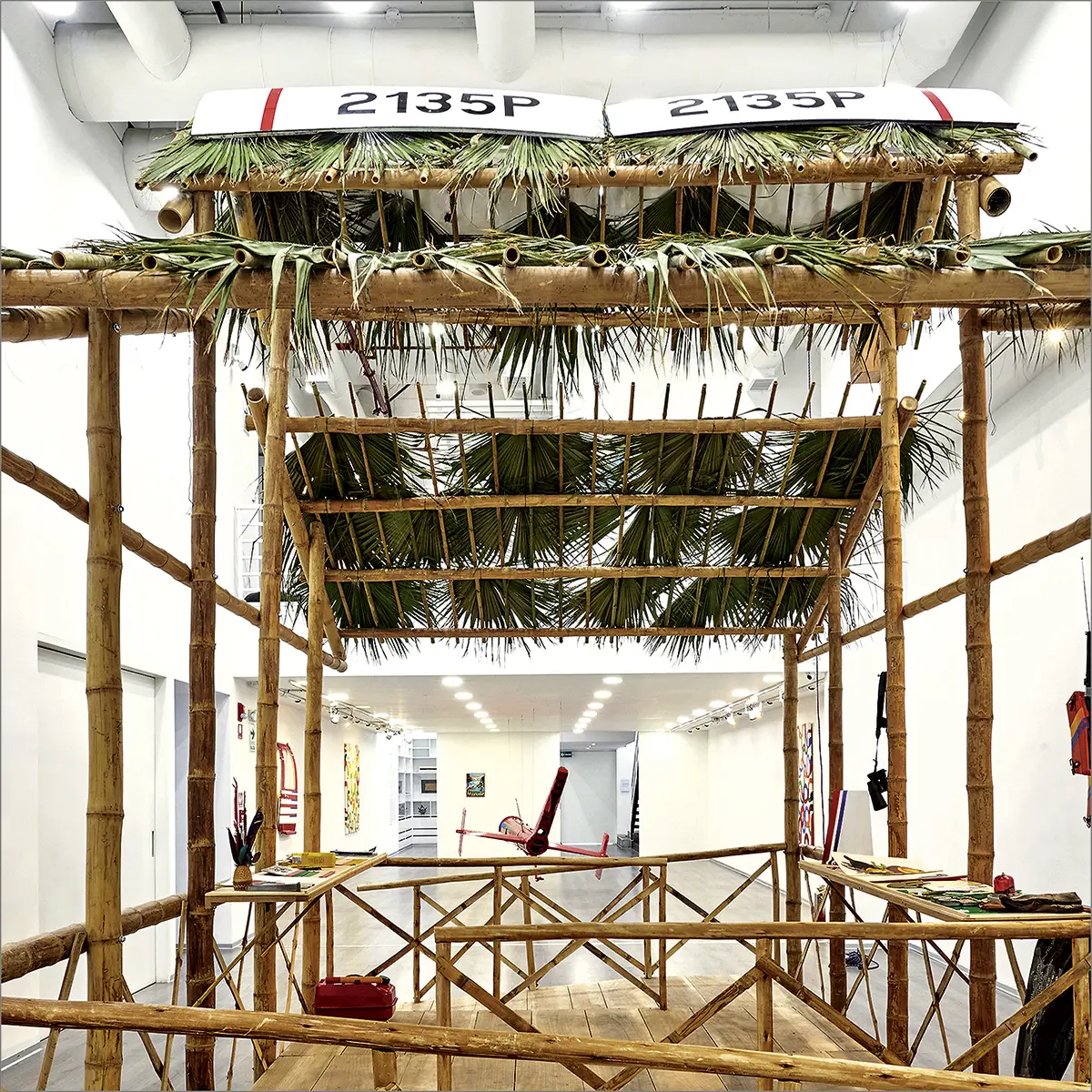
Artist, gleaner, and collector Augusto Ballardo’s years-long project of displaying his many finds and comparing the worlds he has been interrogating achieved a concrete materialization in El último hangar (The Last Hangar), presented at Lima’s Impakto Gallery in 2021. This exhibition seems to us to be part of a dialog in two times, contrasting two civilizations in the context of the Amazon basin region.
Inviting us into a maloka, the artist has us rediscover a site used in Amazonian communities for shamans to seek refuge and find the wisdom of the natural world, and also one where important community events take place. At the same time, he confronts us with the remains of airplanes that force us to face uncomfortable realities concomitant to Modernity, and with other relics transformed into art objects that propose a syncretism of the two cultures.
Augusto Ballardo embodies the artist as collector and appropriator, who uses objects to trace symbolic lines for the understanding of a hermeneutics that, while deeply present in our lives, goes unnoticed by our city-bound, historically exoticizing eyes. The syncretism of the rainforest and its dimensions can be apprehended through the a priori information that the elements selected for exhibition offer. The exoticism with which the Amazonian context has been treated among us is brought to the fore by means of illustrations, postcards, and other objects.
At the entrance to the gallery, Ballardo builds an archeological cabinet to showcase, through a variety of artifacts, a concentration of designs. Many local collections support this museological display; the textiles, feather works, and pottery created by Amazonian and Andean societies are able to illuminate the Amazon peoples’ worldview.
In his work, Ballardo always seeks collaborators based on bartering and the exchange of knowledge. In this case, by producing El último hangar with archeologist Daniel Morales and museographer Ana Mujica, he incorporates the concept that animates his scientific investigation, “living archeology”, which posits that the first people’s traditions continue to diligently preserve the very knowledge (the written and graphic language) that archeology, through the findings of different research projects, seeks to decipher.
A separate mention must be made of the airplane parts Ballardo has found. Appropriated into artworks, they feature multicolor geometric patterns inspired in Amazonian and pre-Columbian worlds, both present in the artist’s palette and applied to his art since the beginning of his career. Their symbolic connection to birds renders a cultural relationship with modern flying vehicles even more visible. The remains of those airplanes were used as components in shrines that became central in different kinds of rituals.
The museographic presentation of these two materialities, antagonistic in their origins, quickly drives us to recognize the thread of modernity’s integration in the Amazon region, as well as the exoticism with which it is seen in the city. The maloka helps us see the entire staging under a more Amazonian gaze; architecture is always crucial for understanding any moment in the history of art, and, without a doubt, Amazonian architecture brings us closer to the aesthetics and vision of the forest. Books, accessories and necklaces, illustrations, pottery, pigments, feathers, radio transmitters, and musical instruments enframe us in a reflection about the region’s territory; meanwhile, the ruins of military and civilian airplanes that fly over it end up in spaces of worship, which undeniably also tell a rather contemporary story—that of the transport of illegal drugs, sketchy military operations, and failed forest journeys.
After Hangar, Ballardo presented Panamazonía - Arqueología Viva (Panamazonía - Living Archeology), at the 2021 Cuenca Biennial, invited by curator Blanca de la Torre. The Biennial’s focus is on three transversal axes: ancestral knowledge and other epistemologies; ecofeminism; and future scenarios. The event is oriented towards sustainability and the environment. Ballardo, an artist whose proposal has architecture and the study of pre-Columbian design as its foundation, fits perfectly within those curatorial lines; moreover, the museum/cabinet that accompanies him involves the viewer in the understanding of specific cultural, social, and historical processes. Behind this entire museological display lies a years-long research project focused not only on gathering objects, but on giving them meaning within its narrative to reveal a hybrid, modern/postmodern, highly contemporary worldview, one that is a lived experience in the rainforest region.