Image, space, time, and memory make up the substance of André Severo’s art. His search to allocate these elements within his creative experience and the possibilities of representation have been a constant in his work, as evidenced by the complex relationship between the processes and their recording mediums; mixing audiovisuals, performance photography, and actions in landscape, among others.
The magnitude of his work can be appreciated in the solo show “Andrés Severo: Archiperiscopio”, curated by Paulo Herkenhoff, which recently took place at the Centro Oi Futuro in Rio de Janeiro. Covering an extensive panorama of this South Brazilian artist’s production, the show presented various works based on references from the history of Western art to explore human relationships, nature, and images. The title “Archiperiscope”—a reference to the optical object that places two mirrors in relation to each other to allow an enlarged and long-distance vision—alludes to the multiple trajectories of André Severo, who is also a curator and producer.
Paulo Herkenhoff considers “Archiperiscope” to be a metaphor for a polysemic, multiple, wandering, plurivocal, heterotopic regime. “André Severo’s work is about the circulation of art-as-image. His bare presence in videos, photographs, books, and exhibitions hides the complexity of that challenge. Publics are not always aware that they are encountering an art proposal and that they are also a target of this proposal. For the artist, all cultural circulation is a form of social contract with its reception,” avows the curator, who began planning this exhibition nearly three years ago.
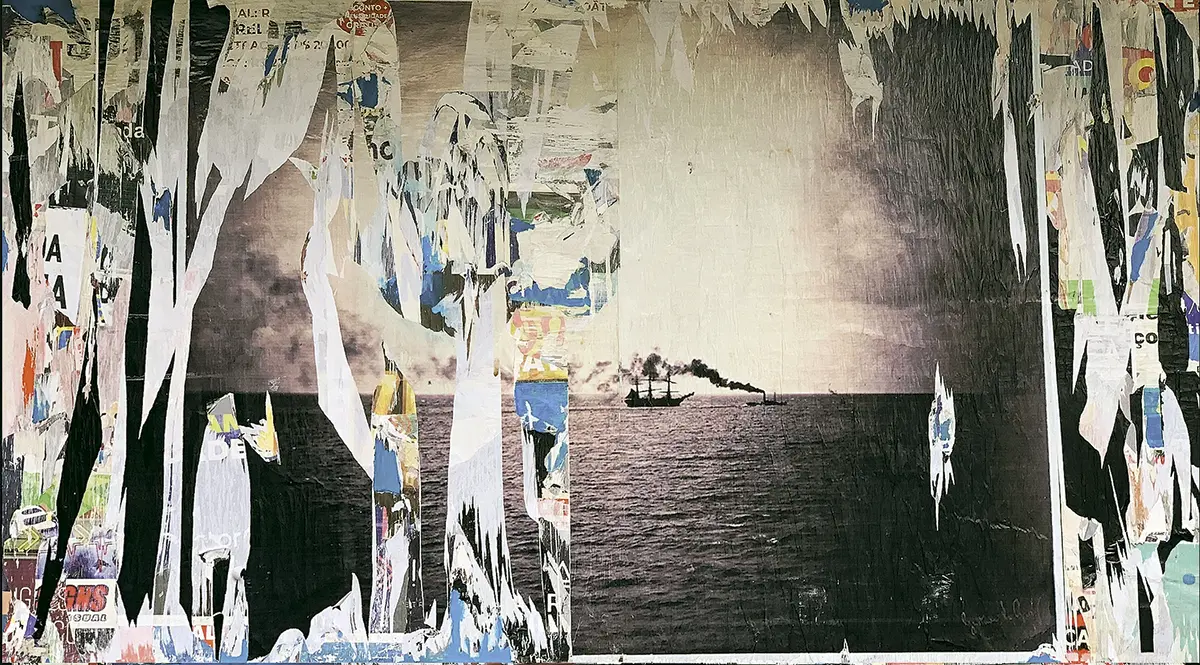
In Oi Futuro’s courtyard, a large installation entitled Rastro (Trace) presented the ephemeral layered remains of an urban intervention by the artist: he had enlarged an image by Gustave Le Gray (one of the most important French photographers of the 19th century) in the format of a street poster and pasted it on the walls of public places. Eventually, Severo removed these posters along with the remains of other previous posters and fragments of new superimposed ones, which became the Rastro panels.
Other works in the exhibition also quote names and moments of Western canonical art, such as the A onda/La vague (The Wave) series, with paintings reproducing works by Gustave Courbet (1819-1877), the French master of Realism. In Academia, a series of twelve works made up of about fifty drawings each, the artist references the 18th- and 19th-century academies, where artists learned to draw by copying the works of others. In large formats, they comprise a huge panel of juxtaposed and superimposed drawings.
The relationship between image and representation, as well as its ontological role for Western culture, led to the creation of Passage, comprised of fourteen videos with animations of photographs of the movement studies carried out by Eadweard Muybridge between 1883 and 1887. A kind of passage between death and resurrection, this installation portrays isolated individuals, out of time and from different walks of life, marching in the same direction, each traveling at their own pace and in their own way.
Other works were composed with literary material, such as The Messenger, a collage of excerpts from various books by the Mexican poet Octavio Paz (1914-1998). Twelve texts were scattered in various corners of Oi Futuro. Initially produced in the context of a trilogy of exhibitions between 2015 and 2021, Paz’s texts were used for this occasion as a kind of poetic and conceptual guide.
A professor of visual poetics at the Art Institute of the Federal University of Rio Grande do Sul, Severo has participated in exhibitions in Brazil and abroad. Prolific, multiple, and complex, his work is always presented as cyclical, with self-references that signal the artist’s constant poetic search for an ultimate meaning. Looking back at his trajectory, which began twenty years ago, is a way of understanding how the artist reached his actual state, presented in “Archiperiscope”, his first solo show in Rio de Janeiro. Issues such as time, space, and memory have been present from the start, with projects often made in collaboration with others, including non-artists, as well as with immersion methods such as travels, walks, excavations, books, or philosophical debates. Severo shows us that art’s inherences comprise the core of a poetics sustained by an extensive conceptual and philosophical scaffolding, and deep dives into his subjectivity. Beyond the vicissitudes of life, Severo questions himself and art: “I understand everything I do as one thing. I work compulsively and each work is a part of the whole, of who I am, which helps me to grasp the poetic processes, but also those related to my search and existential queries.”