In the framework of Gallery Weekend, Proyectos Monclova took on the task of revising the pictorial work of Mexican artist Abel Quezada, widely recognized as a political cartoonist. His paintings are less known, but just as expressive and ingenious.
Quezada worked for decades as a cartoonist in Mexican print media and occasionally for foreign publications such as The New Yorker magazine. He saw himself as a draughtsman; as someone who produced illustrated texts, and who did not fit neatly into the category of a cartoonist. He worked in his paintings during his free time, as a hobby; and it was not until 1985 that he was given the first exhibition of his paintings, at the Museum of Modern Art in New York.
For decades, Quezada masterfully portrayed society and political figures in refined and scathing critiques. He continued to do so in his painting, while expanding his thematic repertoire with personal experiences and anecdotes to create playful works that surpassed the satiric genre.
At first glance, paintings from the early 1970s up to the late 1980s seem to be simple chronicles, but all manner of details added up to produce eloquent and imaginative storylines. A good example is Jockey Club Members (1972): a disproportionately large horse looms over the tiny characters below it. These figures are elegantly dressed, and we can imagine their milieu, hobbies, and interest in seeing and being seen at the equestrian club where the elite normally gathers.
In Life in Mexico during the crisis of the 1970s and 1980s we feel irony seeping into a country setting. Charros ride on horseback, a couple performs a typical Mexican dance to the music of a trio of musicians, and a miniature table is set with some food and drink. Crises, unfortunately common throughout Latin America, have been a recurring theme in twentieth-century sociopolitical caricatures and have often been humorously rendered by various artists.
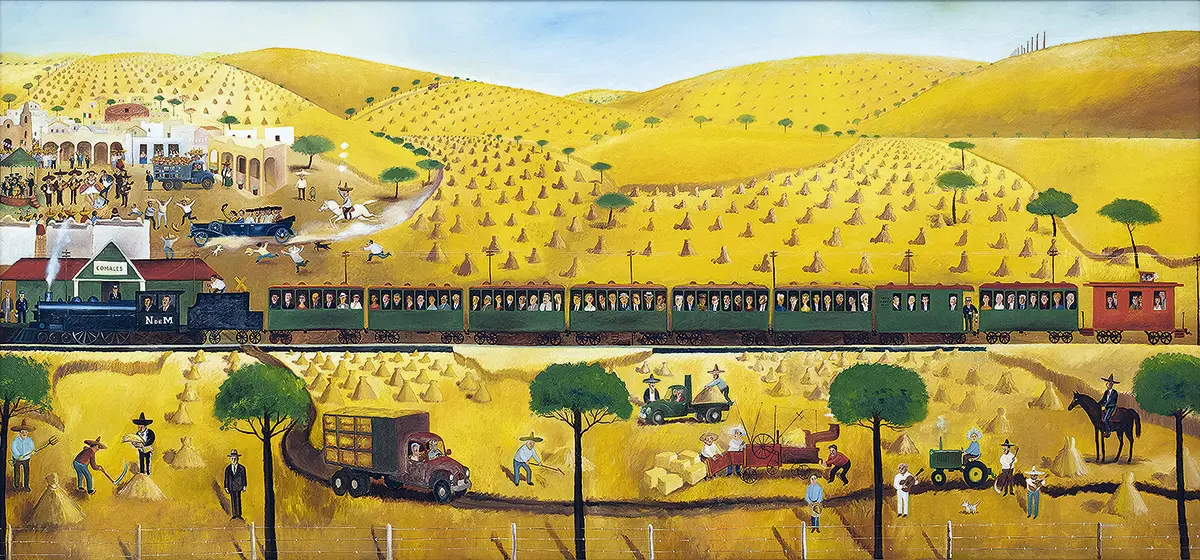
The large-format Project for a Mural: Mexico Emerging from the Crisis depicts an idyllic scene where field workers are sowing and harvesting, while a train passes above as a symbol of progress, packed with distinguished ladies and gentlemen in suits. And in the background: a party, a canvas, an escape from the surrounding reality. The painting was accompanied by a note from the artist: “This mural was never made and remained a project, among other things because of its title, Mexico coming out of the crisis, since it so happens that, while it was being done, Mexico fell back into a crisis” (AQ).
It is fascinating how Quezada was able to capture Mexican idiosyncrasies and, unfortunately, also its crises, which is why his work remains so relevant. He addressed his subjects with sarcasm; humor is known to be the best way to face adversity.
Portrayals of everyday life was another theme he explored in his paintings. A girl leans back in an armchair and, through a window, we notice a couple that seem to be her parents having a drink in the garden: an involuntary family portrait. Or, as in Lady with a Recipe for Stuffed Peppers (1985), a very well-groomed woman proudly poses with a recipe for stuffed peppers, a very traditional Mexican dish.
A portrait painted on a folding screen was possibly inspired by the folding screens that narrate historical passages, a practice originating in Asia, but also present in 17th century Mexican art. Quezada’s version portrays Ignacio Zaragoza, considered a national hero for his triumph against the French army when it invaded Mexico in 1862. The general is rendered in all his glory and mounted on his white horse. This is not the typical epic tribute to war heroes immortalized with their horses, but rather a portrait with the overtones of children’s drawings.
In 1978, the painter José Luis Cuevas visited Quezada in his home-studio in Cuernavaca and became acquainted with his pictorial work. He later wrote Quezada a letter: “Someone said that your painting is primitive (naïve). I do not agree with this judgment since your work is too replete with nuances and artistic wisdom to pigeonhole it in that category.”