The project of describing the flora of the Viceroyalty of New Granada was an ambitious enterprise that remained incomplete. Shipped to Spain in 1817, the project’s entire iconographic production between 1783 and 1816 is housed to this day in Madrid’s Royal Botanical Gardens. Regardless of all debates or possible critiques, based on contemporary understandings, of older colonialist positions, the truth is that 237 years after the fact, the Botanical Expedition helmed by José Celestino Mutis continues to be recognized as the colonial era’s greatest scientific initiative, a defining moment in the history of the visual elements involved in the construction of the American city and of the national sciences.
The Museo Universitario de la Universidad de Antioquia inaugurated the 45th National Arts Salon, Mutis 2020, on August 21, 2021, with an exhibition of works submitted in response to a call launched in the context of the 52nd National Prize for Culture. That call set Mutis’ work as the referent for participating entries. Out of a total of 115, seven submissions were pre-selected based on the relevance and pertinence of the proposal with regards to Mutis’ ideals, as well as the trajectory of artistic investigations in compatible lines backing them. The Salon’s intention was to increase the visibility of artistic works that, through an interdisciplinary practice and a critical standpoint, engaged matters related to the natural world, botany, zoology, ecology, taxonomy, permaculture, sustainable development, biodiversity, and cultural patrimony.
Alberto Gómez, a scientist and professor at Universidad Javeriana; Nadia Moreno, artist and professor at Universidad Nacional, and Laura Zarta, Chief of the Arts and Other Collections Units at Banco de la República were in charge of selecting the finalists for this edition of the Salon, and Zarta was also tasked with curatorial guidance. The honor went to artists Alberto Baraya, Nicolás Bonilla, Ana María Espejo, Benjamín Jacanamijoy, Edwin Monsalve, Mónica Naranjo, and Nadín Ospina. Eschewing literal allusions, their projects seek to revisit those linkages, in some cases by means of knowing gestures and in others, by reflecting on current socio-environmental and cultural conflicts that could be posited as an enrichment of the older scientific project in its didactic and visual perspective, in no sense exempt from the historical and political contradictions of European colonialism.
The selection of works on exhibit in the three levels of the MUUA, arranged so that each inserted itself in the show as an independent, spatially autonomous experience, attests not only to the generational diversity of the participants, but also to the varied strategies with which artists seek to stake their points of view about nature, science, and the forms of knowledge that can be interrogated through artistic practices.
The Projects
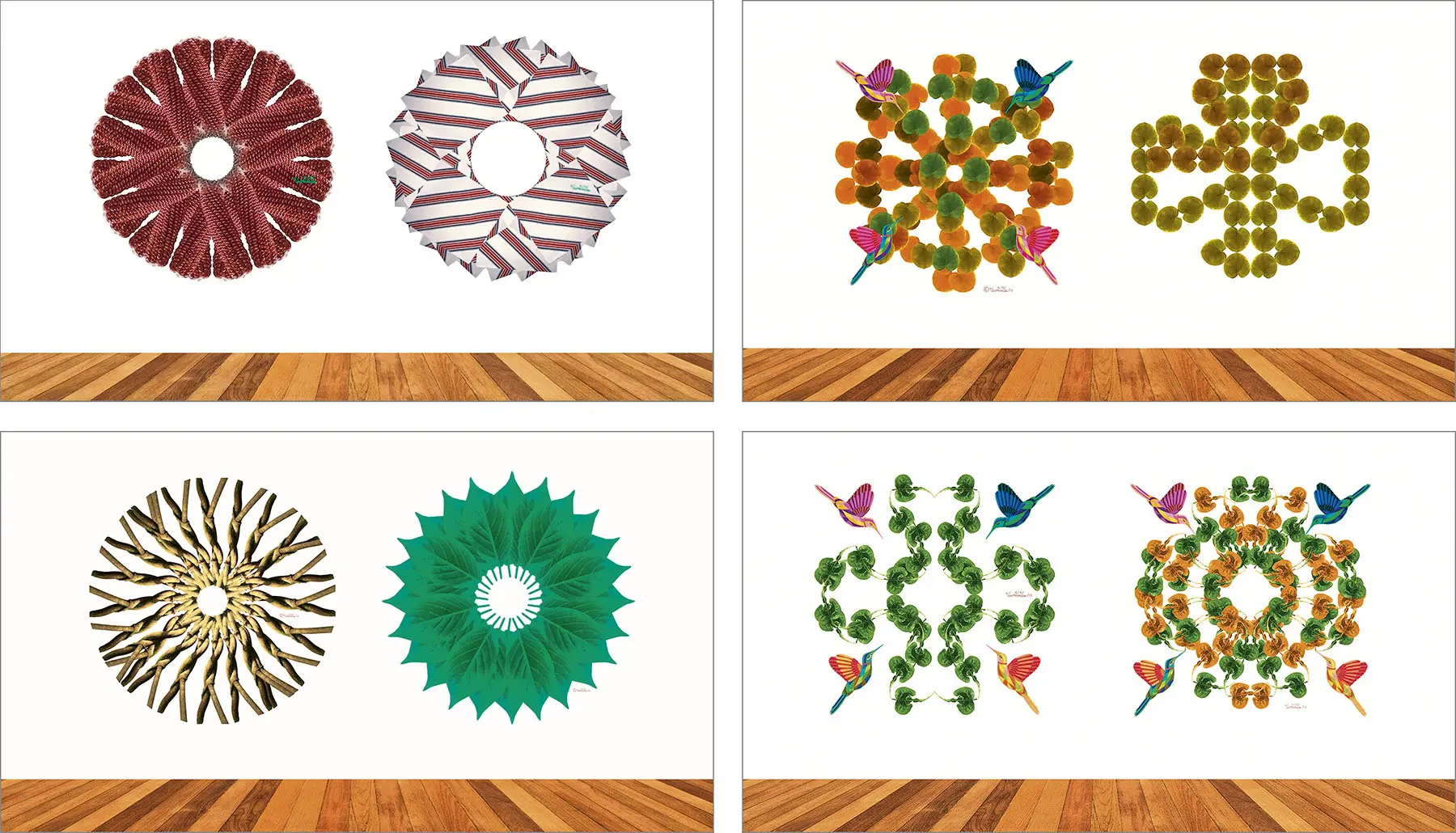
Hauling from the Inga territory, in the Putumayo region, Benjamín Jacanamijoy (1965) has devoted his work to increasing the visibility of his ancestral past and indigenous culture. On this occasion, with En búsqueda de la flor de vientre (In Search of the Womb Flower), Jacanamijoy presents a project derived from communal planting exercise and from the Inga people’s ideas of beautiful thinking and good living.
Based on a narrative about the origins of knowledge, the artist creates a series of visual compositions using various plants classified as vinanes (leaves to revive the spirit), kuyanguillos (herbs for loving and thinking beautifully) and chundures (roots of knowledge used in healing), which are cultivated in orchards, usually under the care of elder women, in the towns of the Sibundoy valley. Resulting from a digital exploration, the colorful dynamism of these images-memory that bring together fauna, flora, and cultural elements is achieved through the modulation of details and fragments, arriving at a kind of local herbal iconography.
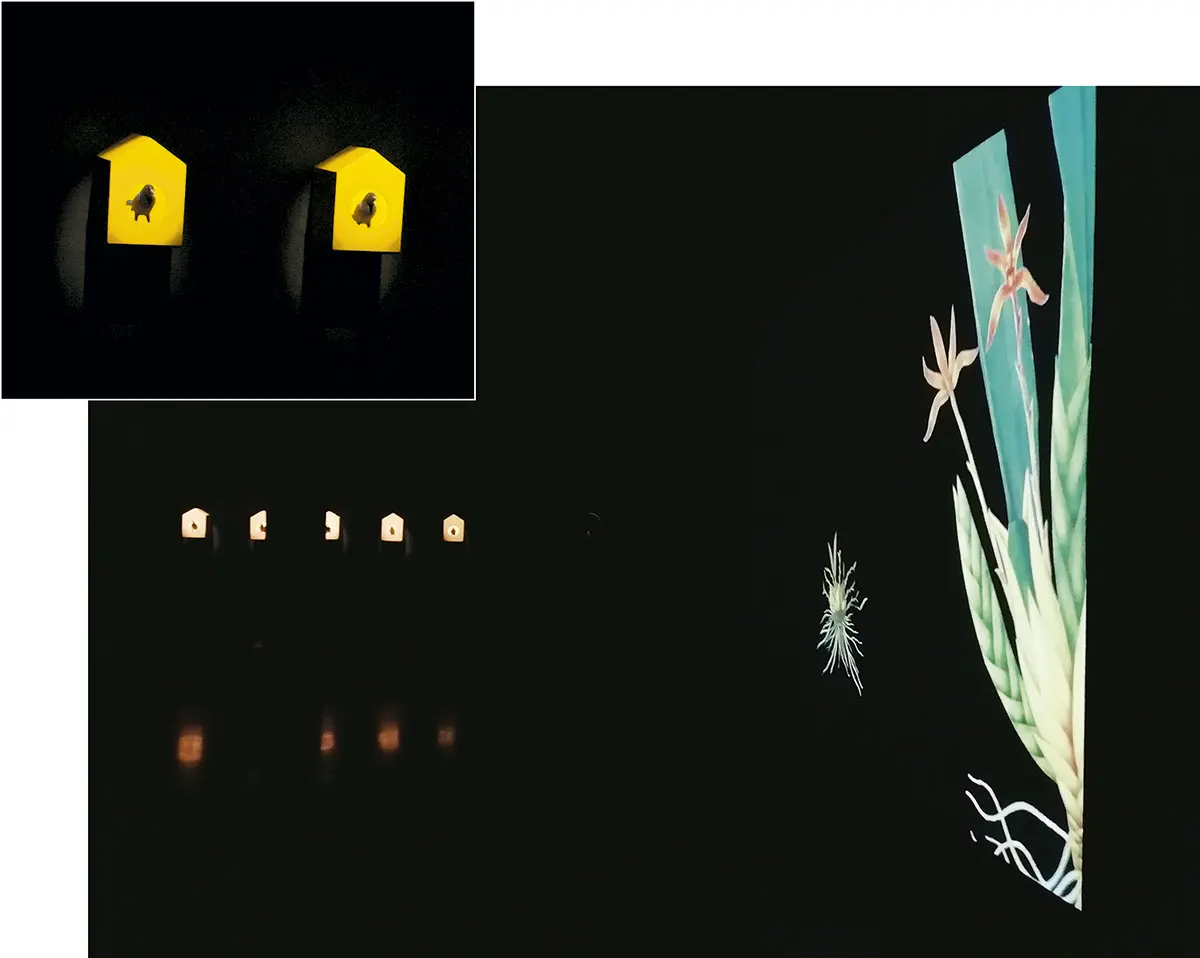
On his part, Nadín Ospina (1960) participates in the exhibition with La preponderancia de lo pequeño (The Preponderance of the Small), an installation that combines audiovisual and sculptural elements in a cocooning experience where sounds and an almost complete absence of light interrogate the value of seemingly minimal things.
Arranged on each side of the exhibition space are figures of native birds in polychromatic bronze: on one side, captive, they occupy small houses; on the other, they alight free on the vegetation. The tension set in motion by the emphatic and mutually antithetical arrangement of these figures—inevitably suggesting a connection with science museums where inert animals were displayed in cases and dioramas, simulacra of their natural habitats—is not limited to the visual.
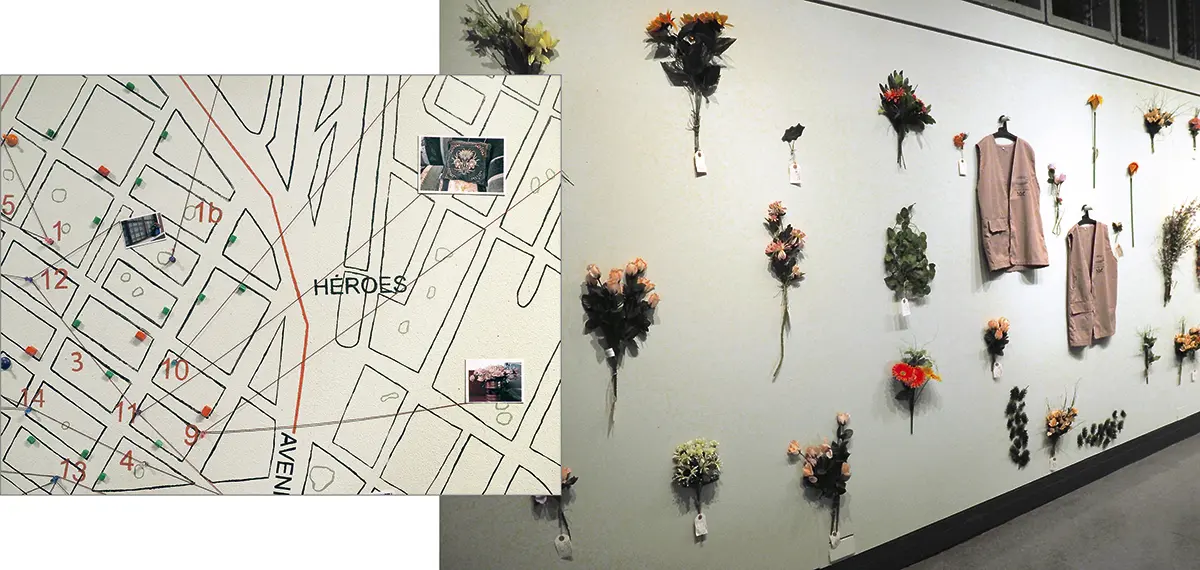
Among the participants, Alberto Baraya (1968) is perhaps the artist whose long-term investigation best connects with the interlocution proposed by the Salon. His long in-progress project Herbario de plantas artificiales (Artifical Plant Herbarium, 2002 and 2021) sets an important precedent in Colombian art with regards to the treatment of the tensions between nature, representation, and history. In that exercise, Baraya extrapolates the organizational, normalizing resource of taxonomy into the building of image-objects where the ideas of the exemplar and the scientific model are made ironic and displaced; a fictional natural world comprised of fake plants collected in a sampler of new landscapes, with the border demarcating the relationship between nature and artifice rendered increasingly more diffuse.
Baraya brings into the Salon the same strategy deployed in those urban expeditions with Flora de Bogotá - Expedición Felipe-Juan (Flora of Bogotá - Felipe-Juan Expedition), the purpose of which was to collect a new herbarium of local plants in the San Felipe and Juan XIII neighborhoods. Later photographed, drawn, classified, and catalogued, the specimens also served to compose a cartography for pathways and findings to be inscribed as traces of the process.
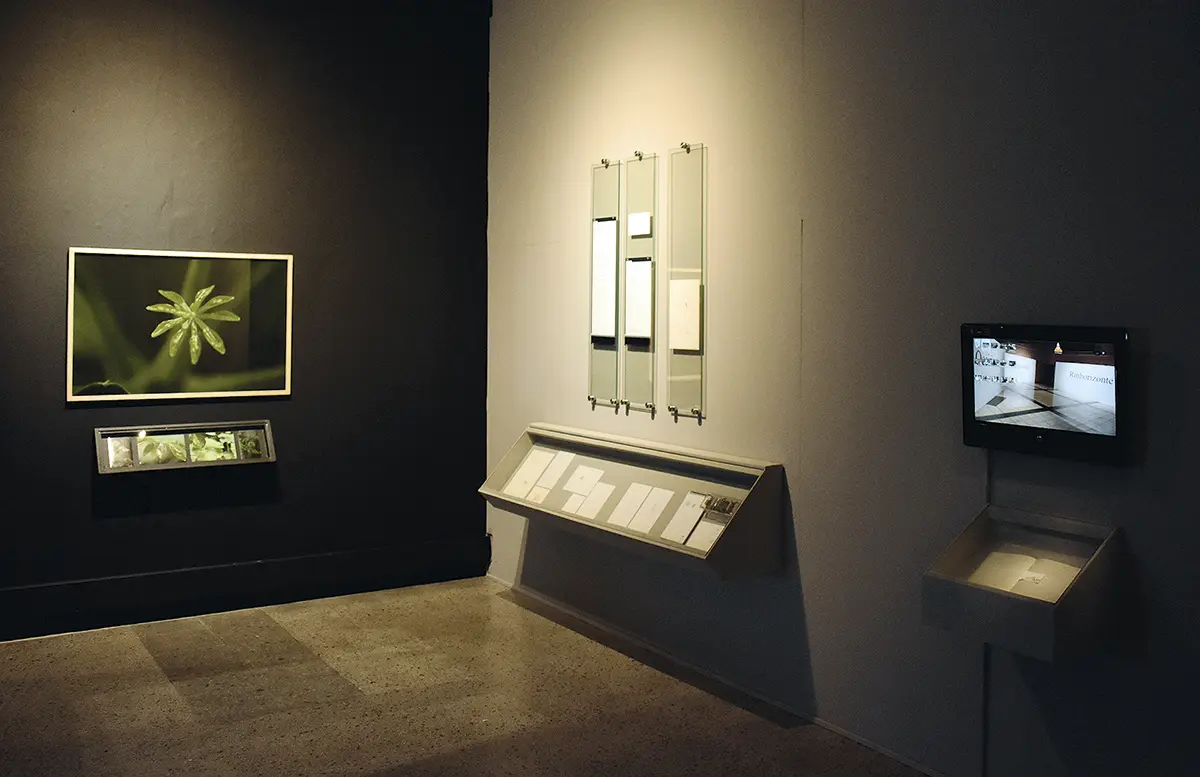
Ana María Espejo (1991) is present with Métodos, exploraciones y excusas para aproximarse a un paisaje inacabado (Methods, Explorations, and Excuses to Approach an Unfinished Landscape), a selection of processes that use as their strategies the observation of nature and territory, documentary inquiry, and drifting as an spontaneous reconnaissance practice (in Guy Debord’s terms), which, materialized in the exhibition space in the form of drawings, photographs, archival and audiovisual material, objects, and living plant elements, propose an unfinished exercise resulting in potency for the viewer.
Walking and observing are the starting points for a number of works that suggest that, in order to move close, one needs to take distance. For Espejo, exploring is equivalent to setting direct experiences and archives in dialog with each other, since the document is also seen as a possible pathway. Particularly suggestive is her proposal of thinking about the surrounding environment as terra incognita, an expression with which she defines the inapprehensible condition of the world, an entity that remains unknown, indecipherable, enigmatic in spite of it all, and, as such, offers inexhaustible possibilities for exploration.
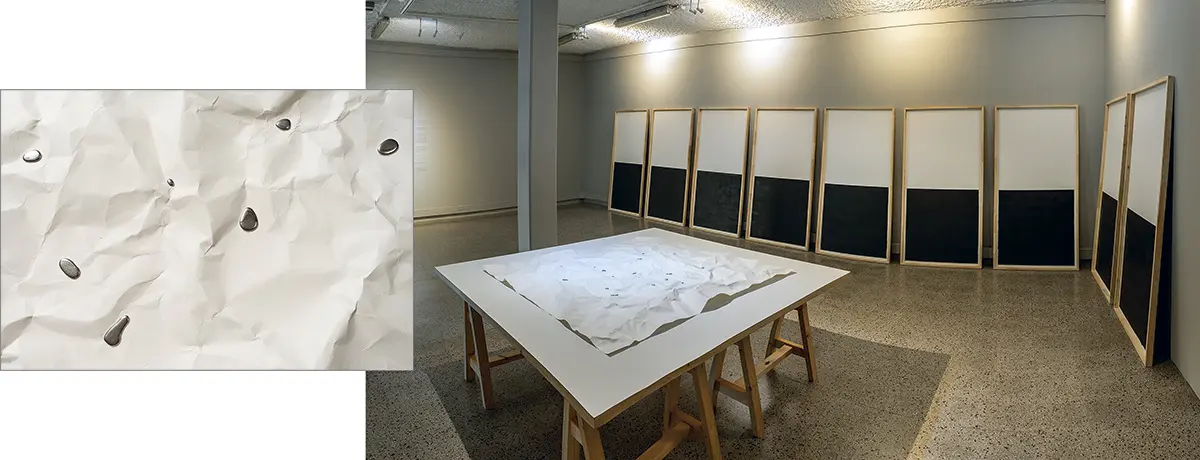
The landscape, anthropic impacts on the environment, and the issue of the image have long been constant preoccupations in the artistic career of Edwin Monsalve (1984). In the project Derivas del paisaje (Landscape Drifts) he proposes also an interrogation of the limits of the representation of nature and a way of pointing out critically the economic and political transformations of the landscape. In the installation, a series of two-dimensional elements leaning against a wall and arranged linearly, suggesting an abstract landscape only by the subtle horizon line, are confronted with the sculptural presence of a topographic model at the center of the space. In the latter, small mercury pools rest unstably between indications of mountains, while among the former, the use of petroleum and mineral coal as pigment and metaphor signifies the fragility both of extractive phenomena and of the items themselves.
With a prior body of work that takes scientific expeditions as its starting point, along with the practice of observing nature and the cultural phenomena associated with the relationship between economy and ecology, Monsalve proposes here an exercise in radical graphic synthesis, a formal and communicative strategy that links his work with minimalism (polished surfaces, solid colors, an economy of form), without losing sight, in the process of abstraction, of its explicit goal of questioning the representation of the landscape.
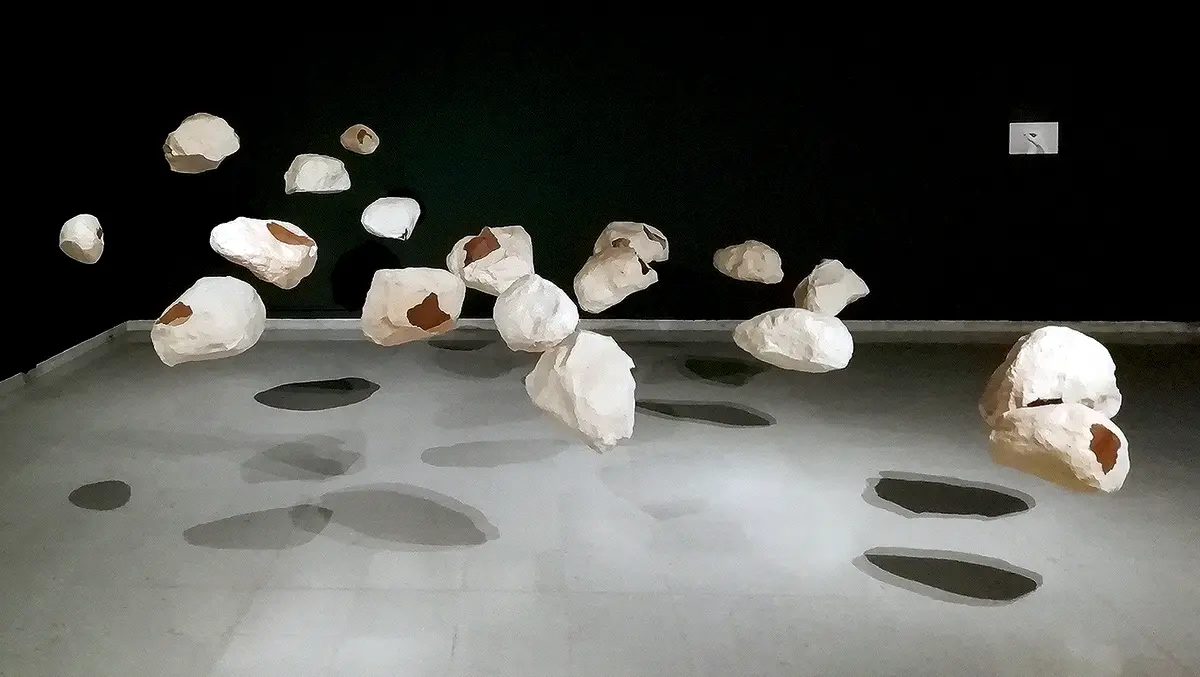
Meanwhile, De la piedra a la cueva (From the Rock to the Cave), by Mónica Naranjo (1980), sets up a way of looking at the landscape where the imperceptible transformations of the mineral realm are revisited poetically through artistic gestures. The shape of the project results from an interest in geology, a discipline from which Naranjo borrows research tools and concepts that allow her to study the territory in its physical condition in order to re-read it, later on, in a variety of media such as drawing, video, photography, pottery, and installation.
In this process, the artist finds in rock an artistic material that can reveal the constant motion of the Earth’s surface from a sensorial perspective. The object and its image dialog in a number of artworks, with the installation El murmullo de la superficie (The Murmur of the Surface, 2018)—a mise-en-scène that evokes especially the visual relationship of the earthbound with the cosmos—undoubtedly dominating the exhibition space. Reduced in front of our eyes to an illusory immutability, in this exercise those rocks constitute a pretext for the rewriting of time as ruin and memory.
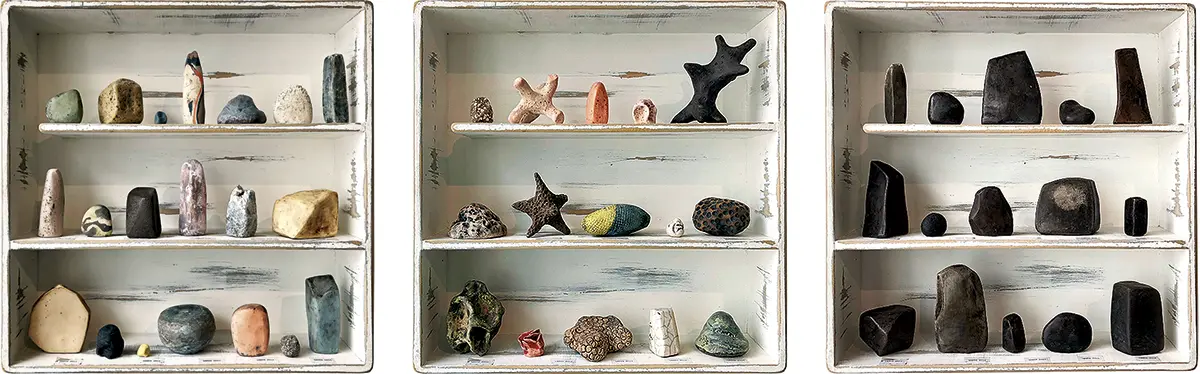
In the Salon’s winning project, Partículas elementales. Inventario de rocas del Servicio Geológico Ápex (Elementary Particles. The Apex Geological Service’s Inventory of Rocks), artist and historian Nicolás Bonilla (1984) offers a critical look at the hegemonic rationalist narratives through which the Western world has managed and molded the relationship between nature, scientific discourse, and political thought. By means of a fictional story that anchors his argument on the foundation of a geological inventory project and moves skillfully between humor and a historically knowing gesture, Bonilla plays with the extrapolation of discourses and strategies of representation/classification that in various contexts of the past attempted to normalize the universe by deploying such notions as scale and collection.
The precepts of Enlightenment knowledge, modern reason, and Nineteenth-Century visual regimes that reach their peak expression in the museum institution, are added on a critical perspective to the use of ceramic techniques for the creation of the mineral sample. In a departure from what occurs in works like Baraya’s, where the gesture focuses on collecting existing lowbrow objects, the 500,000 native rocks in Partículas elementales are presented as original and unrepeatable prototypes (manually modeled). At the same time, the use of ceramic media seems to point, by opposition, towards a kind of knowledge made possible only through the senses; the plasticity of the material can only be experienced and apprehended through its transformation, produced by a direct contact with the body.
By creating new specimens and framing them in fictional contexts supported by exhibition devices associated, in their aesthetic, with cabinets of curiosities and science museums, the artworks in this installation reiterate a critique of the illusory domestication of the world by reason, the subjugation of all that is at once suspicious and wondrous.
It must be noted, in closing, that an aspect transversal to all the projects on exhibit is a fascination for the processes that make life possible, along with a bewilderment at what we do to exploit and degrade it. It is worth remembering that contemporary art is especially called to propose new visualities that are able to respond to deepening socio-environmental conflicts and tensions, and to incentivize the deconstruction of modern anthropocentrism from a postcolonial pespective.
* Finalist project 45 Salón Nacional de Artes, Mutis 2020.
MELISSA AGUILAR RESTREPO