Open, the most recent exhibition of works by Yucef Merhi (Caracas, 1977), presented at The Bonnier Gallery, features 15 works dated between 2000 and 2021. The show is an outstanding opportunity to revisit twenty years in the career of an artist whose interests and studies encompass such diverse fields as technology, literature, linguistics, and philosophy.
Chronologically, the exhibition begins with The Poetic Clock 2.0, (2000), a LED screen showing four lines that change at regular intervals: the first one, every hour; the second one, every minute; the third one, every second. These lines are verses written by the artist in his adolescence, and their combination generates 86,400 different poems every day. The fourth line shows a clock displaying hours, minutes, and seconds in numbers. In this way, a new poem is created at every instant, and with it, a new meaning and multiple connotations. Language “materializes” the flow of time and its unrepeatable experience. The Poetic Clock 2.0 also provides some clues about Merhi’s work in general. Interested in exploring aspects that concern human existence in the contemporary world, Merhi has deployed computer technology as an ontological framework for our times, tracing its imbrication with knowledge and language and lacing it at the service of subversion, understood not only in the political sense but also as a will to transcendent consciousness.
In Atari ex machina (2007), Merhi uses the technology and devices of the Atari 2600 system, all the rage during his childhood, to create a videogame. On a screen divided into vividly colored rectangles we see HOR1 and HOR2, two characters who move randomly until they meet, at which point a sentence appears: “Who Am I?” The artist examines the overlaps between real and virtual “consciousness(es)” whose expression in language formulates multiple questions.
One section of the exhibition is devoted to the series Perfect Language, a system created by Merhi in his attempt to find a language in which the distance between signified and signifier did not exist, and in which reality could be apprehended without the filters imposed by our intellectual conditioning. Perfect Language (Black Bean: Buul) (2004) is a Maya glyph meaning “bean,” carved in wood and filled with beans. To create the works that comprise Perfect Language, Merhi stayed for a year in Antigua, Guatemala, where he had access to the most recent findings about the proto-Maya language. For some of the works in the series, he enlisted local artisans who carved the glyph for “wood” on natural-wood boards from the area. In Perfect Language () (2012), Merhi traced the Korean symbol for “nail” by hammering one thousand nails into a wall. These works are like instruments that make possible a return to “word in itself,” propitiating an unmediated, free event that unites vision and meaning.
The vastly subversive character of Merhi’s work finds a political direction in his “Datagrams,” which directly allude to the totalitarianism of the organs of power, and in particular of the Venezuelan dictatorship. Merhi’s hacking of Hugo Chavez’s email account are famous, for example. Soulless Security 6 (2017) is a perfectly composed and framed collage made using data intercepted from the Venezuelan police, the Policía Nacional Bolivariana, one of the regime’s most feared forces of repression whose agents generally operate with their faces covered. This work reveals not only names and possible age ranges, but also the number of individuals in it.
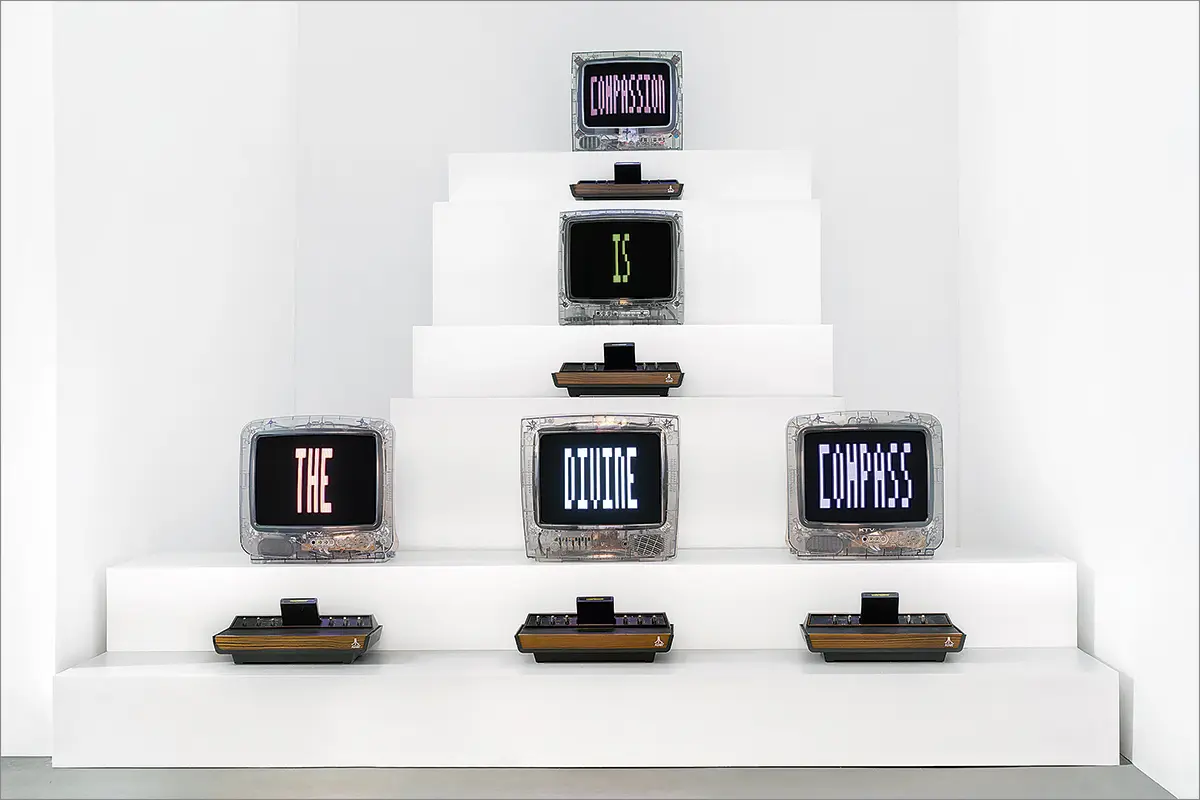
The installation Compassion (2020) is comprised of five translucent TVs connected to five Atari consoles. This type of TV was used in US prisons to make sure nothing could be hidden inside the device. On the screens we read phrases like “Compassion is divine” and “Compassion is the divine compass,” generated by Atari cartridges programmed and assembled by the artist. The work is part of a transcendent experience Merhi underwent about love and compassion, which, in a way, altered the course of his life. It belongs to a larger project titled Retrocycling, where the artist salvages obsolete devices and uses them to create art. This project has recently granted Merhi a fellowship to join the OpenDocLab at MIT.
Yucef Merhi’s work signal an understanding of art as a large-scale rebellion, a protest against the mechanism that contribute to the numbing of the human. His subversion, as he put it in a 2018 conference, is “nothing but a poetic attitude towards the limitations imposed on us in order to cut off what we truly are: consciousness in expansion.”
KATHERINE CHACÓN