Within the framework of this year’s second exhibition cycle, called “Conversation in the South / Mothers and shadows,” Chilean artist Voluspa Jarpa’s solo show “Syndemic” is displayed in the third floor of the Museo de Arte Moderno in Bogotá. This project received the Julius Baer Prize for Latin American women artists in its inaugural version. The award will be awarded biennially in collaboration with the MAMBO.
Voluspa Jarpa extrapolates the term syndemic from the field of medicine—where it refers to the confluence of several pandemics on the same population—to address an equivalent situation in the sociopolitical field in both Chile and Colombia. The social, economic, political, and cultural effects of a pandemic in this case are transposed to the context of social protest.
In both these countries, strong social demonstrations emerged more or less simultaneously—between the end of 2019 and the beginning of 2020—generating violent repressions by armed forces. There were shared features in terms of what motivated the protests and the social dimension they acquired, as well as the police repression they unleased, particularly the systematic violation of human rights involving physical violence, such as torture, sexual abuse, and murders.
The public staging of the project included a direct intervention on the architecture of the museum, which produced a large compartmentalized installation focusing on different aspects of the social outbreak in these two countries, and supported by different formal resources such as video, photography, printed matter, objects, texts, laser projections, and even a participatory piece.
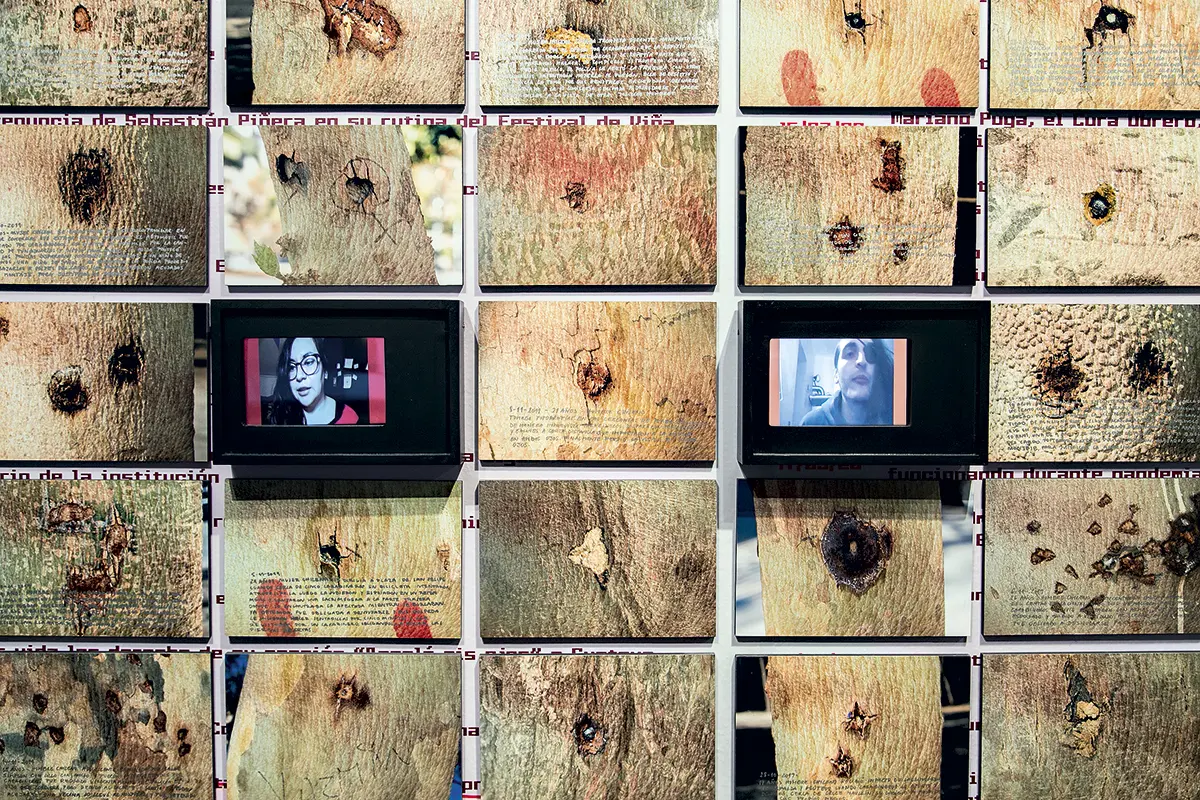
Placed on the longest wall of the room, multiple hangings produced what could be described as a chronology of infamy. A list of the human rights violations occurring during the social outbreak in Chile is preceded by their respective dates. A pink, red and purple “atmosphere” highlights specific aspects of the events through videos, photographs, graphics, texts, and drawings. This makes it possible to both read the chronology and to review recurring events that suggest the existence of State policies involving the mutilation of bodies or the disproportionate responses to protesters’ actions.
The wall hangings are interrupted at the center by a kind of void or window revealing the room behind, where there are twelve folders containing all the documents collected during the investigation. This research involved a process of collaboration with people from other disciplines: “an astrophysicist, a mathematician, a Mapuche poet, a witness, and a woman that was in the first line of fire.” Any visitor interested in a more linear reading of the facts can sit down and study the documents or choose to make the discontinuous journey through her other pieces. Part of the room is occupied by an installation containing an infinite number of pellets that are suspended with threads from the ceiling and whose space is crossed by green and a few white laser projections. The piece (commissioned by the MAMBO for this project) echoed a series of photographic images in the great chronological wall installation, which showed tree trunks impacted by different types of projectiles that had been launched at the protesters.
For a long time, Voluspa Jarpa has worked on reconstructing the traces of repressed, veiled, or erased events by investigating different types of archives and following diverse clues. With this project, she attests to these events in real time, from many sources, and with the help of other disciplines, so that the stories of those in power will not be able to hide them or minimize them in the future. As she herself has said, “this did happen and will not be erased.”
JAIME CERÓN