A very pertinent metaphor to illustrate artist Thiago Rocha Pitta’s present moment is perhaps that of a man sitting on a mountaintop and looking at a deep horizon and at a valley dotted with forests. Coherent and strong, his work is now in a very mature phase, as can be verified in “Nigredo,” his first solo show at Casa Triângulo. The exhibition, accompanied by a text by curator Pedro Cesarino, brings together the artist’s most recent multimedia production; videos, sculptures, and paintings, explore the relationship between man, nature, and time. The man-artist, with a mountain’s arrogance, gazes at the horizon both of the world and of art, with the confidence of someone who knows he is following his deepest aspirations.
We can see how Thiago Rocha moves between painting, sculpture, video, photography, and installation, producing works that establish a direct relationship with nature as co-author, be it by chance, bad weather or the material elements. The primary element is fire; he represents events such as the fire in Rio de Janeiro’s Museu Nacional located at Quinta de Boa Vista Park, as well as the artist’s subjective fictions.
Fluctuating from audiovisual technology to techniques as old as fresco, the artist goes beyond the paradoxes that are part of the transience of life and of human civilization itself. The term nigredo (from the Latin ‘dark’), adopted by alchemists to designate the first stage of alchemy (spiritual death and decomposition) would be the “beginning of the end” represented in works of strong visual impact. This aesthetic (and anesthetic) force is expressively present in the ensemble The Clopen Door. Here the artist borrows from topology the term clopen, fusion of the words ‘close’ and ‘open’, understood as complementary and cyclically continuous. Ideas represented by the sculpture of a bonfire with a door fixed at its highest point. The image of this sculpture comes to life in a projection of a large fire burning continuously, until the door is completely destroyed.
The paintings in the exhibition complement this repertoire around the image of fire and other natural elements, as in the 2021 frescoes Incendio en el Museo (Fire at the Museum) and Suplicio de Cabral (Cabral’s torment), recalling older works with references to fire and water, such as his Tribute to William Turner, a video portraying a ship in water slowly catching fire. As for Cabeza Fuego (Head Fire), the film is presented as a kind of consecration of the entire show. With images by Thiago Rocha and texts by the curator, it tells the story of a fictional character: an ancestor who foresaw and lived through a sequence of violent episodes and fires, such as the first attack on her town, when she was “separated from her body” and taken away as a trophy to another territory.
Fire has been one of the most significant elements in the trajectory of Thiago Rocha Pitta, who in the last two decades has been reflecting upon the actions of time, natural phenomena, and the chemical and physical reactions to the destruction of things and the transformations of the planet. They are poetic configurations that seem to distill the thought of philosopher Gaston Bachelard on the archetypes of the four elements (water, air, earth, and fire). The symbolism of these elements—broken up in structures created by the artist’s poetic imagination—is transformed into art, and his obsession with the fire element (according to the models of Bachelard’s own poetic epistemology and metaphysics) is its indelible mark.
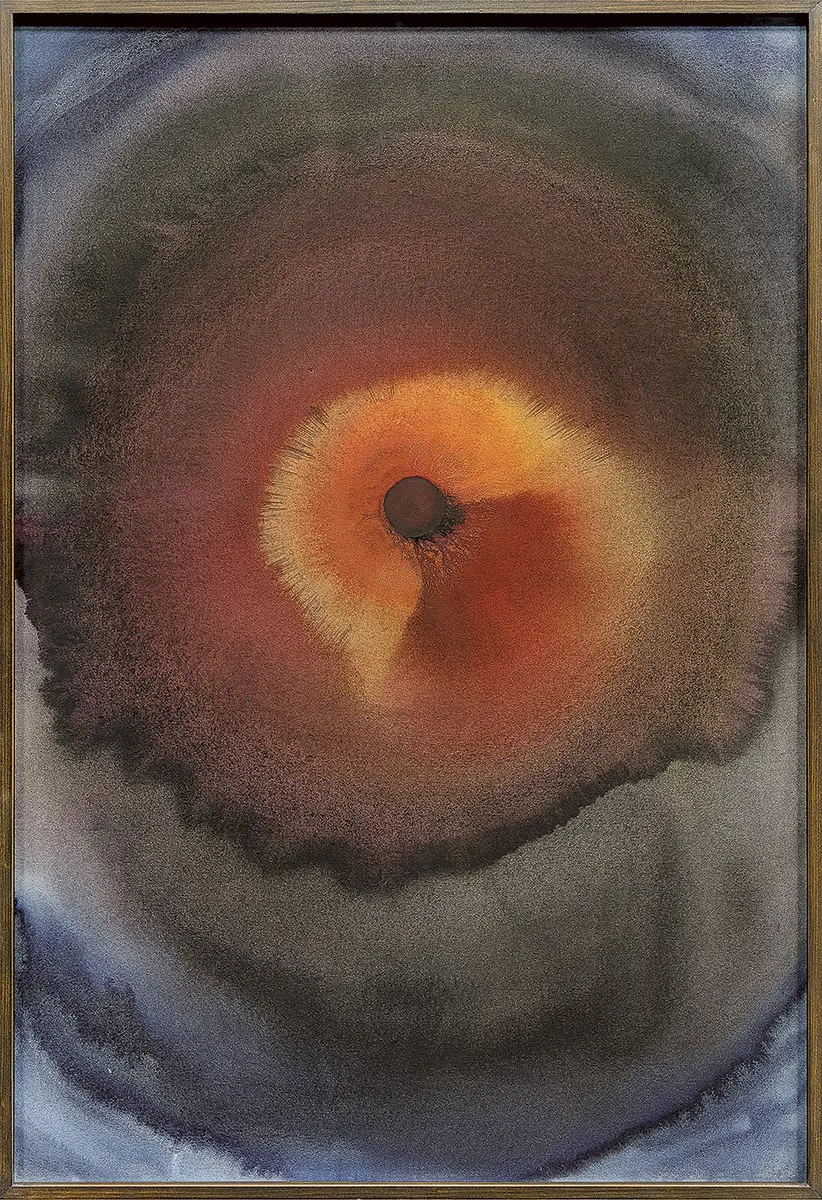
Real events appear to meet the artist’s philosophical aspirations, such as the fire that in 2018 turned the Museu Nacional—the oldest scientific institution in the country, linked to Rio de Janeiro’s Universidade Federal—into ruins, and the fire of 1978, which destroyed Rio’s Museu da Arte Moderna. Both are references in the video Cabeza Incendio. “How many built the catastrophe? Who lit the flames? How many more fires will be necessary for our extinction? Questions like these, in the video, evoke human responsibilities in the face of our destructive political and civilizational course. For the artist, the answer seems to flow with the spiral of fire, and to forget oneself and the world. The ashes on the ground bring to Nature and life a mineral memory that will not forget those crimes. However, the artist indicates that the last voices will break away from things. The world will become nature without people. And the artist will be able to collect himself among the carbon particles, where the light will be redeemed. It is as if there is still some flame of hope in the works in which the artist seems to provide the materials that will transform the present moment, and transcend time and places. Alchemy can finally take place, as in the representation of the fluctuating colors of eclipses in his beautiful watercolors.
ALESSANDRA SIMÕES