To organize or not an Art Biennial in a time of Covid is one of the great dilemmas of the era we are living through. After 45 years, Guatemala’s Paiz Art Biennial was forced to delay the opening of its new edition. It was originally slated for 2020, but the Covid-19 pandemic and the resulting sanitary emergency left it in suspense. Yet the Paiz Foundation for Education and Culture persisted, and on May 6, 2020, the Biennial’s 22nd edition opened its doors. Complying with all bio-safety protocols, it featured projects by 40 artists, on display in six sites distributed between the capital and the city of Antigua: Casa Ibargüen, the Centro Cultural de España and the Centro Cultural Municipal; in Antigua, the Fundación para las Bellas Artes, the Centro de Formación de la Cooperación Española and La Nueva Fábrica.
Although the concept of an art biennial and its formats have been abundantly interrogated and critiqued already, the current period has brought us back to square one. In the grand stages of the art world, the biennial idea was built as a mega-spectacle around which cultural-tourism corridors could take shape and aspirations to theoretical definition could emerge. Evidently, the new challenge arises from the urgency of rethinking one of the most emblematic devices for the exhibition and mapping of contemporary art. But beyond the traditional debates between the center and the periphery around the pros and cons of biennialism, this particular biennial, held in a country like Guatemala in a time of great uncertainty, is quite unprecedented.
The Paiz Biennial began in 1978 and has evolved through several heterogeneous stages. In its earliest decades, with fluctuating resources and possibilities, it established itself as a kind of art salon that gave out prizes in the categories of painting, sculpture, printmaking, photography, and at a certain point also pottery. During the dark years of the country’s civil war, it was able to position itself as a point of reference in the local arts. In my view, this most recent edition introduces a point of inflection, bringing to the fore a number of challenges that will define the future of the project, in a country severely lacking in platforms for the exhibition of contemporary art. Setting aside the dilemmas of physical presence and the dynamics of migration to the virtual, with the “zoomism” mandated by the times, I believe it more important to define topics that are truly relevant and the reflections that might emerge from the curatorial projects. The moment is ripe for engaging in an interrogation of the grand paradigms of capitalism, exploring and activating historically negated, diverse modes of intellection and knowledge, and decolonizing gazes that are the legacy of historical forms of power, racisms, plunder, and violence.
Alexia Tala (Chile) and Gabriel Rodríguez (Guatemala) are the two curators charged with this great responsibility. Overcoming many obstacles, they wagered in favor of a discourse that takes into account the complexity of local realities while also keeping in mind the contradictory phenomena of the contemporary in general, and the lines that separate the aesthetic and the political. “In order to see the present and envisage the future, we need to turn to the past, which is history and ancestral knowledge,” Tala insists. With that in mind, some of the questions that open the biennial reverberate from a revision of Guatemala’s very history and its living effects on society. Perverse and accursed geographies, violence, capitalisms, extant colonialisms, racisms, voices rendered inaudible, a life dominated by technology, xenophobia, heartless economies, and fundamentalisms are some of the words that emerge in that historical revision, like unsettling coordinates, and help answer questions like: Where do we identify colonizing violence? What past can we build for the future? How can the pasts of the Global South be approached today? Precisely because they accept the challenge of bringing to the fore the exceptional character of the current moment and the problems ahead.
The exhibitions that comprise the 22nd Paiz Biennial favor the dialogic synchrony that results from bringing together projects conceived in such diverse contexts as Guatemala, Switzerland, Chile, Egypt, Mexico, Colombia, or Congo. Eschewing an itinerary defined by those geographies and opening itself up instead as a map “for getting lost,” as mentioned by some of the texts that accompany the exhibits, the 22nd Paiz Art Biennial responds to the title Perdidos. En Medio. Juntos (Lost. In Between. Together), taking as its reference a 2013 publication by the BAK’s New World Academy, edited by Jonas Staal, Yoonis Osman and the We Are Here collective. That sense of loss is, indeed, an invitation to let ourselves be carried away by Latin America’s cultural and geographic diversity. But it is also a suggestion that memory is like a canvas folded into an infinite number of shapes, where many folds and possible readings coincide. If there is one thing the curators have intended to highlight, it is that ability of the Global South to tell its own story, with an observant eye for its own roots and the richness of its ancestral knowledge. According to the curators, it is on that basis that artistic expressions marked by certain forms of activism, agency-production, consciousness-raising about human rights, and an intense interest in the domain of the sacred, are brought together.
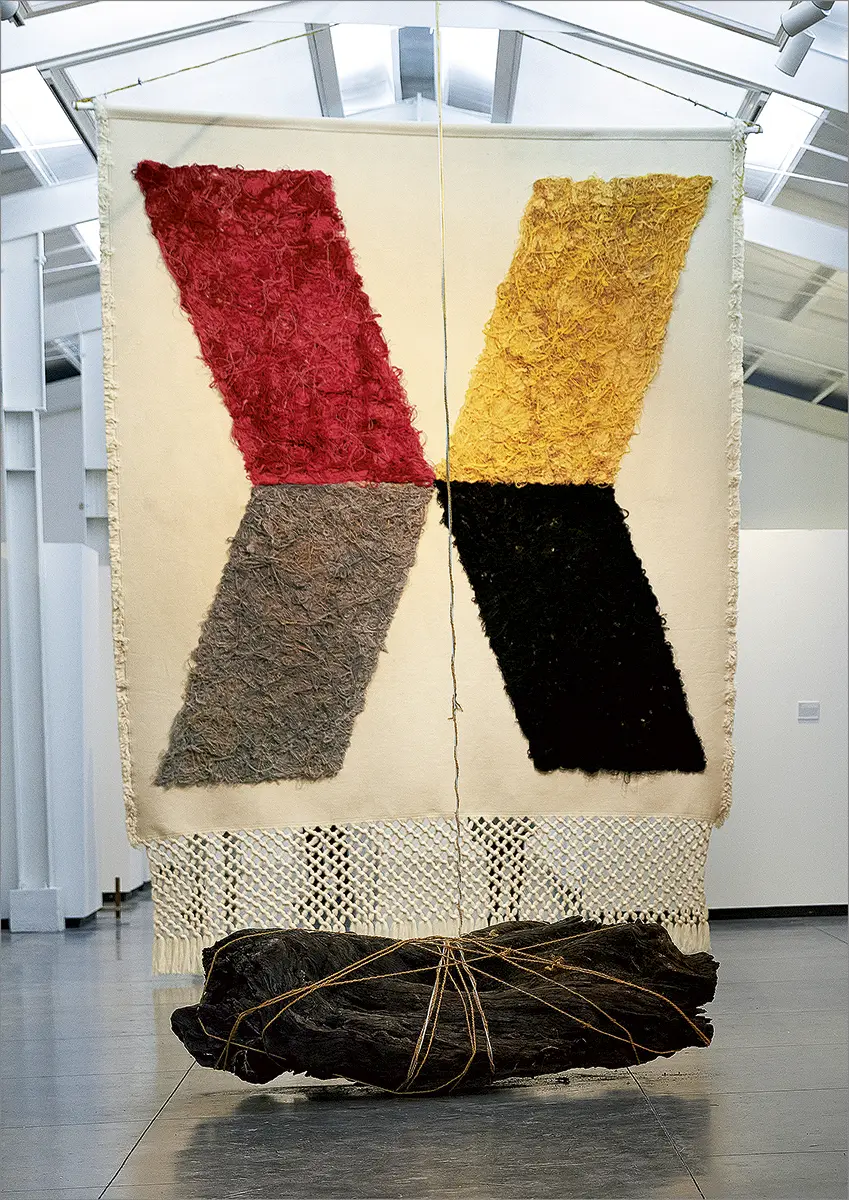
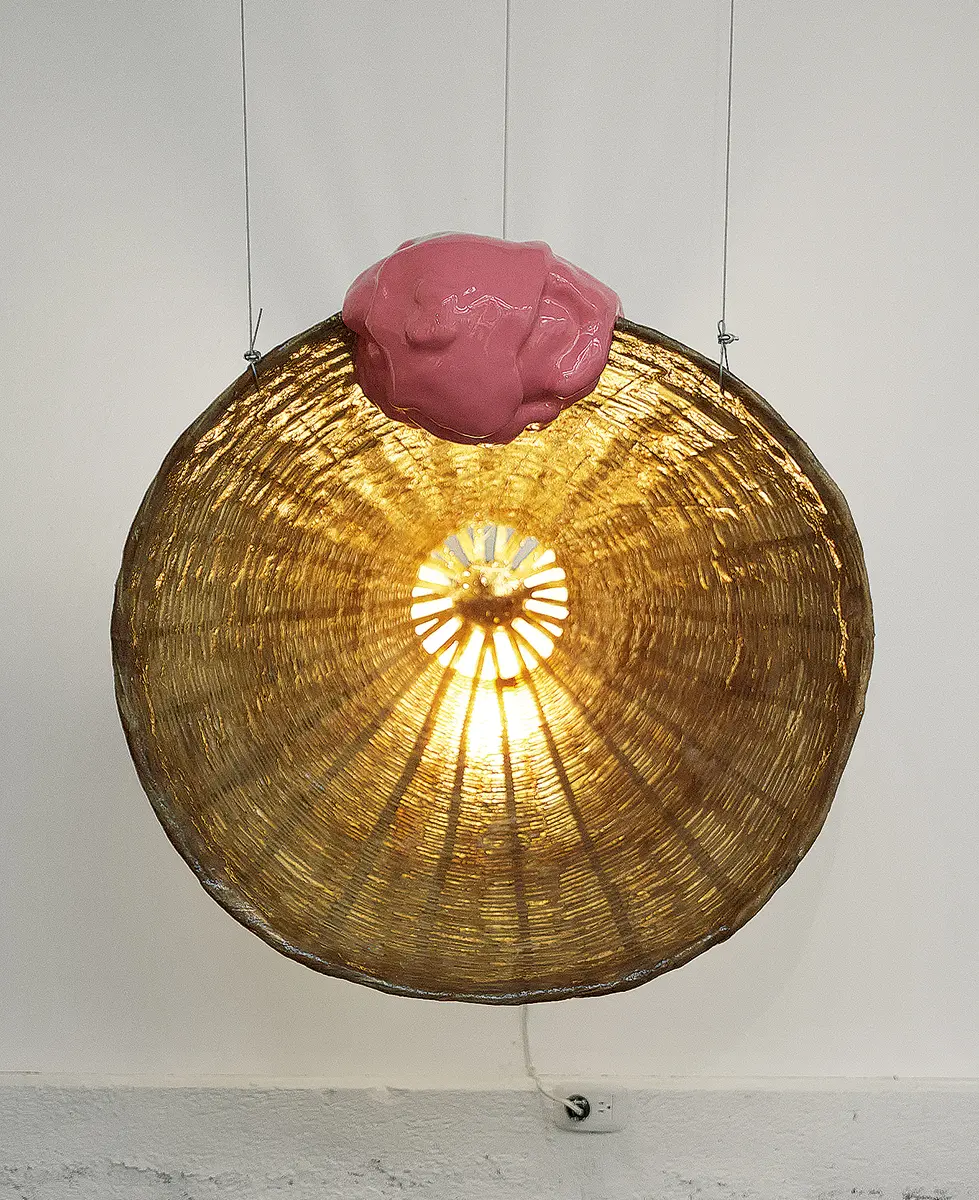
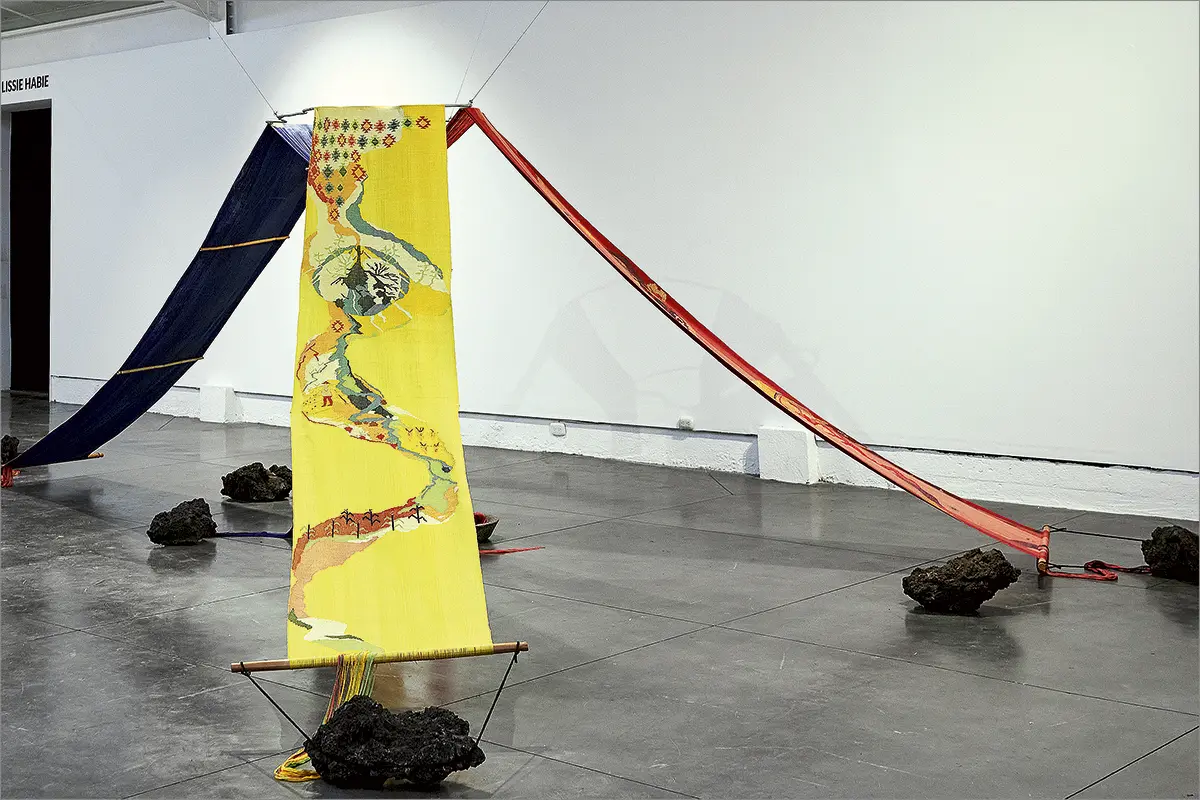
The three thematic axes from which Tala and Rodríguez formulated their curatorial thesis are Pasts. Eternal. Futures; Perverse Geography / Cursed Geographies; and Universes of Matter. In Universes of Matter they refer to materiality not as something fixed and inert, but as something capable of allying itself with the production processes of cultures, knowledges, memories, senses of belonging, and subjectivities as infinite as they are diverse and enrooted. The standouts in this territory are works that incorporate materials with a highly symbolic payload and emerge from places such as the land itself in order to re-signify different dimensions of knowledge. For example, works that combine archeology and contemporary art, like La sombra misma del cielo (The Very Shadow of the Sky), by Óscar Santillán (Ecuador), which regulates a dialog between satellite pieces and archeological items. Pablo Vargas Lugo (Mexico) presents a video based on his exploration, in 2017, of the Naj Tunich caves, located in the area around Poptun, in Petén, Guatemala’s department bordering Mexico and the location of the country’s largest remains of ancient ceremonial centers. Lugo’s work involves a warning about the destruction of information and its survival in cultural interweavings, cannibalizations, and digestions. Repurposing garbage thrown in the emblematic Atitlan lake, the Maya tz’utujil artist Manuel Chavajay creates a series of objects using plastic materials in a strident pink color to signal the threat of contamination. Across the continent, and especially in the great Mesoamerican civilizations, textiles have been produced not only as clothing items but as sacred objects. In a country where weaving is central to people’s lives, artists like Antonio Pichillá, a tz’utujil Maya and a native of San Pedro la Laguna, produced a game of patterns and knots to form an outsize loom filled with sacred symbolism; Angélica Serech, from San Juan Comalapa, explores the symbiosis between threads and human hair to create a tapestry of unprecedented physicality, and Hellen Ascoli exhibits a collection of her own weavings and objects traditionally used in the manufacture of textiles that “capture” the motions of the body. Complementing this platform are works by Edgar Calel (Guatemala), Ayrson Heráclito (Brazil), Detanico & Lain (Brazil), Ana Teresa Barboza and Rafael Freyre (Peru), and Uriel Orlow (Switzerland).
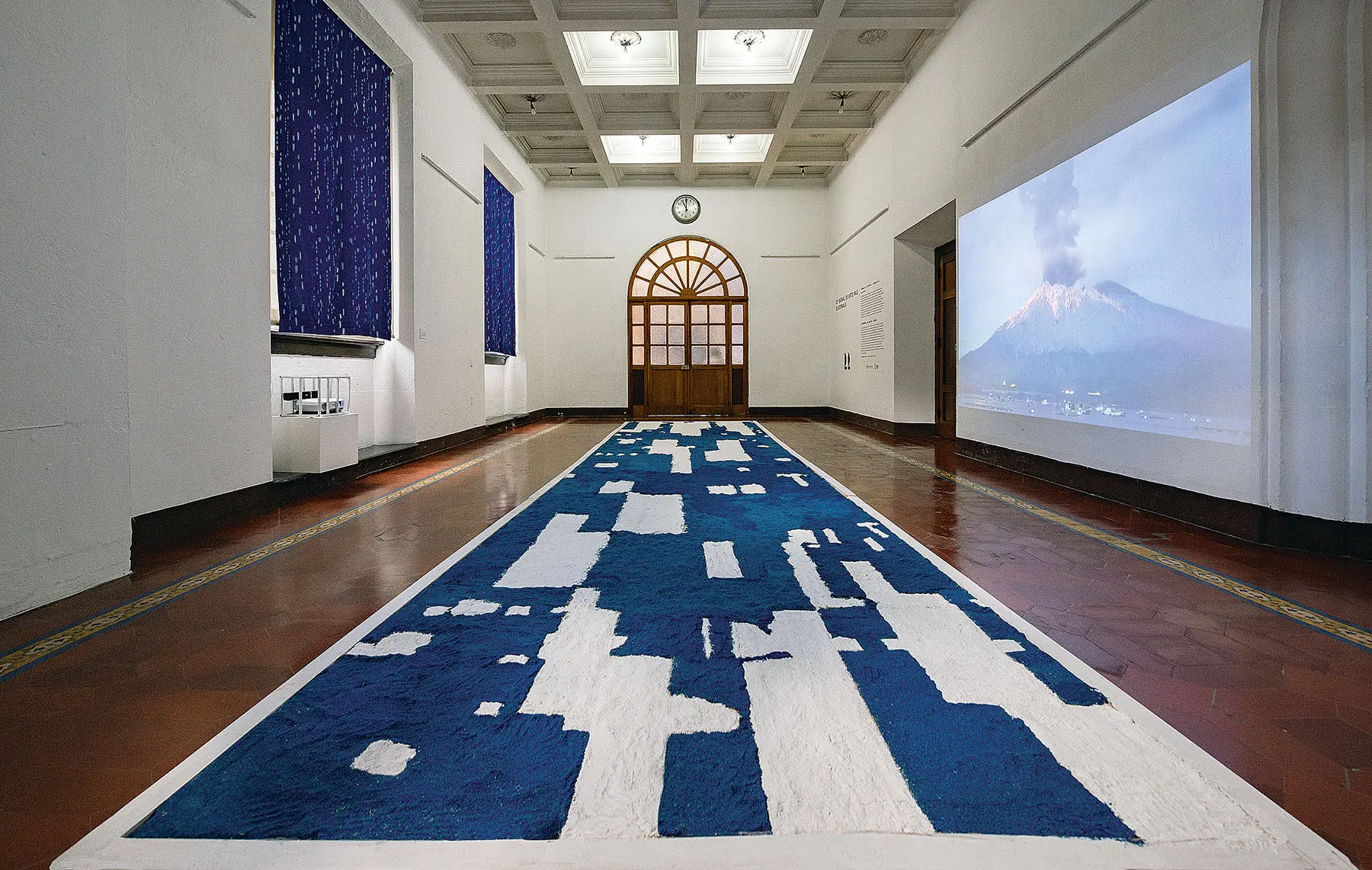
The disquietingly titled Perverse Geography / Cursed Geographies is the project’s second coordinate. Focused on contemporary and historical conflicts rooted in the colonial era, it speaks of the north-south relationship as a point where everything becomes unbalanced and turns perverse, due to colonization, exoticization, and the will to power, and in the midst of discrimination, racism, and segregation. Resisting maudlin evocations of an eternal springtime in bucolic landscapes, it explores the problems that lacerate the territory, impose borders, and promote capitalistic uses of the land. The implicit quest in this reflective space is to render visible the demands and the effects of the power, exploitation, and biopolitics exerted on diverse lifeforms and nature. But it also contributes alternative versions that facilitate the exploration of new modes of coexistence that are non-exclusionary and respectful of all lifeforms, human and non-human. Yasmin Hage (Guatemala) and Antonio José Guzmán (Panama) use clay and indigo, respectively, to revise the weighty role that those two materials have played in the shaping of history. With clay as her raw material, Yasmin Hage creates a replica of a water filter in monumental proportions. This work has the power of evoking the power of the land and the importance of the land in the conservation of water. With the help of an artisan renowned for his colorful sawdust rugs, traditionally made in Antigua during Holy Week, Antonio José Guzmán designed a rug as the central item in his project. Made with sawdust painted in indigo blue, it integrates a series of designs that combine DNA-sequence patterns, Maya patterns, and other Central American symbolisms.
In a playful and poetic vein, Naufus Ramírez Figueroa (Guatemala), working with the poet Wingston González (Guatemala), presents Lugar de consuelo (Place of Solace). Ramírez Figueroa conceives this work as the recreation of a play by Guatemalan playwright Hugo Carrillo, Corazón de Espantapájaros (Scarecrow Heart, 1962), censored during the armed conflict for its references to power (the military, oligarchs, dictators, cardinals) and to the repression of students and art workers. In perfect tandem, the exhibition includes projects by Forensic Architecture and Forensic Oceanography (United Kingdom) and Heba Y. Amin (Egypt). Sebastián Calfuqueo (Chile), Jonathas de Andrade (Brazil), Oswaldo Macía (Colombia), and Fernando Poyón (Guatemala) complete this section.
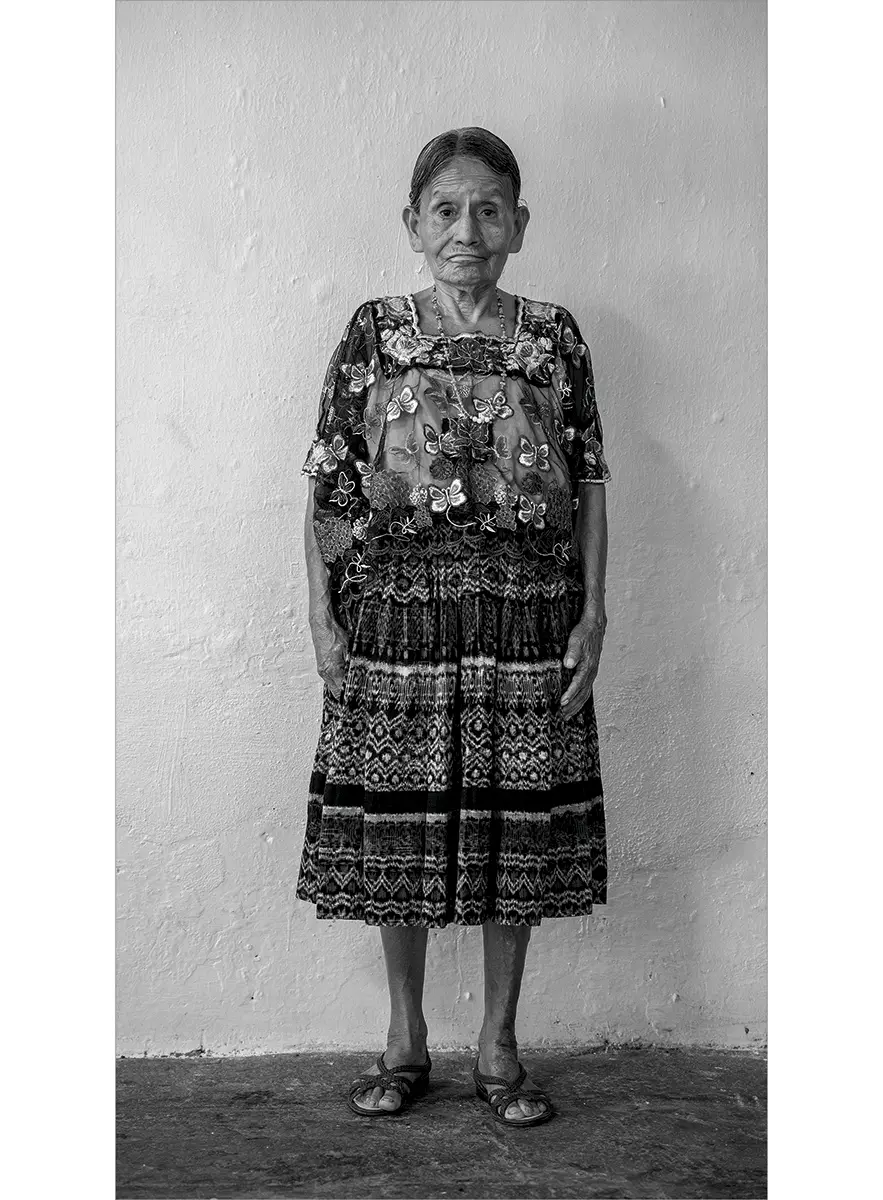
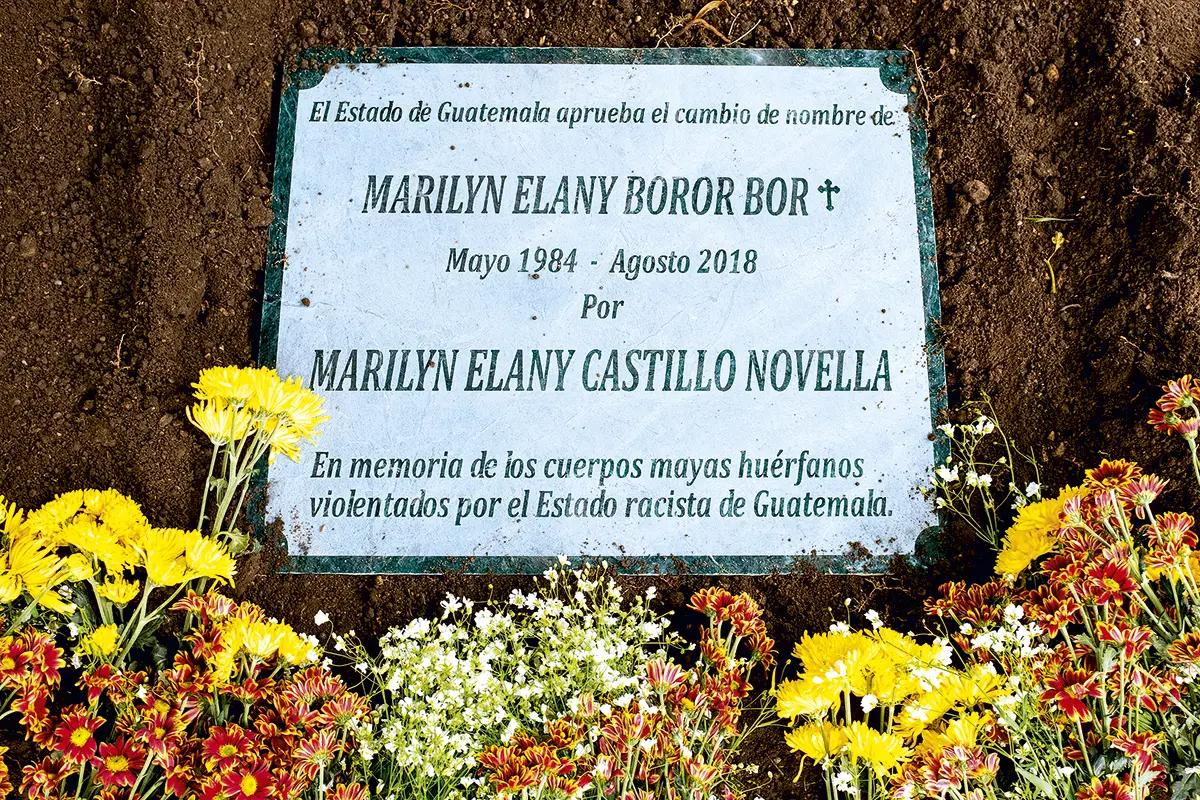
The projects included in the third axis, titled Pasts. Eternal. Futures, allow us to wander through different notions of temporality and to escape from linear readings and Westernized ways of seeing. This is connected with the necessity of creating spaces that help reactivate the human need for the symbolic, the spiritual, and the poetic, in the form of acts of healing, ritualism, and transubstantiation. At a time when even the simple, everyday act of gathering with others has been broken, a work of art like The Theory of the Ghost, by Maya Saravia (Guatemala), seeks to investigate the markings of memory on the body and in that way to trace the routes of slavery through music and dance expressions such as reggaetón and dance hall. Resilencia tlacuache, by Naomi Rincón Gallardo (Mexico), takes us inside a landscape inhabited by symbols, nahuales, and mythologies. In a fable-like video, Rincón Gallardo expresses her intention of mitigating the violence of extractive projects through ritualistic forms that tend towards healing of the body and the soul. The works of Guatemalan artists Alejandro Paz, Benvenuto Chavajay, and Marilyn Boror Bor coincide in their interest in the issue of representation, the influence of the colonizing gaze in the construction of stereotypes, and the complex dilemma that has kept awake more than one critic in Guatemala: the construction of the ladino gaze in detriment of and opposition to indigenous cultures. Set up in dialog with one another, the three works bring to the fore some of the complex networks of culture and belonging that shape Guatemalan society. El rey Fernando y Botargel (King Ferdinand and Botargel), by Alejandro Paz, appropriates and freely adapts a colonial-era dance known as “The Spaniard”, still performed in some municipalities with growing ladino population near the country’s capital. Chavajay’s Ladino por decreto (Ladino by Decree) explores the 1867 legislative decree that mandated the indigenous population of San Pedro, San Marcos, in the western part of the country, to abandon their knowledge and customs. Marilyn Boror Bor’s Edicto: cambio de nombre (Edict: Name Change) is the result of her investigation into the innumerable, incessant publication in Guatemala’s official government newspaper of name-change resolutions where indigenous names change to ladino ones, a strategy used to erase signs of identity and navigate the racist systems that prevail in the country’s public life. In a performative vein, the artist changes her surnames, Boror Bor, to Castillo Novella, in reference to two of Guatemala’s richest families. Also on display in the exhibition are the threatening, overtly racist messages she received during the development and final presentation of the project.
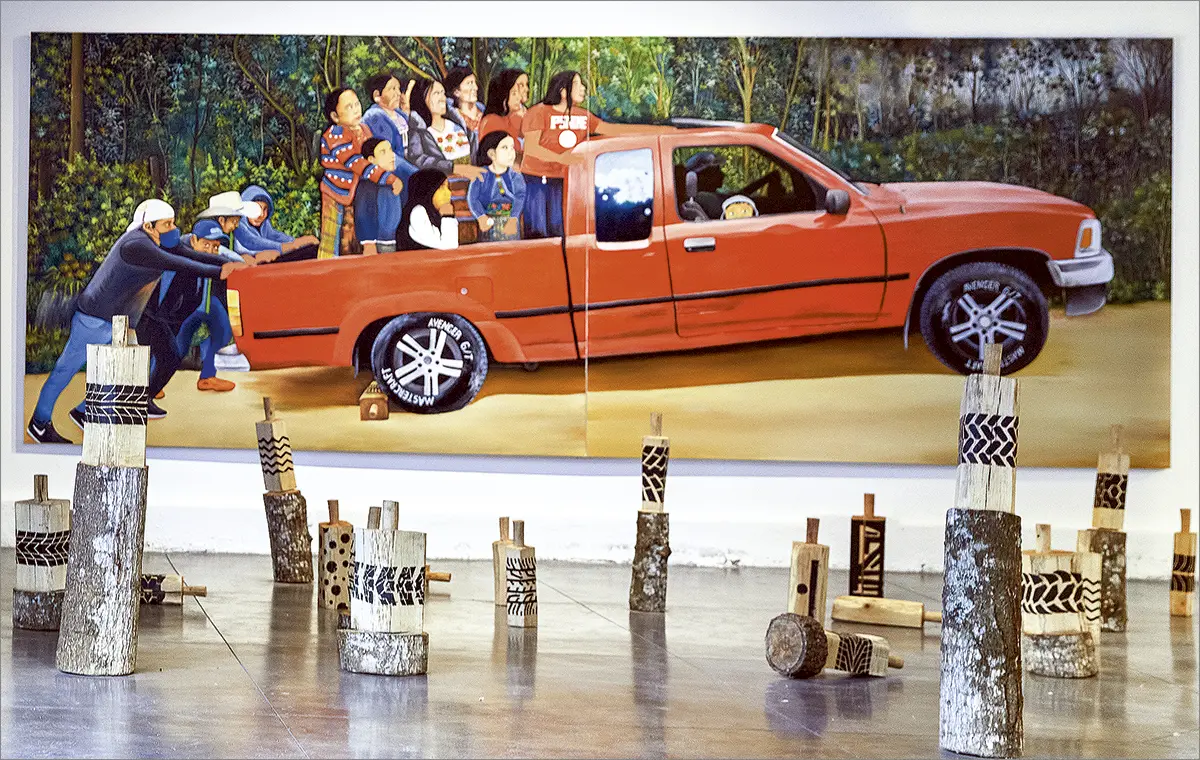
Monumentos plegables, by Jessica Kairé (Guatemala), consists in a replica, in fabric, of the funeral monument to Jacobo Árbenz, the president and national hero who was the central figure of the last years of the democratic period known as the October Revolution or the Democratic Spring (1944-1954), denounced as a communist and accused of endangering the interests of the United States, the local oligarchy, and Guatemala’s power cabals. Kairé’s monument remains folded on the ground and the audience is invited to raise it using a system of pulleys and ropes, transforming it into a mere memory of the object where the weight of history is counteracted by its diluted symbolism. Following the thread of Guatemalan history, Oscar Perén (Comalapa, Guatemala) presents three paintings with the titles of La cárcel (The Prison), Secuestros, incendios y asesinatos en Comalapa (Kidnappings, Fires, and Murders in Comalapa), and La noche del zafarrancho (The Night When All Hell Broke Loose), which recover images and memories of the quotidian violence he experienced during the years of internal conflict in the country.
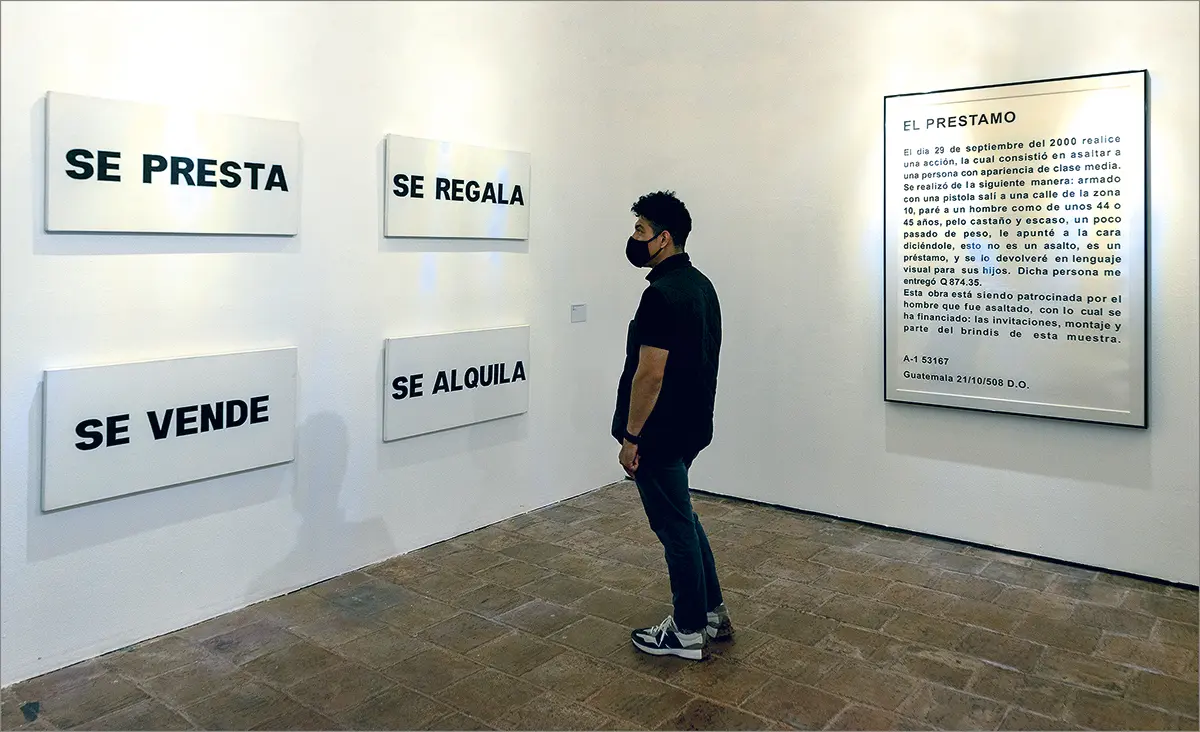
Solo exhibitions by Aníbal López (Guatemala City 1964 – 2014) and Paz Errázuriz (Santiago de Chile, 1944), two towering figures in the contemporary art scene in Latin America, were organized as grand complements to the biennial. These two exhibitions, veritable gravitational centers for the event, presented works emerged in contexts where marginality is a topic as complex as it is unprecedented. Lopez’s show is the largest retrospective of his work ever brought to the public, and the first institutional tribute to one of the most lucid figures of recent years. López’s oeuvre, based mainly on concepts, images, and actions, starkly reflects the ethical and moral repercussions that the dynamics of power, injustice, and exclusion have in Guatemala, and includes a potent critique of the art-world systems, with their complicities and corruptions. The exhibition showcases his lesser-known facet as a painter into his later years, and includes emblematic works like El Préstamo (The Loan, 2000) and Testimonio (Testimony, 2012), the latter presented at dOCUMENTA 13 in Kassel. Among the more than 80 works by Aníbal López loaned by private and public collections, one standout is the Archivo Oral (Oral Archive), a project that has gained continuity as a commission by the 22nd biennial, intended to safeguard testimonies by Lopez’s collaborators from across the world.
Paz Errázuriz’s solo exhibition includes new works created in Guatemala specifically for the Biennial—Errázuriz’s first works made outside Chile—alongside emblematic series from the photographer’s 40-year career. La Manzana de Adán (Adam’s Apple, 1982-1990), Nómades del Mar (Nomads of the Sea, 1991-1995), and El Infarto del Alma (The Infarction of the Soul, 1992-1994) will be accompanied by the new series Sepur Zarco (2019), which shows for the first time the faces of the women involved in the legal case of that name, based on their denunciations of acts of violence perpetrated by soldiers during the civil war. Trans Guatemala (2019) results from collaborations with the transgender community in Guatemala.
A symposium debating various aspects of Guatemala’s cultural context and its intersections with the characteristic complexities of the Global South in the past, the present, and the future complemented the 22nd Paiz Art Biennial.
This completes a map of ideas and works of art that discuss, in a polyphonic way, the logics of domination. In the midst of a planet-wide pandemic, this biennial connects us with experiences and issues from other contexts. By means of a borderless map, it has been a wager in favor of dialog and, above all, of the gesture of listening to each other.
*Photo: Andrés Asturias / Estudio A2
ROSSINA CAZALI