One of the first pieces I saw by Teresita Fernández (b. 1968, lives in Brooklyn, New York) was the installation Untitled (crawl space, 1996). It was a hanging platform with two rope ladders that, although they did not lead anywhere, represented the possibility of symbolically traveling many paths for both the artist and the viewer. Moving to different places—or the inability to do so—is one of the issues she tackles in her work. Fernández recalls that “for immigrant and first-generation kids such as myself, travel was nonexistent. My family worked long hours in Miami factories, and they struggled to communicate in English. (...) We certainly didn’t feel American. Our world was entirely local, but we were somehow distinctly conscious of our geographic positioning, of the complexity of place, and the drama of human exile, migration, and displacement.”1 Through this work and others that she subsequently carries out, the artist reflects on the meaning of “place” not only as a geographical location but as a way of defining her identity. The artist grew up in Miami, where she experienced contrasting realities. The city provided freedom and opportunities for her parents, immigrants of Cuban origin, who preserved many of their expressions and traditions, but also showed them the reality of a racially and ethnically segregated society, which instilled in the young woman the need to speak out in favor of inclusion in both art and society.
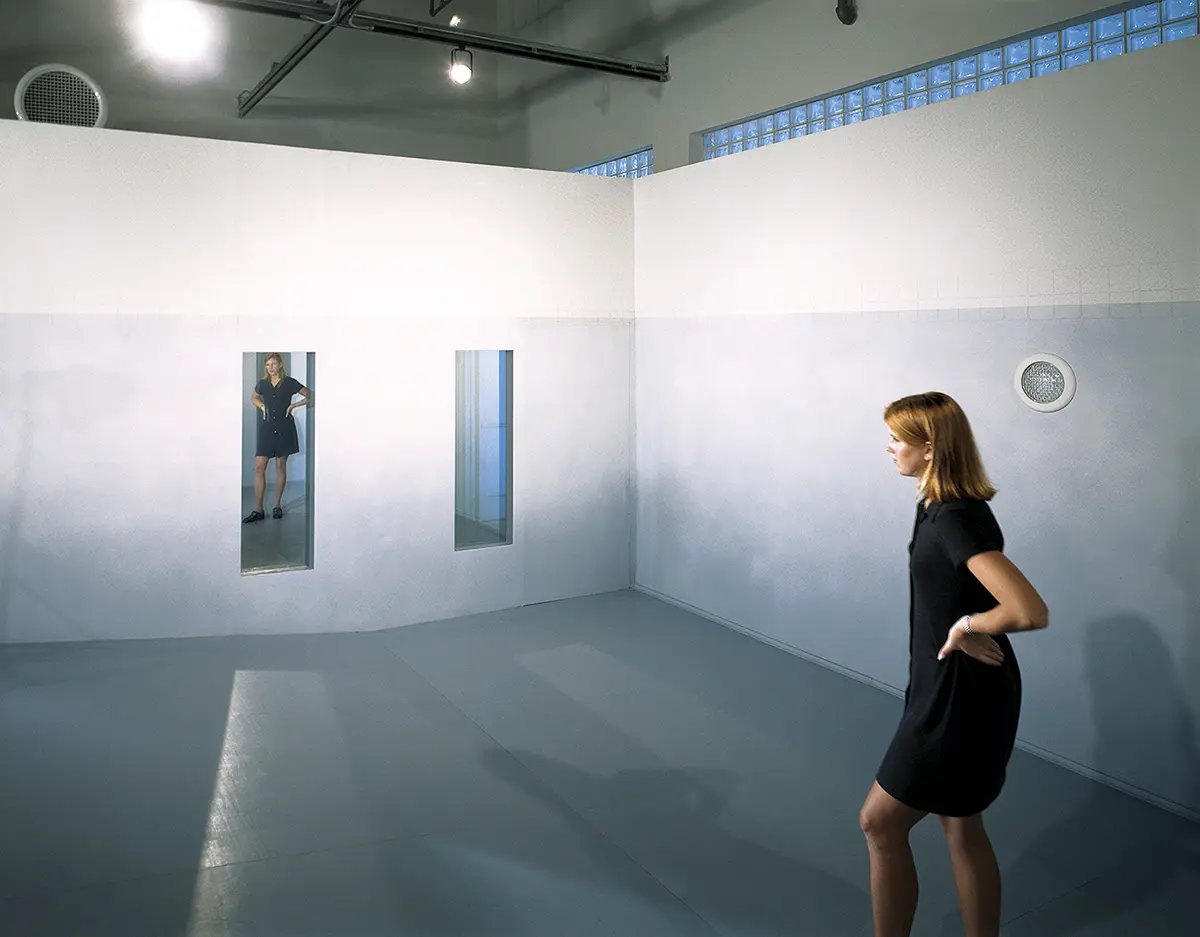
Upon completing her Bachelor of Fine Arts at Florida International University (1990), her position as a conceptual artist was clearly defined and was consolidated after graduating with a Master of Fine Arts from Virginia Commonwealth University in Richmond, Virginia (1992). In 1996, on the occasion of the inauguration of the new building of the Museum of Contemporary Art in North Miami, she made the installation Untitled (Pool), in which several characteristics that would mark the development of her work became evident. As a first step, the role of drawing in the realization of her work. Since her university work—I remember, in particular, the meat sketches done on large sheets of paper—drawing has played a fundamental role in her creative process. Minimal representations of gardens, swimming pools, and imagined landscapes devoid of figures serve as the basis for her sculptures and monumental installations. The drawing, generally made with graphite, is the obligatory starting point and, in the case of the works that she later produces with that material, the connection with the materials that she carefully chooses for their execution. Similarly, this life-size pool devoid of water, which is accessed by a side ramp in which visitors can see the interior of the work through windows, introduces two essential aspects to Fernández’s work. On the one hand, the realization of large-scale works, and on the other, the public’s participation in the creative process. In this case, people can access the pool and enter it by going down a ramp to the facility’s bottom. According to Fernández, in this piece, she is interested in “the projection of the body in an imaginary, kinesthetic way, penetrating history and distance cinematographically, almost like a dream.”2 Depending on the location, the person acts as a “voyeur” or as an active participant within the pool’s space. When reaching the bottom of it, the individual can be seen reflected in the windows that, within the space, function as mirrors. Reflective surfaces are frequently used in Fernández’s work as a strategy to link the viewer and give him a leading role.
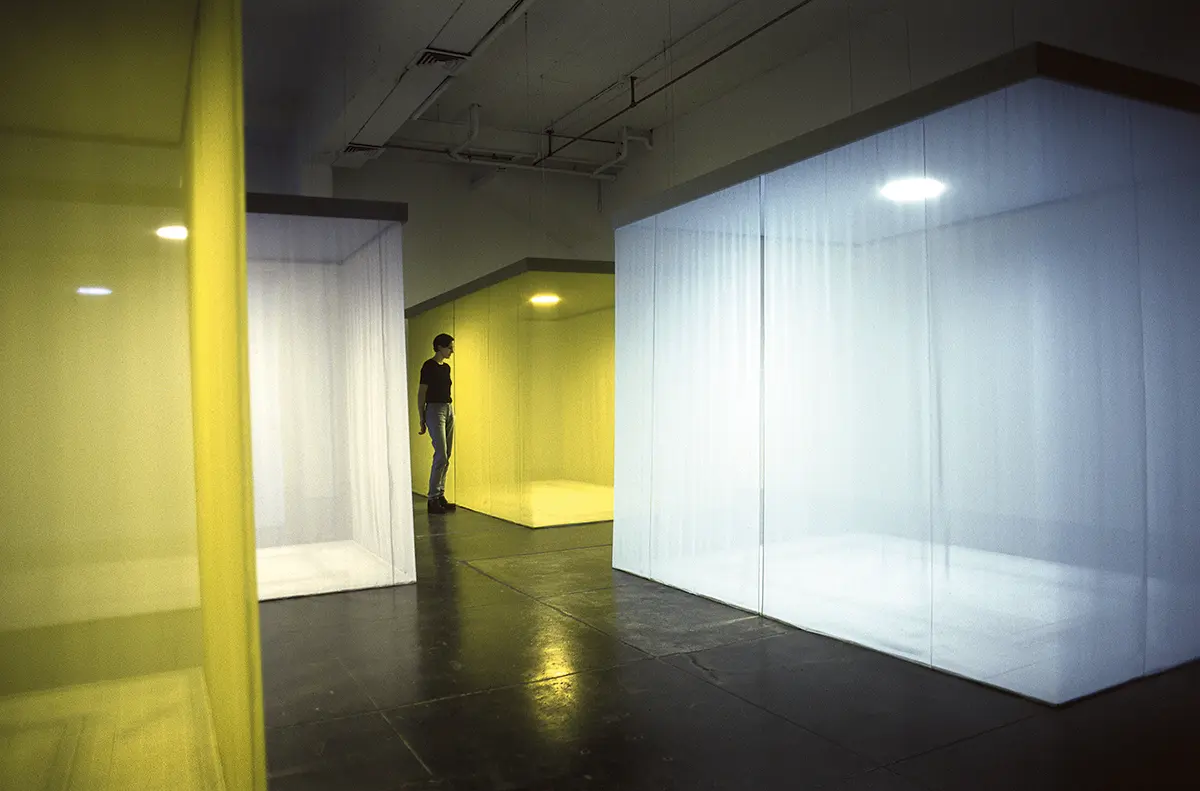
It is pertinent to note that Fernández participated in a residency in Japan in 1997 and traveled to Rome thanks to a grant in 1999. In these places, she had the opportunity to study Japanese and seventeenth-century European gardens and the relationship between the space and the individual that roams through it. Hence her interest in public participation, fundamental in works such as Borrowed Landscape (Blue, Cerulean, Citron, Violet) (1998), an installation conceived during her residency at ArtSpace in San Antonio, Texas. Again, the work starts with the drawing, this time represented in the strokes made with pencil on the panels that make up the floor of each of the five rooms that form the piece. According to writer Ann Wilson Lloyd, the “intricate gridded floor design suggestive of fancy tiles, oriental carpeting or possibly a formal garden maze. These subtly drawn grids are a continuing motif in her work and are visual mesmerizers intended to provoke constant and dizzying shifts in scale and perspective.”3 Each of the modules that make up the installation is delimited by transparent curtains in blue, cerulean, citron, and violet colors, placed in such a way that the visitor can walk around them but not enter them. As the person moves, he can observe variations in the shades of the colors of the veils and the degree of transparency generating a sensory experience. In addition, the rooms are illuminated with simulated daylight that accentuates this experience and transports the public to a dreamlike place.
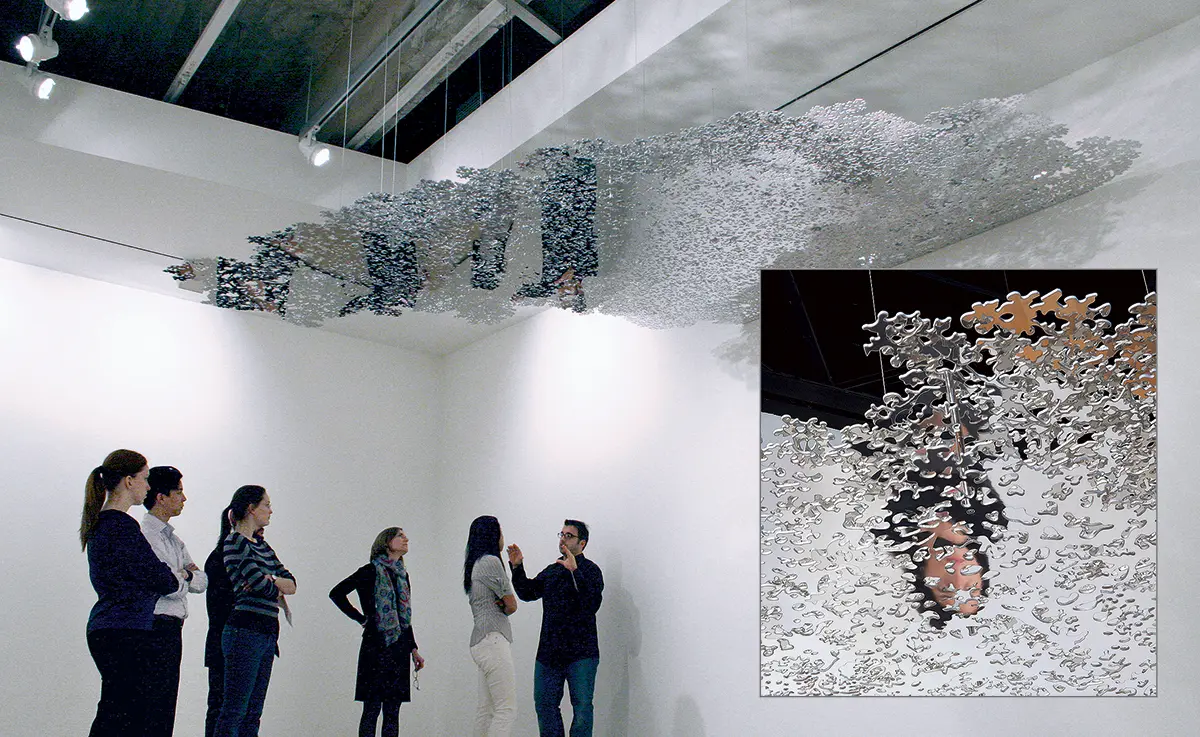
This type of sensory stimulus is repeated in numerous works that the artist has made using different media and strategies. In Vertigo (Sotto in Su) (2007), as the title indicates, she utilizes the “bottom-up” technique used by Renaissance and Baroque painters to give the illusion that the figures depicted on the ceilings are suspended in the air. In Vertigo, Fernández superimposes eleven layers of polished metal that resemble tree branches or clouds that spread over visitors’ heads. The organic shapes of cut aluminum overlap, creating a dome that produces shadows on the surrounding walls and floor. When looking up, the reflection of the faces creates an intimate relationship between the spectators and the work, which is transformed as they move, generating a cinematographic effect.
According to writer and curator Laura Lindenberger Wellen, “tracing the relationships between the natural and the human, between the landscapes that are found and those that are made, is at the heart of Fernández’s sculptural projects.”4 Indeed, the landscape representation in the context of her work must be understood from this perspective. According to the artist, “people think of my work as being about landscape, but I’ve tried in my practice to amplify the word ‘landscape,’ just like the word ‘climate.’ Landscape is much more about what you don’t see than what you do see. There is essential knowledge inherent in remembering that we are a tiny part of this whole thing. We’re not just witnessing it, watching it, outside of it, assessing it. Our bodies are running on the same exact systems as the rest of the universe.”5 Each of her installations and sculptures attracts a viewer who must move to see and experience them. The presence of an audience that moves, in some cases around them and others inside or below them, activates them and consolidates them conceptually. The perception of the work depends to a great extent on this interaction. For example, at first glance, Drawn Waters (Borrowdale) (2009) is an imposing aluminum sheet that becomes a pile of graphite rocks when it reaches the ground. As you move away, especially when viewed from a higher level, you can better appreciate the meaning of the work and its relationship to the landscape of the Borrowdale Valley in Cumbria, England, which inspires it.
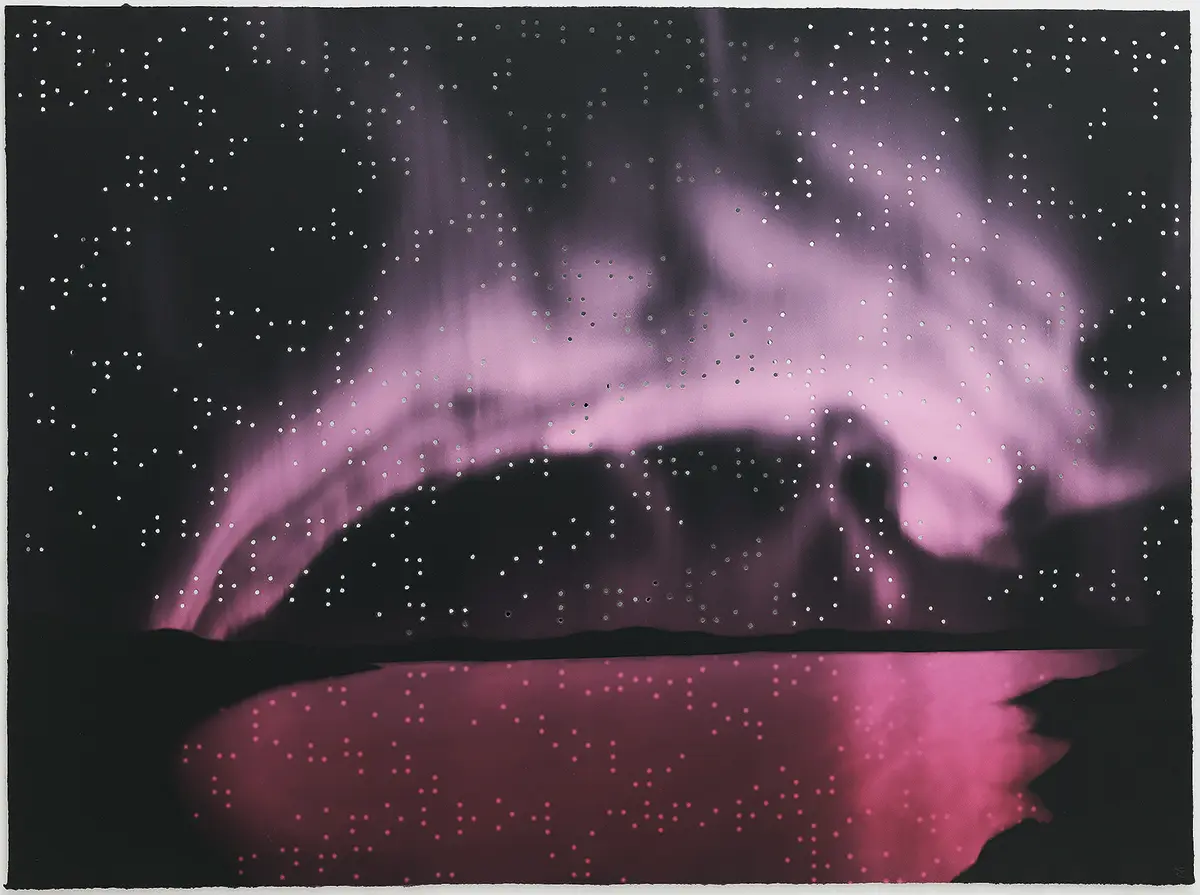
Another piece in which the artist successfully represents a natural phenomenon is Night Writing (Hero y Leander) (2011). Inspired by the truncated love story from the Greek mythology between Hero, an Aphrodite priestess, and Leander, Fernández makes a sculpture that resembles beautiful and colorful Northern Lights. Made in paper pulp and mirror, the piece attracts the viewer who, when approaching, feels disoriented, which is why Leander drowned and died when the light that guided him to Hero went out. Once again, Fernández uses mirrors and glossy surfaces to attract the public and share a sensory experience.
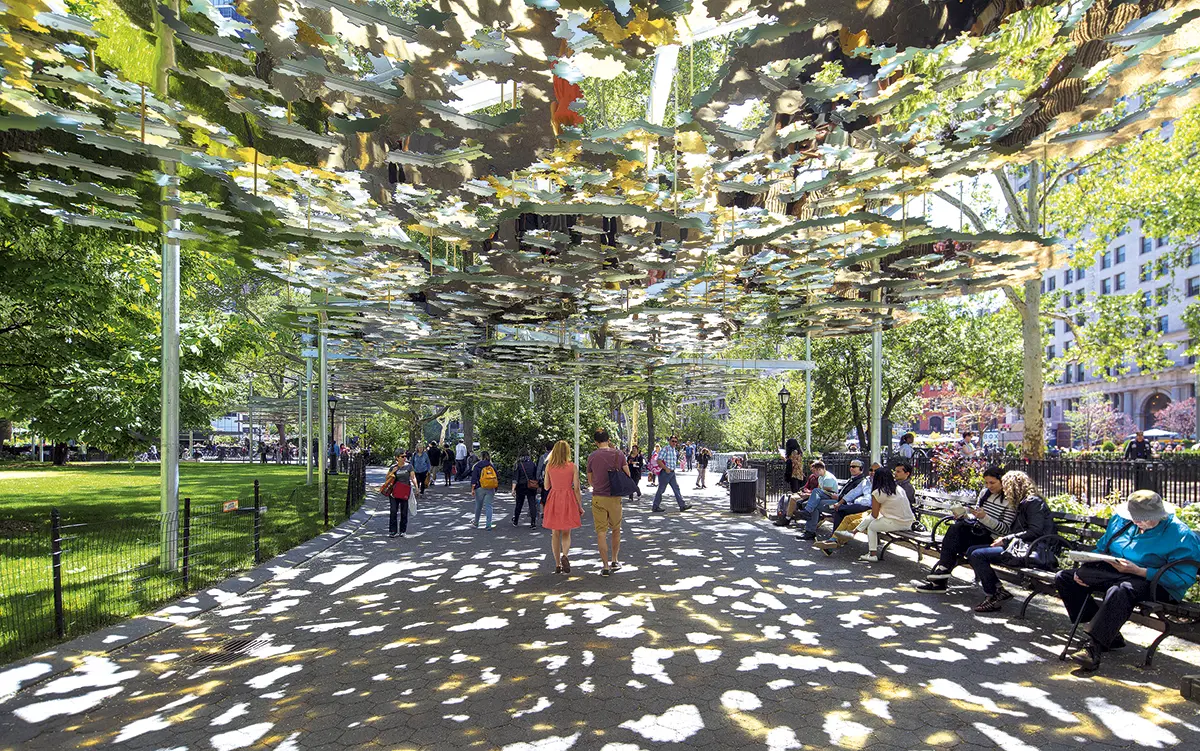
The continuous exploration of what she calls “landscape sculpture,” through installations that suggest rocky mountains, rivers, lakes, and night skies, serves as a preamble to one of the most ambitious projects she has carried out so far: Fata Morgana (2015). As its name indicates, it is a kind of optical illusion. In this case, it is not due to a temperature inversion but to the transformation of an iconic space in New York City, Madison Square Park. Using a scaffolding system, Fernández transforms the park into a wonderful mirage by placing at a considerable height an installation of golden mirrors cut into organic shapes, assembled so that they blend in with the trees around them and through which the sun’s rays filter through. It is important to note that during the time it was exhibited, the work served as the stage for different multidisciplinary activities through which the artist, in collaboration with musicians and dancers, activated the space highlighting the talent and richness of the culture of Latinx origin in New York.
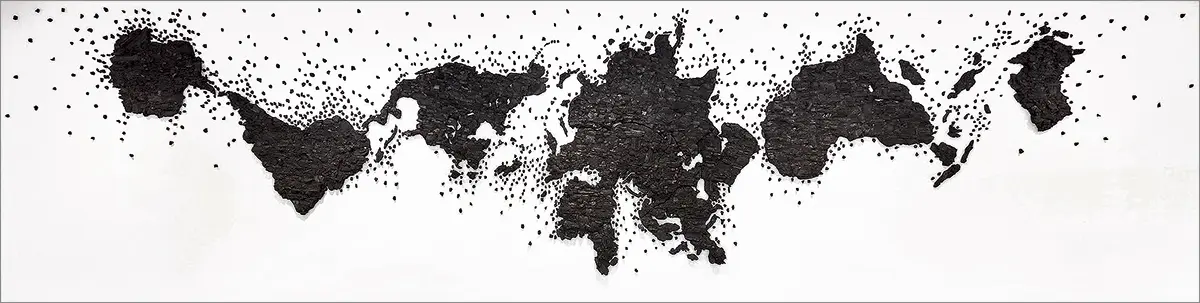
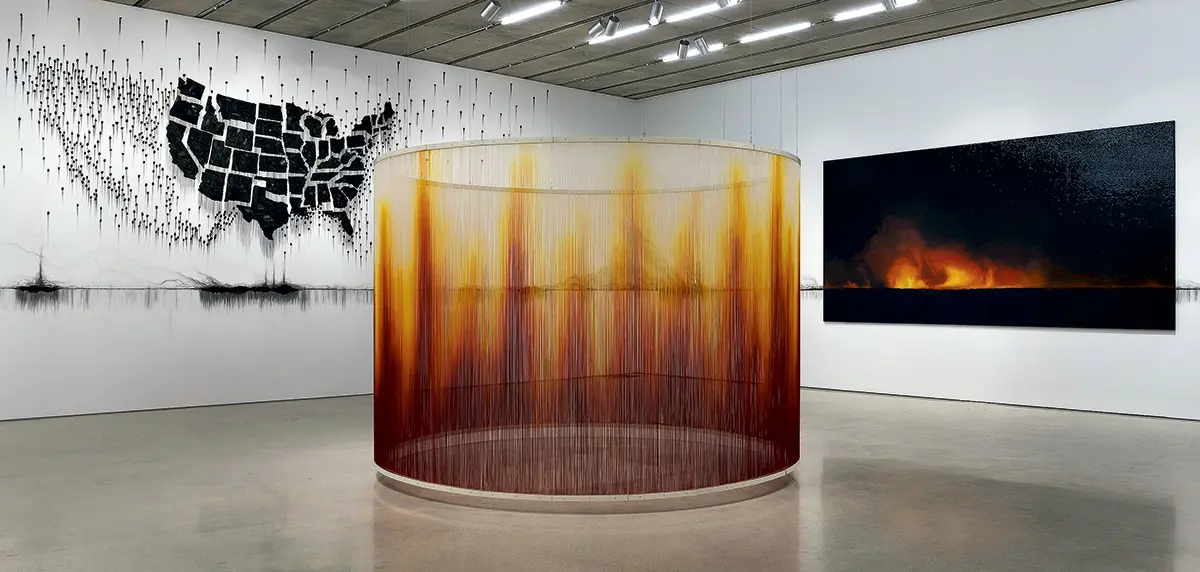
In 2017, Fernández created Fire (United States of the Americas), a large map of the United States made with chunks of black coal representing all fifty states. The charred and fractured image of the country symbolizes the political and social reality that existed at the time of elections and is still in force. In the essay “Teresita Fernández and Félix González-Torres: Something Personal,” Amada Cruz makes a successful counterpoint between these two artists of Cuban origin and in particular, between this work and the one by González-Torres entitled Untitled (America) (1994), made with cables and illuminated bulbs that fall to the ground. According to Cruz, “the cautious optimism of González-Torres’ light piece becomes a smoldering inferno in Fenández’s work.”6 Previously, the artist had done works inspired by fire as an element, beginning with Fire (2005), a nine-foot-high suspended sculpture in the shape of a circle made with silk threads dyed in yellow, orange, and red shades. The artist did several works in which fire and other associated materials such as coal become metaphors for the political and social situation experienced in the country and the world.
Materials play an essential role and have significant symbolic content. As art historian Heather Diack points out, “the artist’s material decisions—particularly her use of gold, graphite, bronze, concrete, and malachite—function as ethical indictments of the violent histories of extrication and exploitation associated with each substance.”7 Fernández also clarifies that it is important to note that each material has its own identity associated with its place of origin. “Materials aren’t just materials; materials are parts of places. When I make a new landscape out of charcoal, something that used to be a burned tree, I’m creating what I refer to as ‘stacked landscapes’—multiple things happening at once.”8
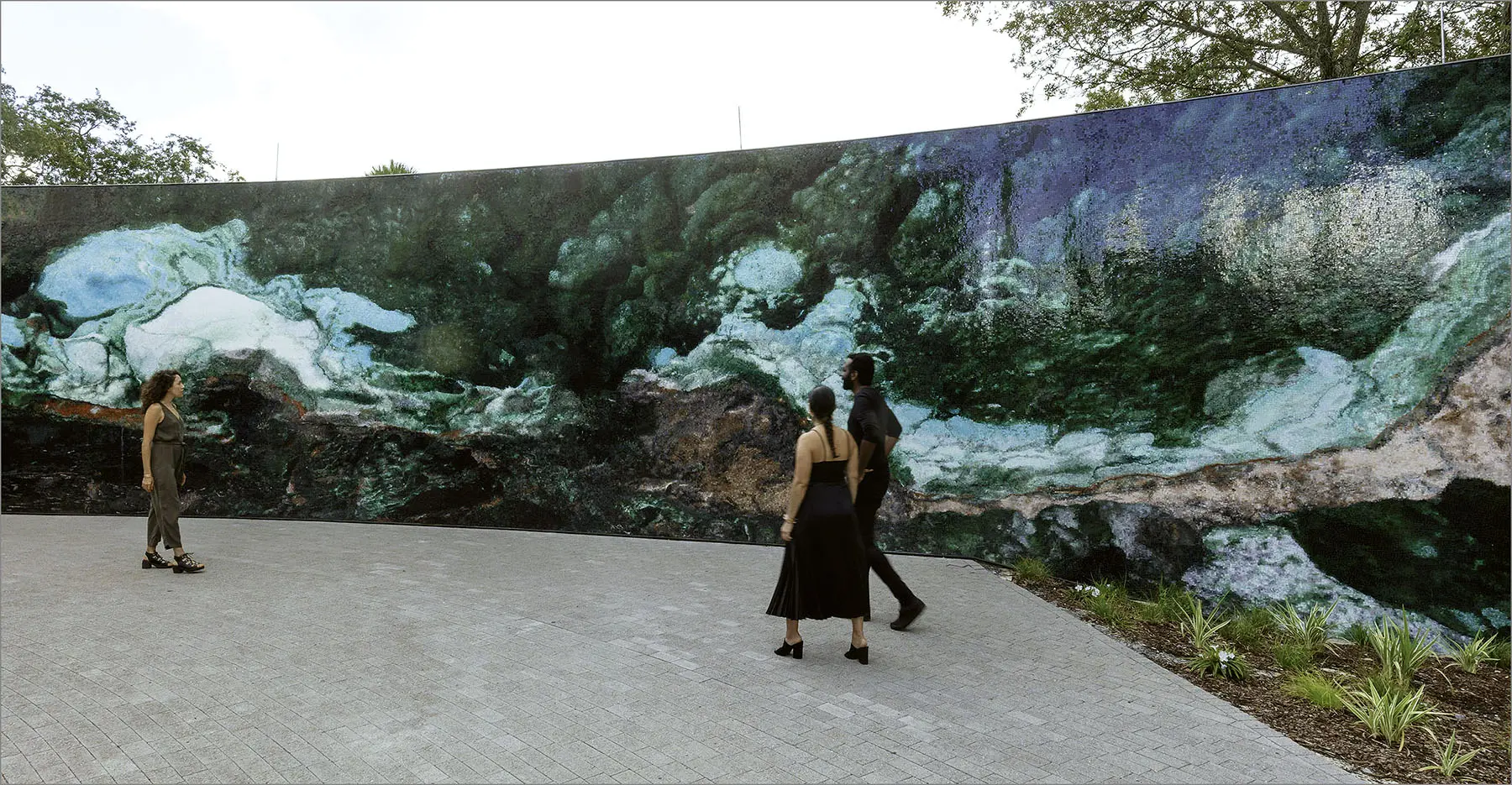
Perhaps the series that best illustrates the concept of “superimposed landscapes” is Viñales (2015), whose main piece, Viñales (Reclining Nude) (2015), is a sculpture made with rock formations of malachite and bronze placed on several cast concrete pedestals in cascade shape that give the impression of representing, as the title indicates, a reclining female body. Inspired by the rural landscape of the Viñales Valley in Cuba, the series explores the visual richness and symbolism of the green malachite. Fernández uses pieces of the mineral brought from the Democratic Republic of the Congo due to the similarities between these and the natural characteristics of the Viñales Valley, especially its caves, the same ones that inspired the iconic silhouettes of Ana Mendieta, one of the artists that Fernández most admires. These caves were used by indigenous Taínos before the arrival of the Spaniards and later by maroons, runaway slaves from the surrounding plantations, many of them initially from Congo. By using the malachite that comes from an African mine and creating an imaginary landscape from it, the artist connects two geographical points and delves into the historical and cultural relationships that exist between Africa and Cuba. As far as the viewer is concerned, he is transported to different places simultaneously, either in the original installation that includes large ceramic plates in which the veins of the malachite are turned into beautiful rocky landscapes or in the imposing commission made for the New Orleans Museum of Art titled Viñales (Mayombe Mississippi) (2018), a mosaic mural conceived as an extension of the museum that emerges from the building and blends into the surrounding landscape of the Besthoff Sculpture Garden.
Fernández believes that the constant exploration of materials allows her to expand her work permanently. “The process of shaping, melting, and forging metal; carving hard stone; and mastering industrial processes and tools was instrumental in my understanding that everything in the world comes from the landscape, that materials were just matter extracted from the earth, transferable and mutable. It really taught me to look at everything around me in a different way, and I became obsessed with understanding how things were made; how processes and materials become what they are and what their elemental origins are; and how they used to be something that when you look at them, you can’t readily see anymore.”9
Finally, it is worth mentioning that Teresita Fernández was a MacArthur Foundation Fellow (2005) and has received numerous awards, including the Guggenheim Fellowship (2003), the Louis Comfort Tiffany Biennial Award (1999), the American Academy of Rome Fellowship (AFAAR) (1999) and the National Endowment for the Arts Individual Artist’s Grant in Visual Arts (1994). In 2011, she was appointed by President Barack Obama to the U.S. Commission of Fine Arts, being the first person of Latin origin to be part of the prestigious group. She is currently working on a monumental sculpture titled Paradise Parados for the roof of the BAM Harvey Theater in Brooklyn, New York.
NOTES
1. “Teresita Fernández in conversation with María Elena Ortiz.” Teresita Fernández Elemental (Miami: Perez Art Museum Miami; Phoenix: Phoenix Art Museum; Munich, London, and New York: DelMonico.Prestel, 2019), 12.
2. Ann Wilson Lloyd, “From an Architect of Desire, Many- Layered Constructions,” New York Times, March 21, 1999, https://www.lehmannmaupin.com/press/new-york-times. (Accessed October 18, 2021).
3. Ibid.
4. Laura Lindenberger Wellen, “Teresita Fernández. Museo de Arte Blanton”, Artforum, February 28, 2010, https://www.lehmannmaupin.com/press/artforum60. (Accessed October 18, 2021).
5. Laura van Straaten, “The intimate and the vast: a conversation with Cecilia Vicuña and Teresita Fernández,” Art Basel Stories, December 2019, https://www.artbasel.com/stories/cecilia-vicuna-and-teresita-fernandez-new-york-interview. (Accessed October 18, 2021).
6. Amada Cruz, “Teresita Fernández and Félix González-Torres: Something Personal,” Teresita Fernández Elemental (Miami: Perez Art Museum Miami; Phoenix: Phoenix Art Museum; Munich, London, and New York: DelMonico.Prestel, 2019), 50.
7. Heather Diack, “Teresita Fernández”, Artforum, https://www.artforum.com/picks/teresita-fernandez-81548. (Accessed October 18, 2021).
8. Laura van Straaten, “The intimate and the vast: a conversation with Cecilia Vicuña and Teresita Fernández,” Art Basel Stories, December 2019, https://www.artbasel.com/stories/cecilia-vicuna-and-teresita-fernandez-new-york-interview. (Accessed October 18, 2021).
9. “Teresita Fernández in conversation with María Elena Ortiz.” Teresita Fernández Elemental (Miami: Perez Art Museum Miami; Phoenix: Phoenix Art Museum; Munich, London, and New York: DelMonico.Prestel, 2019), 14.
* Courtesy of the artist and Lehmann Maupin, New York, Hong Kong, Seoul and London
FRANCINE BIRBRAGHER-ROZENCWAIG